15 Hardest SAT Geometry and Trig Questions, Solved (2026)
Σ
Sigma Prep
SAT Math Instructor · 10+ Years Experience
September 24, 2026·5 min read
Geometry and Trigonometry is the smallest domain on SAT Math, about 15% of the section, 5 to 7 questions. That is why students skip it. It is also the most learnable material on the test, because the hard questions barely change: the same handful of configurations come back with new letters on the vertices.
Once you have seen enough tests, almost every hard one is similar figures wearing a costume. Of the 15 types below, 8 are a similarity question. Counted September 2026 against our Geometry and Trigonometry hard set, which holds 693 questions. All 15 are solved in one video:
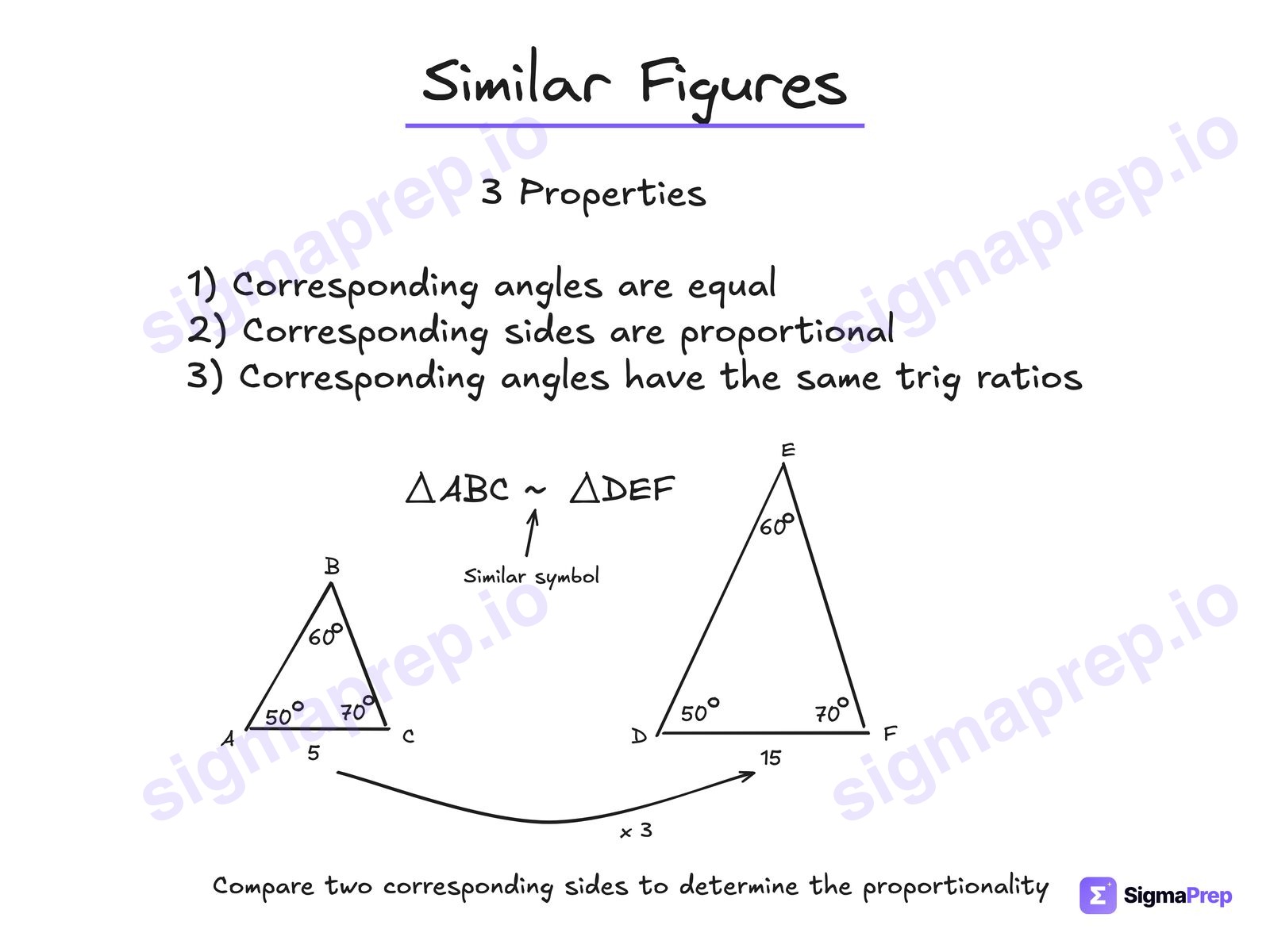
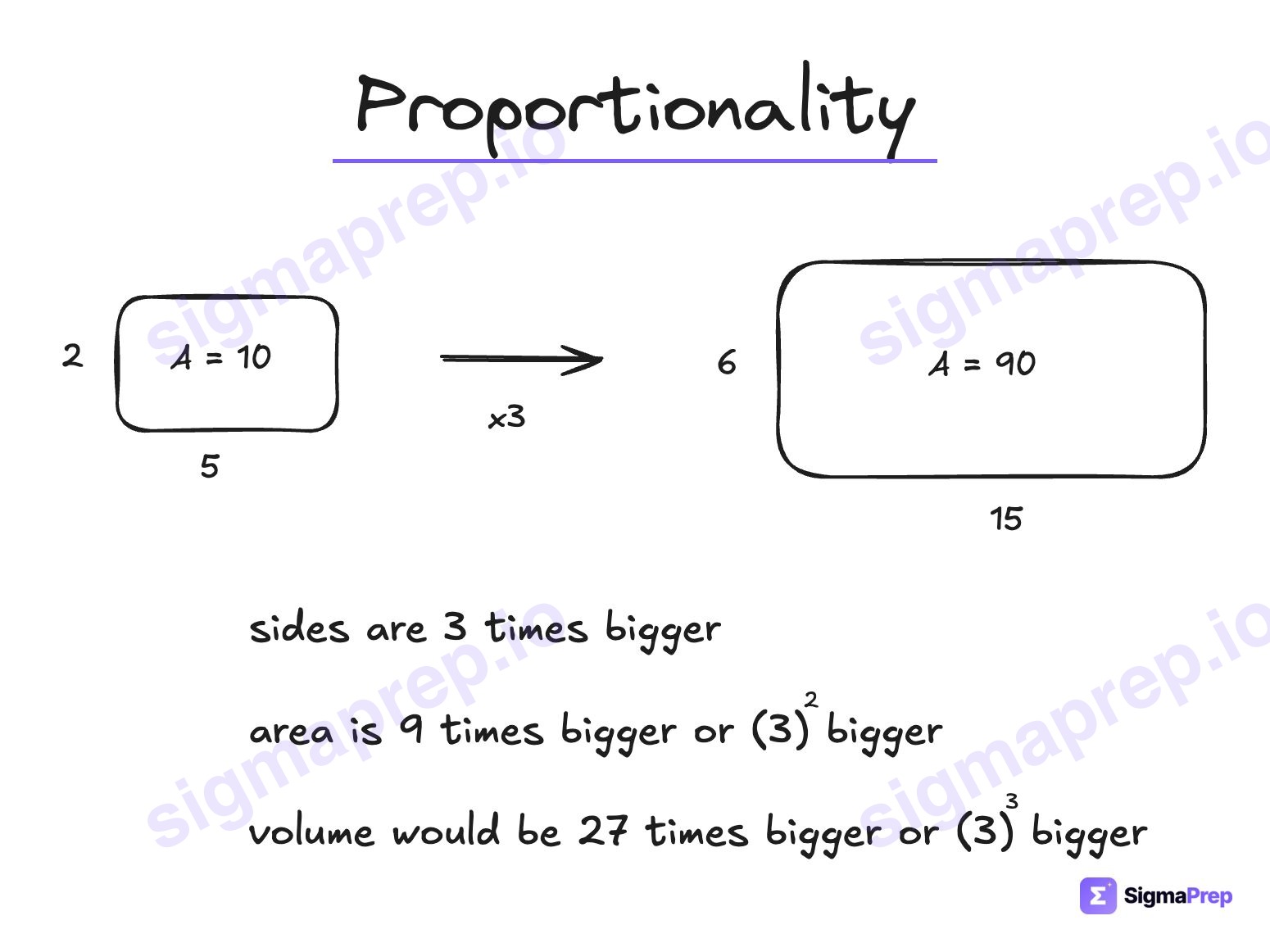
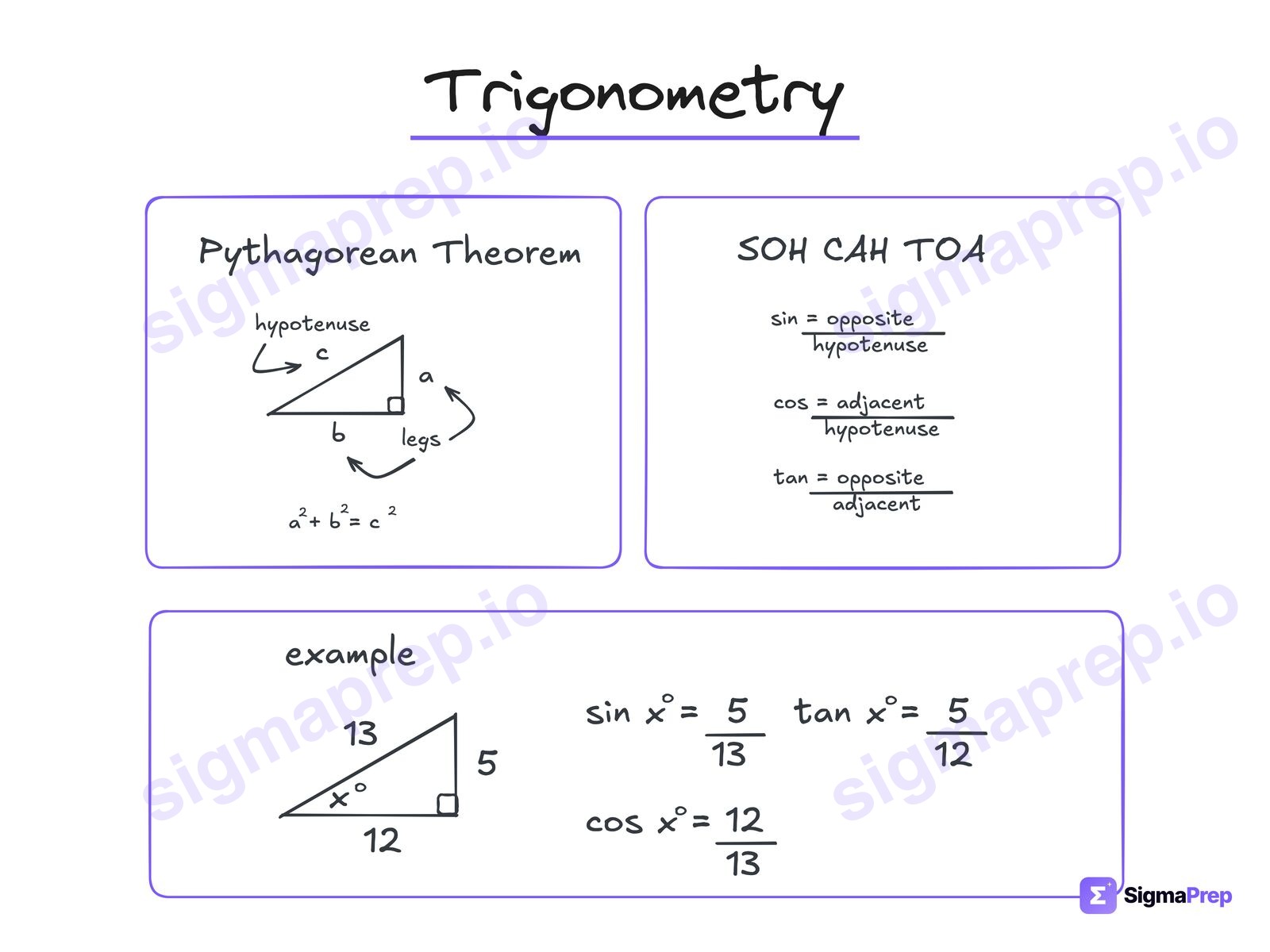
20. Similar FiguresSimilar figures are very common on the test, and it is super important that you always remember the first two properties. The third property, the one about trig, is not always used, but it is nice to know.Worked example in the app →21. ProportionalityIf the sides are k times bigger, the area is k squared times bigger and the volume is k cubed times bigger. Area is units squared, volume is units cubed. One calculation, not a whole recomputation.Worked example in the app →23. TrigonometrySOH CAH TOA and the Pythagorean theorem ONLY apply to right triangles. Use the Pythagorean theorem to find a missing side. Trig questions just want a ratio.Worked example in the app →
What the 15 Questions Cover
The video is chaptered, so you can jump to any type. Grouped by what they actually test:
Similar figures: triangles inside a right triangle, an altitude dropped to the hypotenuse, a crossed figure with one pair of parallel sides, similar rectangles, similar prisms. Eight of the fifteen are this one idea. If you only fix one thing in this domain, fix this.
The ratio trap: sides scale by k, area by k², volume by k³. Four questions hand you one of those and ask for another, and the wrong answers are always the other two ratios.
Parallel lines: three of them, including one that asks which angle sum is impossible, which is the same knowledge asked backwards.
Circles with a tangent: two. A tangent meets the radius at a right angle, and that single sentence is the entire question both times.
Right-triangle trig: converting tan A into sin D across two similar triangles, which is a similarity question that happens to use trig notation.
Notice what is not on that list. No unit circle, no identities, no proofs. The domain is narrow. What makes these hard is that the figure hides which two triangles are similar, not that the math is advanced.
All 15, in order
#
Question type
What it tests
1
Equilateral triangle, perimeter to circle radius
Circles
2
Similar triangles inside a right triangle, find DE
Similar figures
3
Right triangle with an altitude, find BC/BD
Similar figures
4
Circle tangent at a point, find another point on the line
Circles
5
Two tangents and a perimeter, find the distance to the center
Circles
6
Parallel segment and an area, find HF
Similar figures
7
Two prisms glued, surface area to base length
Area and volume
8
Parallel lines, which angle sum is impossible
Lines and angles
9
Right triangle with an altitude, find DC
Similar figures
10
Similar right triangles, tan A to sin D
Similar figures, trig
11
Similar prisms, surface area to volume
Similar figures, ratio
12
Prism, base area to surface area
Area and volume
13
Parallel sides in a crossed figure, find LQ
Similar figures
14
Similar rectangles, area to side length
Similar figures, ratio
15
Parallel lines, angle sum to w
Lines and angles
Questions 3 and 9 are the same configuration on purpose. An altitude drawn to the hypotenuse splits a right triangle into two smaller triangles, and all three are similar to each other. What changes between them is only which length the question asks for.
Similar figures, which is most of the domain
The work is never the arithmetic. It is matching the sides correctly, and then not stopping one step early.
Lines, angles, and triangles · Hardanswer C
In the figure, LQ intersects MP at point R, and LM is parallel to PQ. The lengths of MR, LR, and RP are 7, 9, and 12, respectively. What is the length of LQ?
LM is parallel to PQ, so the alternate interior angles match and the vertical angles at R match, which makes triangles LMR and QPR similar. Match sides by the angles they sit across from: MR corresponds to PR, so the scale factor is 12/7, and QR comes out to 108/7. Then read the question again. It asked for LQ, which is LR plus RQ, so 9 + 108/7 = 171/7. Choice B is 108/7 sitting there waiting for everyone who found QR and stopped.
The ratio trap
One line of work if you know the rule, and a guess if you do not. There is nothing in between.
Area and Volume · Hardanswer 17956
The length of each side of square A is 134 times the length of each side of square B. The area of square A is k times the area of square B. What is the value of k?
Sides scale by 134, so area scales by 134², which is 17,956. That is the whole question. The reason it is worth a chapter is that the same rule appears three more times in the video pointed the other way: given the area ratio, find the side ratio; given the surface area ratio, find the volume ratio. If sides are k times bigger, area is k² and volume is k³, and the two you were not asked for are the wrong answers.
Right-triangle trig
Most SAT trig is not really trig. It is a ratio question with SOH CAH TOA vocabulary.
Right triangles and trigonometry · Hardanswer 0.96
In triangle PQR, cos(Q)=5014 and angle P is a right angle. What is the value of cos(R)?
P is the right angle, so Q and R are the two acute angles and they add to 90. That makes cos(R) equal to sin(Q), and now you never need angle R at all. cos(Q) = 14/50 gives you adjacent 14 and hypotenuse 50, so the opposite side is 48, and sin(Q) = 48/50 = 0.96. The complement rule is the single highest-value thing to memorize in this domain, and it is not on the reference sheet.
Try one
A real question from our Lines, Angles and Triangles set. Work it, then watch how I do it.
try one · Lines, angles and triangles · Medium
In the figure shown, triangle CAE is similar to triangle CBD. The measure of angle CBD is 43°, and AE=15(BD). What is the measure of angle CAE?
How to Use the Video
Do not watch it straight through. Pause at each chapter, draw the figure yourself, and specifically write down which two triangles are similar and why before you touch a number. That is the step the test is actually charging you for. If your way took two minutes and the video took twenty seconds, the gap is not knowledge, it is recognition.
Watching a solution feels like progress. It is not, yet. The question that beat you cannot measure you again, because next time you will remember the answer instead of finding it.
There are nearly 700 hard Geometry and Trig questions on Sigma Prep and only 15 made this video. Every type in it has fresh versions with new numbers and new figures, each with my video solution attached, so you can drill a configuration until you spot it instantly. Working the other domains too? The 20 hardest Advanced Math questions and the 12 hardest algebra questions got the same treatment. It is free to start, no card required. Start free today!
Common Questions
Similar figures, by a distance. Triangles sitting inside other triangles, the altitude drawn to the hypotenuse, crossed figures with a pair of parallel sides, and similar solids. After that it is the ratio questions: sides scale by k, area by k squared, volume by k cubed, and the question always hands you one and asks for another.
About 15%, so 5 to 7 questions across the two modules. It is the smallest of the four domains, which is exactly why students skip it, and why the points are cheap if you do not.
Only right-triangle trig: sine, cosine and tangent, the two special right triangles, radian conversion, and the complement rule that sin of one acute angle equals cos of the other. No identities, no unit circle, no graphing.
Want more SAT tips like this?
One article a week. No spam.
Ready to raise your SAT Math score?
Take the free Diagnostic Quiz and see where you stand. No payment required.