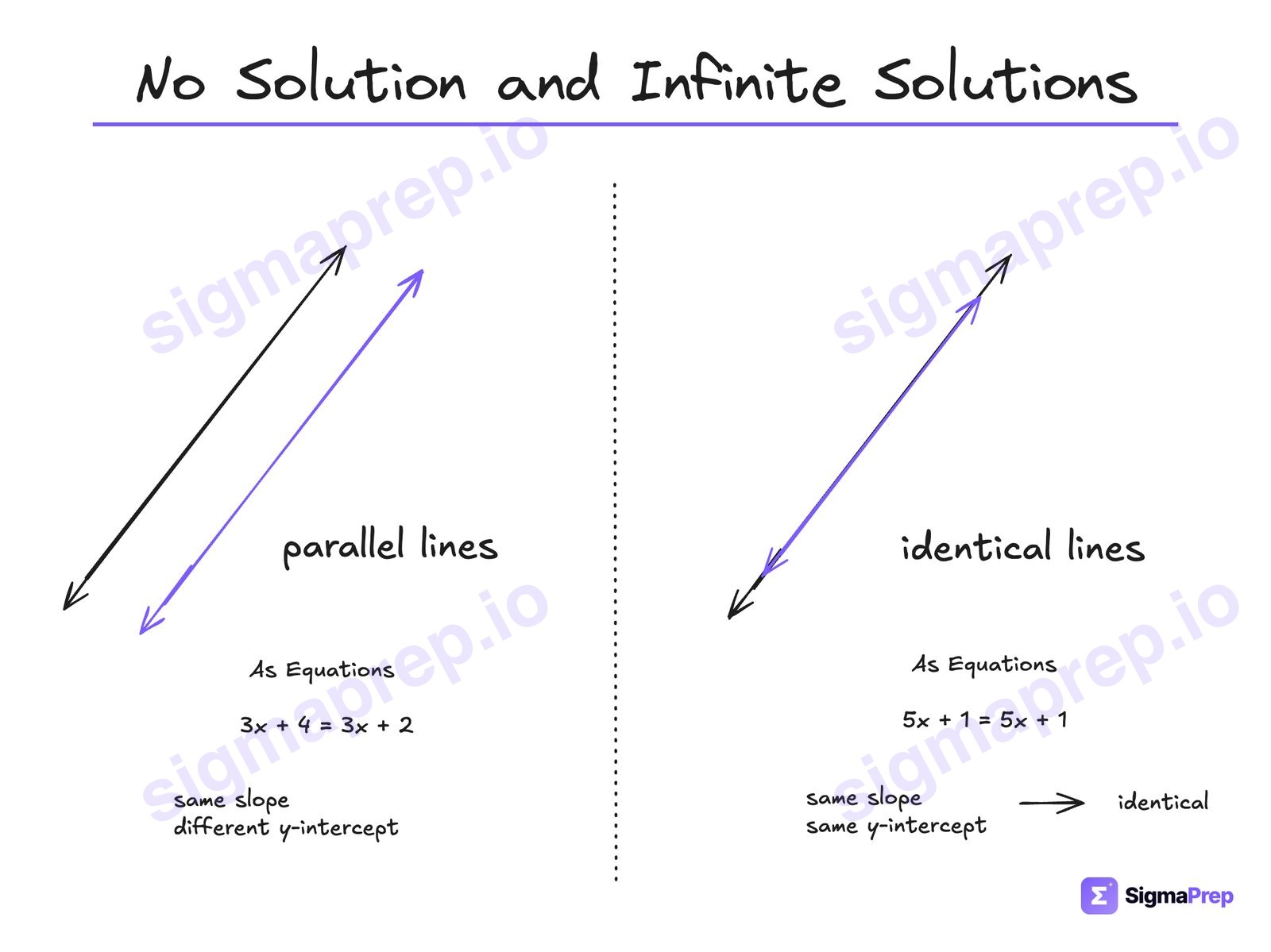
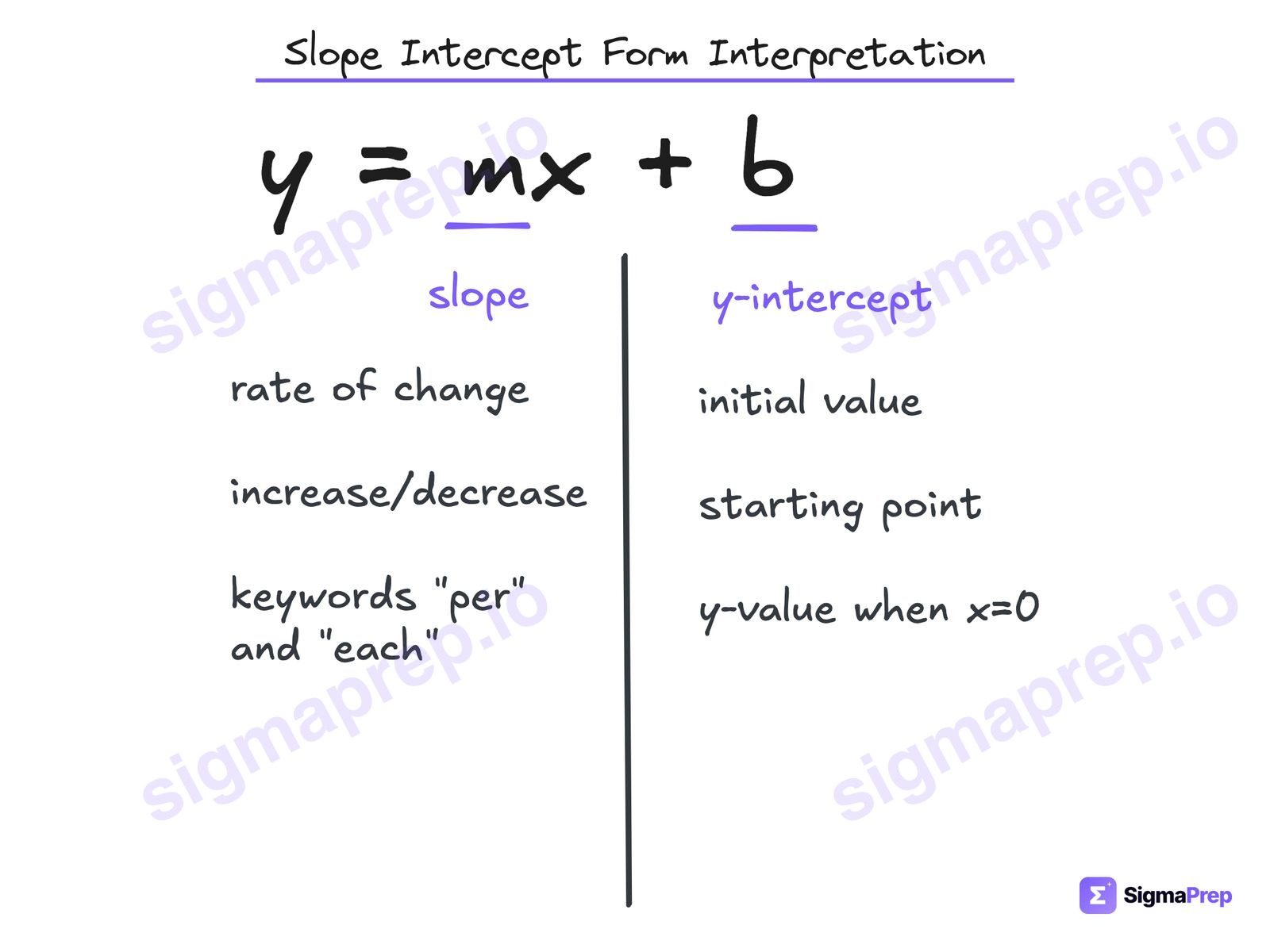
3. No Solution and Infinite SolutionsNo solution means parallel lines: same slope, different y-intercept. Infinitely many solutions means the same line: same slope and the same y-intercept. Get both sides into slope-intercept form, then match the slopes (and, for infinite, the intercepts) and solve for the constant.Worked example in the app →1. Slope-Intercept Form InterpretationSlope is always attached to the variable, and the keywords are per and each. Slope is the change in y for ONE change in x.Worked example in the app →
Hard SAT algebra is strangely repetitive. Once you have seen enough tests, nearly every hard algebra question sorts into one of three buckets: a system with no solution, a system with infinitely many solutions, or a word problem that is really asking you to build a simple function. The numbers change. The buckets do not.
We collected the 12 hard algebra questions that show up most consistently and solved them all in one video:
The Three Buckets
No solution. Two lines never meet when they are parallel with different intercepts. Every "the system has no solution, find the constant" question is testing whether you know that one sentence. It shows up three separate times in the video in three different costumes, including the Roman numeral version that asks which statements must be true.
Systems of linear equations · Hardanswer C
One of the two equations in a system of linear equations is given. The system has no solution. Which equation could be the second equation in this system?
Divide the given equation through by 2 and it reads x = 12y − 9. The second equation has to have that same slope and a different intercept, so it is the one that matches the x and y coefficients but not the constant. Choice A is the given equation halved, the same line, which gives infinitely many solutions rather than none. That is the trap the question is built around.
Infinitely many solutions. Same idea pushed one step further: the two equations are secretly the same line, so every coefficient has to match proportionally. Find s. Find g and k. Different letters, same move.
Systems of linear equations · Hardanswer 4/9
In the given system of equations, g and k are constants. The system has infinitely many solutions. What is the value of kg?
Same line means every coefficient scales by the same factor, so g over k has to equal the ratio of the x and y coefficients in the first equation. That is 4/7 over 9/7, and the sevenths cancel: 4/9. The constants on the right never enter it, which is why this one is quick once you see it and slow if you start multiplying things out.
Word problems that build functions. Copper production over time, a budget for premium supplies, lines intersecting at a point with an unknown. The algebra is easy. The translation from English to equation is the actual test, which is why we wrote separately about word problems being reading problems.
Linear functions · Hardanswer A
An HVAC technician charges $180 for the first two hours of service plus an hourly fee for each additional hour. The total cost for 4 hours of service is $300. Which function f gives the total cost, in dollars, for x hours of service, where x≥2?
The $180 covers the first two hours, so the extra hours are what is left: $300 minus $180 is $120 across 2 extra hours, which is $60 an hour. Now write it for x hours: 60 times (x − 2) plus 180, which expands to 60x + 60. Two of the choices keep the 180 sitting there as the intercept, which is what you get if you never subtract the first two hours.
Try one
A real question from our Systems of Equations set. Work it the fast way, then watch how I do it.
try one · Systems of equations · Medium
If the given equation is one of two equations in a system of linear equations that has infinitely many solutions, which of the following could be the second equation in the system?
−10x+15y=45
Where Desmos Comes In
Parallel lines, matching coefficients, intersection points: all of it is visible. Type both equations into Desmos, add a slider for the unknown constant, and drag until the lines stack on top of each other. What takes a minute of careful coefficient matching on paper takes seconds on a graph, and you can see whether you are right. The video leans on this hard, and if the calculator is unfamiliar territory, most students never learn what it can do.
Same Deal: Watch One, Then Drill the Type
Pause before each chapter, attempt it, then compare your path to the video's path. And when a type beats you, do not just rewatch it. The question you just saw cannot measure you twice.
The formulas and concepts behind these twenty are collected in the SAT Math formula sheet: 24 diagrams, each one solved on a real question, free.
Every type in this video has fresh versions on Sigma Prep with new numbers and new context, each with my video solution attached, so you can drill the bucket until it is boring. Advanced Math student? The 20 hardest Advanced Math questions got the same treatment. It is free to start, no card required. Start free today!
Common Questions
Nearly all of them sort into three buckets: a system with no solution, a system with infinitely many solutions, and a word problem that is really asking you to build a simple linear function. The numbers change; the buckets do not.
Put both equations in slope-intercept form. Same slope with different intercepts means parallel lines and no solution; same slope and same intercept means the same line and infinitely many. The constant they ask for is whatever makes the slopes, or the whole equations, match.
Yes. Graph both equations and look: parallel lines never meet, identical lines sit on top of each other, and for word problems a regression on the given points returns the function directly.
Want more SAT tips like this?
One article a week. No spam.
Ready to raise your SAT Math score?
Take the free Diagnostic Quiz and see where you stand. No payment required.