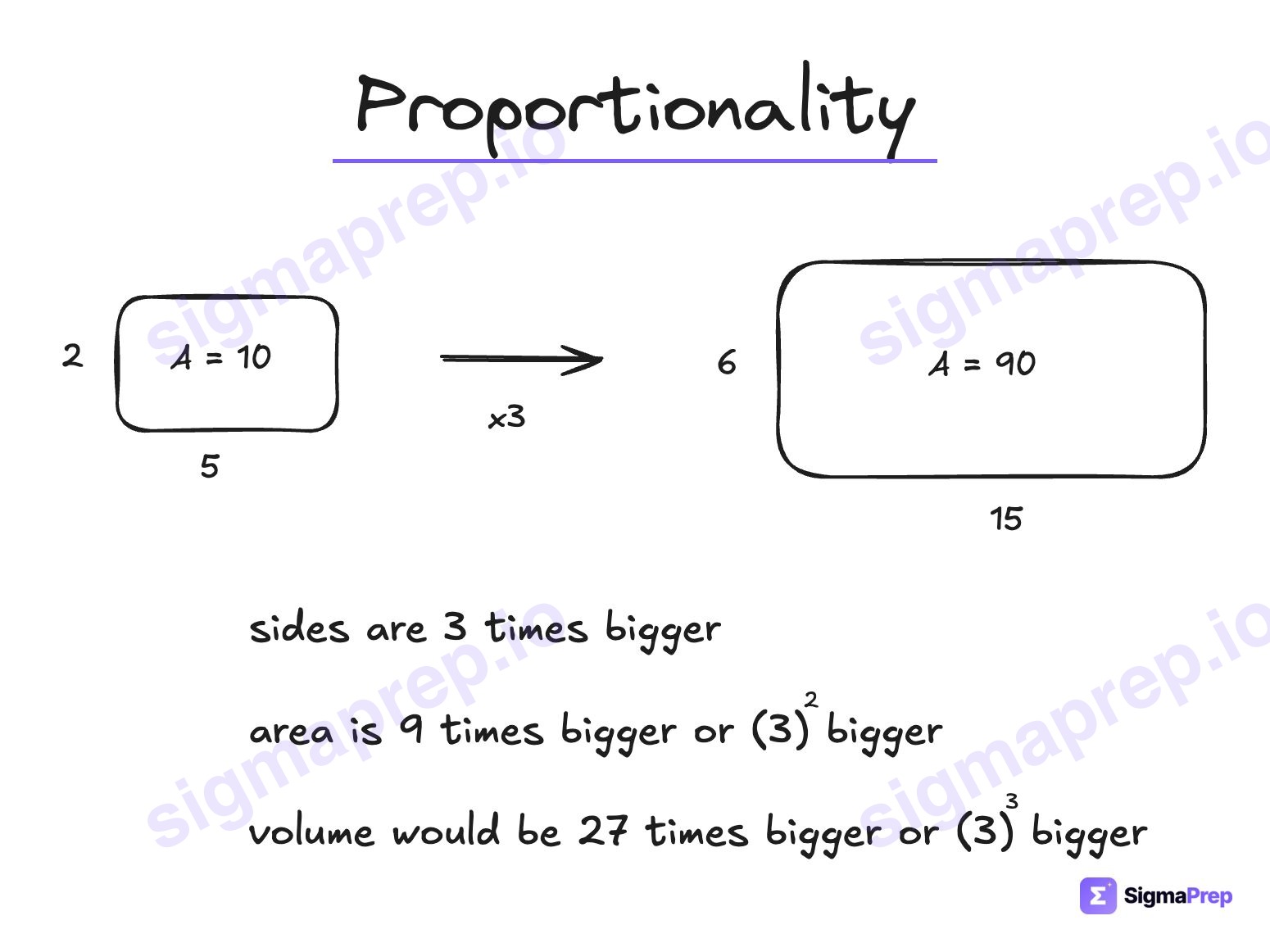
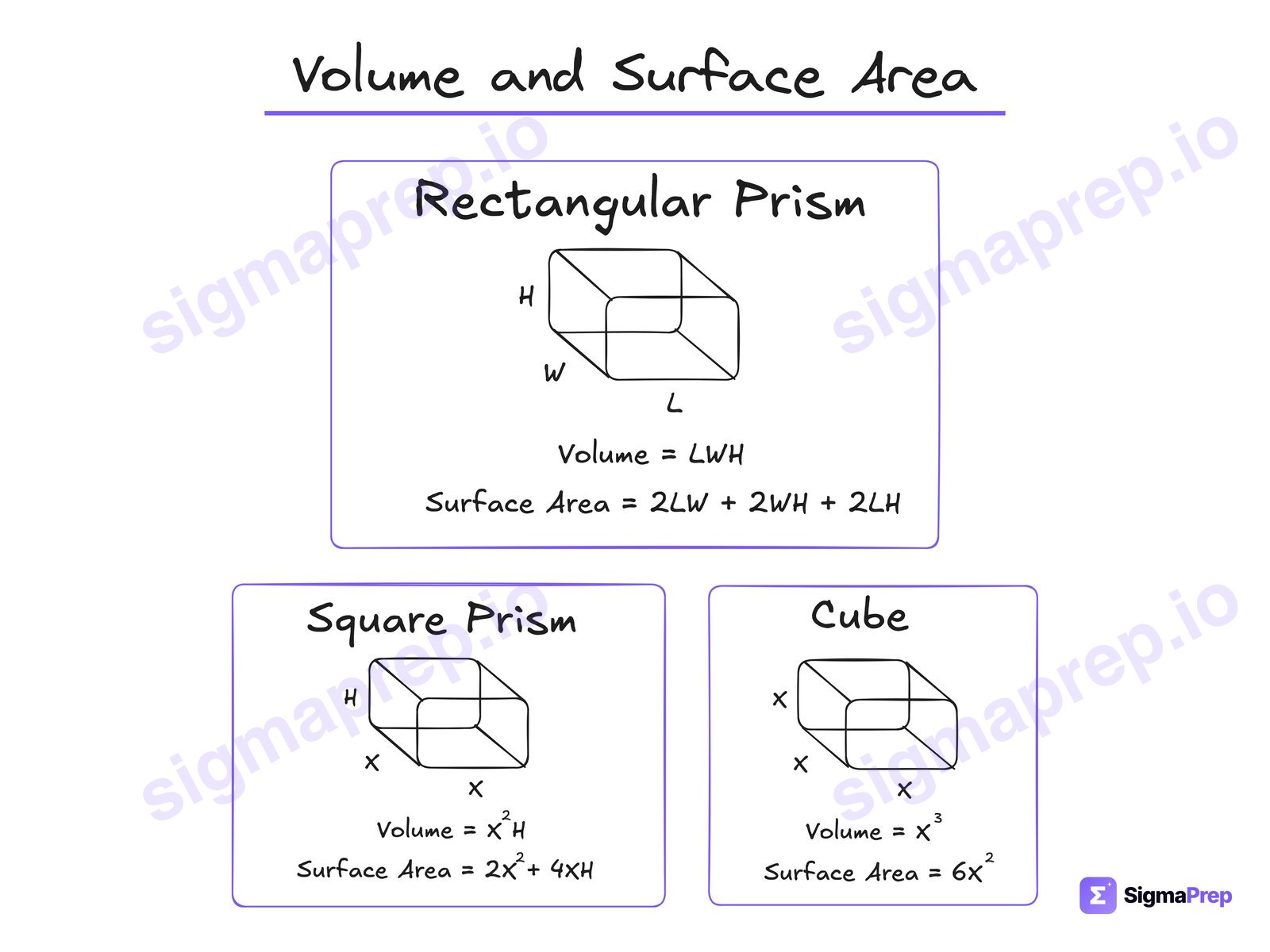
21. ProportionalityIf the sides are k times bigger, the area is k squared times bigger and the volume is k cubed times bigger. Area is units squared, volume is units cubed. One calculation, not a whole recomputation.Worked example in the app →22. Volume and Surface AreaThe SAT gives you the rectangular prism on its reference sheet, but it does not give you surface area. You need to be able to derive surface area by looking at the figure, or memorize it from here. The square prism and the cube are variations of a rectangular prism, with two sides the same and all three sides the same, respectively.Worked example in the app →
Geometry and Trigonometry is about 15% of SAT Math, 5 to 7 questions, and area and volume are the ones the reference sheet covers. The sheet gives you every volume formula you need. What it does not give you is surface area, and it does not tell you the one rule that makes the hard questions one line long.
The one rule
If the sides are k times bigger, the area is k² times bigger and the volume is k³ times bigger. Area is units squared, volume is units cubed. A question that seems to need you to recompute an entire figure is usually this rule in one calculation.
The five ways the SAT asks it
1. Plug into the formula
Area and Volume · Easyanswer 756
A rectangular prism has a length of 9 meters, a width of 7 meters, and a height of 12 meters. What is the volume, in cubic meters, of the rectangular prism?
Length times width times height: 9 × 7 × 12 = 756. The formula is on the reference sheet. The only trap is a question that gives a diameter when the formula wants a radius, so read which one you were handed.
2. Work the formula backwards
Area and Volume · Mediumanswer D
A right circular cylinder has a volume of 48π cubic inches and a height of 3 inches. What is the radius, in inches, of the base of the cylinder?
Volume of a cylinder is πr²h, so 48π = πr²(3), r² = 16, r = 4. Set the formula equal to the number, cancel the π, solve. Or type 48π = πx²(3) into Desmos and read the positive crossing. The choice 16 is r² mistaken for r.
3. Proportionality
Area and Volume · Hardanswer 17956
The length of each side of square A is 134 times the length of each side of square B. The area of square A is k times the area of square B. What is the value of k?
Sides 134 times bigger means area 134² times bigger: 17,956. One calculation. Without the rule you make up side lengths, compute two areas and divide, and get the same answer with three chances to slip. The volume version is the same with a cube instead of a square.
4. Surface area from volume
Area and Volume · Hardanswer 24576
A cube has a volume of 262,144 cubic units. What is the surface area, in square units, of this cube?
Volume of a cube is s³, so s = 64. Surface area is six squares, 6s² = 24,576. The reference sheet has the volume but not the surface area, so you derive it from the figure: six faces, each s². Same idea for a rectangular prism, two of each face.
5. Increase each dimension by a percent
Area and Volume · Hardanswer 360
A poster has an area of 250 square inches. The length and width of the poster are each increased by 20%. What is the area, in square inches, of the new poster?
Each side times 1.2, so the area times 1.2², which is 1.44: 250 × 1.44 = 360. Not 250 × 1.2, and not 250 plus 20%. It is the proportionality rule with k = 1.2, and it catches a lot of students who know the rule for whole numbers and forget it for percents.
Try one
This is a real question from our Area and Volume · Medium set. Solve it the fast way, then watch how I do it.
try one · Area and volume · Medium
A circle has a radius of 3. A square has the same area as the circle. What is the length of a side of the square?
Where the points actually go
Stopping at r² instead of r, recomputing what proportionality would have given in one step, and using the reference sheet for a surface area it does not contain. The app has 413 area and volume questions, 126 easy, 112 medium and 175 hard, every one with a video explanation. The free diagnostic shows whether this is where your points are going.
Common Questions
Multiply the sides by k and the area is multiplied by k², the volume by k³. Sides 3 times longer give 9 times the area and 27 times the volume. This applies to percent changes too: sides up 20% means area up by a factor of 1.44.
No. The sheet gives volume formulas but not surface area. Derive it from the figure: a cube has six faces of s² each, so 6s²; a rectangular prism has two faces of each of its three rectangles.
Set the formula equal to the volume: πr²h = V. Divide by πh, then take the square root. For a volume of 48π and height 3, r² = 16 and r = 4. The common mistake is answering with r² instead of r.
Geometry and Trigonometry is about 15% of SAT Math, 5 to 7 questions, split across area and volume, lines and angles, right triangles, and circles. Expect one or two area and volume questions per test.
Want more SAT tips like this?
One article a week. No spam.
Ready to raise your SAT Math score?
Take the free Diagnostic Quiz and see where you stand. No payment required.