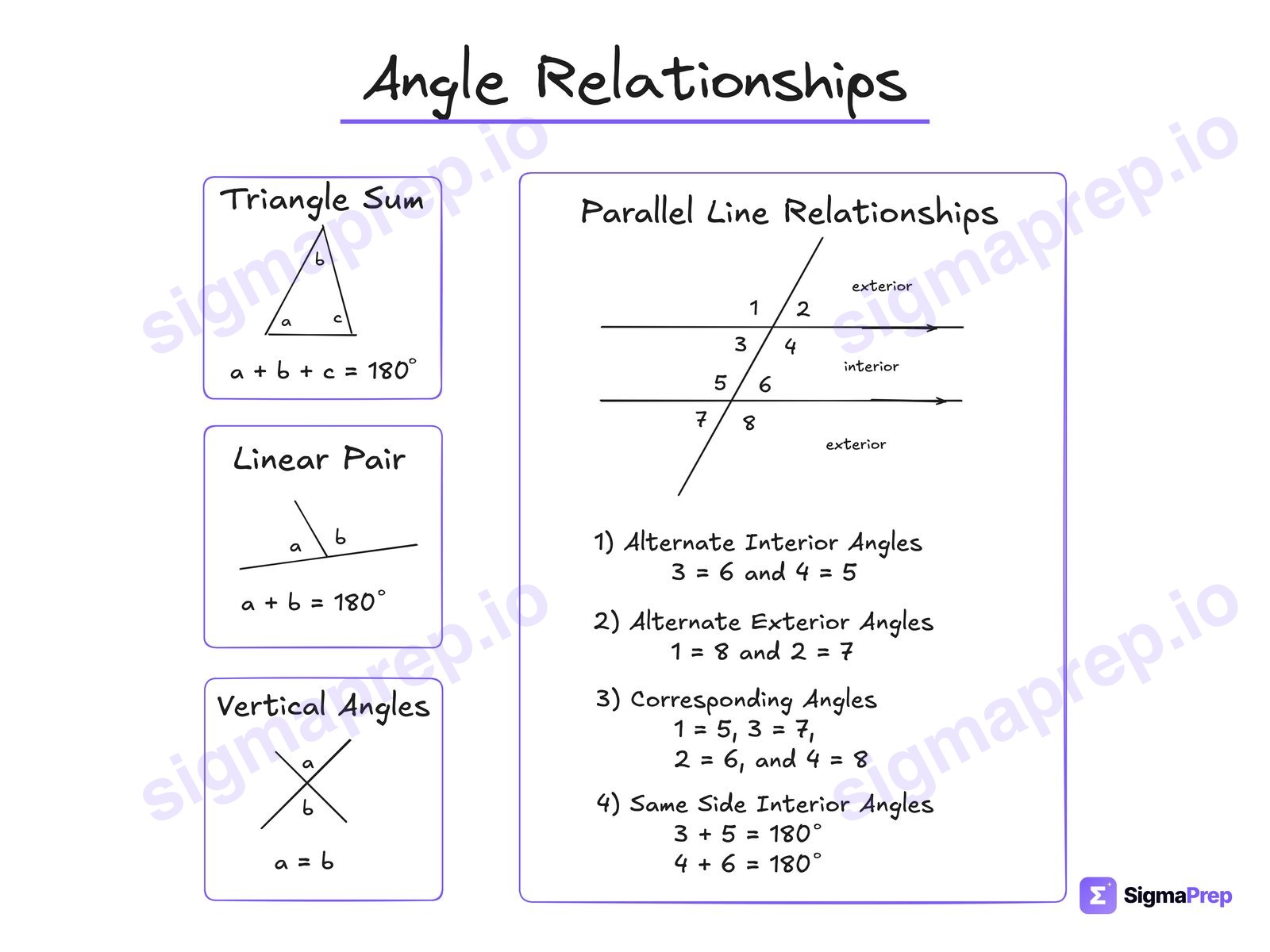
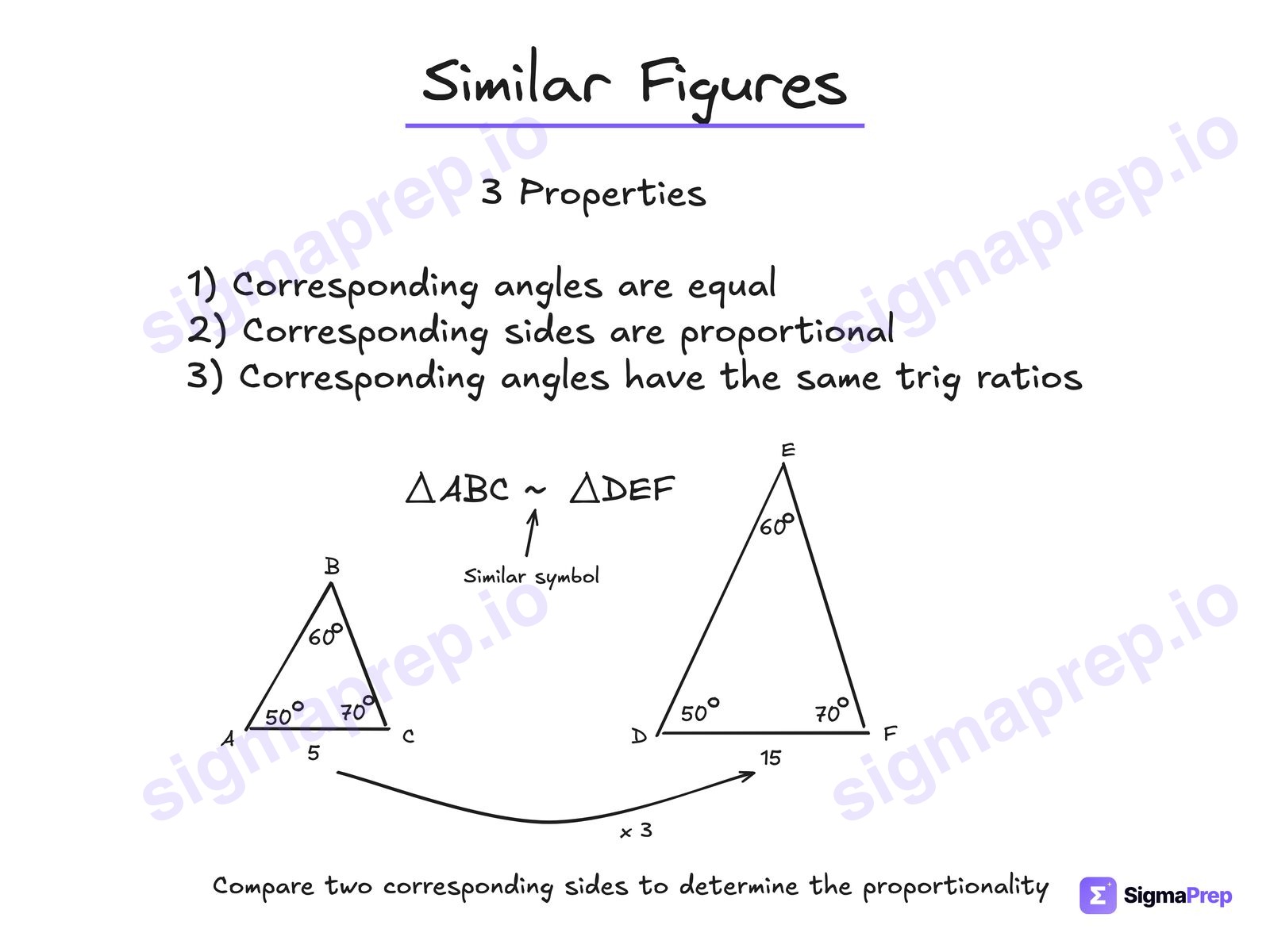
19. Angle RelationshipsWhen they say parallel, you are using one of the parallel-line relationships: alternate interior, alternate exterior, corresponding, or same-side interior angles. The other relationships shown here do not require parallel lines and are always true: vertical angles, linear pair, and triangle sum.Worked example in the app →20. Similar FiguresSimilar figures are very common on the test, and it is super important that you always remember the first two properties. The third property, the one about trig, is not always used, but it is nice to know.Worked example in the app →
This is the geometry skill with the most questions in the app, inside Geometry and Trigonometry, about 15% of SAT Math. It runs on three facts: a triangle's angles add to 180°, parallel lines create matching angles, and similar triangles have proportional sides. Almost every question is one of those facts, and the hard ones are two of them stacked.
When they say parallel
You are about to use one of the parallel-line relationships: alternate interior, alternate exterior, corresponding or same-side interior angles. Vertical angles, linear pairs and the triangle sum are always true whether or not anything is parallel. Similar triangles are usually hiding behind the word parallel too, so mark the matching angles before you set up a ratio.
The six ways the SAT asks it
1. The angles add to 180°
Lines, Angles, and Triangles · Easyanswer B
In △DEF, the measure of ∠D is 31∘ and the measure of ∠E is 87∘. What is the measure of ∠F?
180 − 31 − 87 = 62. The choice 118 is what you get by stopping one subtraction early. A right triangle's two acute angles add to 90° for the same reason.
2. Parallel lines and a transversal
Lines, Angles, and Triangles · Easyanswer D
In the figure above, line m is parallel to line n, and line t is a transversal that intersects both lines. If x=155, what is the value of w?
With parallel lines, every angle at the two crossings is either equal to x or supplementary to it. Decide which by position: same corner at each crossing, or vertical to it, means equal, so w = 155. The choice 25 is the supplement, for people who assumed different meant supplementary.
3. Shadows and similar triangles
Lines, angles, and triangles · Mediumanswer D
A flagpole 12 feet tall casts a shadow that is 8 feet long. At the same time, a nearby fence post casts a shadow that is 6 feet long. How tall, in feet, is the fence post?
Same sun, same time, so the two triangles are similar: height over shadow is the same for both. 12 over 8 equals h over 6, so h = 9. Any word problem with two objects and their shadows is this proportion, and Desmos solves it the moment you type it in.
4. Similar triangles by name
Lines, angles, and triangles · Mediumanswer D
Triangle GHI is similar to triangle JKL, where G, H, and I correspond to J, K, and L, respectively. The length of GH is 18, the length of JK is 12, and the length of GI is 25. What is the length of JL?
The letter order tells you what matches: GH goes with JK, GI goes with JL. So 18 over 12 equals 25 over JL, and JL is 50/3. The trap is pairing the wrong sides, and the fix is reading the correspondence off the letters before you write a single number.
5. The isosceles trap
Lines, angles, and triangles · Mediumanswer A
In triangle DEF, the measure of angle D is 70°. If triangle DEF is isosceles, which of the following is NOT a possible measure of angle E?
Isosceles means two angles match, and the question does not say which two. If E matches D, E is 70. If E and F match, they split the remaining 110, so E is 55. If D and F match, E is 40. Every case fits except 110. "NOT possible" questions on this topic are always about running the cases.
6. Eight angles, two values
Lines, angles, and triangles · Hardanswer A
A line intersects two parallel lines, forming four acute angles and four obtuse angles. The measure of one of these eight angles is (5x−180)°. The sum of the measures of four of the eight angles is k°. Which of the following could NOT be equivalent to k, for all values of x?
A transversal across parallel lines makes only two angle sizes: four copies of the acute one and four copies of its supplement. Any four of the eight add to one of a few expressions, and the one that cannot happen is the one no combination produces. Set the acute angle to 5x − 180 and the obtuse to 360 − 5x, then try two of each, four of one, three and one. The hard version is the same picture as type 2 with algebra on top.
Try one
This is a real question from our Lines, Angles and Triangles · Medium set. Solve it the fast way, then watch how I do it.
try one · Lines, angles and triangles · Medium
In triangle GHI, the measure of angle G is 52° and the measure of angle H is 86°. In triangle JKL, the measure of angle J is 52° and the measure of angle K is 86°. Which of the following additional pieces of information is needed to determine whether triangle GHI is similar to triangle JKL?
Where the points actually go
Pairing the wrong sides of similar triangles, assuming an angle is supplementary when it is equal, and missing a case on an isosceles question. The app has 406 questions on this skill, 154 easy, 119 medium and 133 hard, every one with a video explanation. The free diagnostic shows whether this is where your points are going.
Common Questions
When a line crosses two parallel lines, corresponding angles, alternate interior angles and alternate exterior angles are equal, and same-side interior angles add to 180°. Vertical angles and linear pairs are equal or supplementary regardless of parallel lines.
Match the sides by the order of the letters in the similarity statement: in triangle GHI similar to triangle JKL, GH corresponds to JK and GI to JL. Then write corresponding side over corresponding side and cross-multiply.
Lines, angles and triangles is one of the four skills in Geometry and Trigonometry, about 15% of SAT Math. Expect one or two per test, and the similar-triangle and isosceles versions in the harder module.
The question says the triangle is isosceles but not which two angles are equal, so there are up to three cases. A question asking which angle measure is NOT possible wants you to run all three and see which value never appears.
Want more SAT tips like this?
One article a week. No spam.
Ready to raise your SAT Math score?
Take the free Diagnostic Quiz and see where you stand. No payment required.