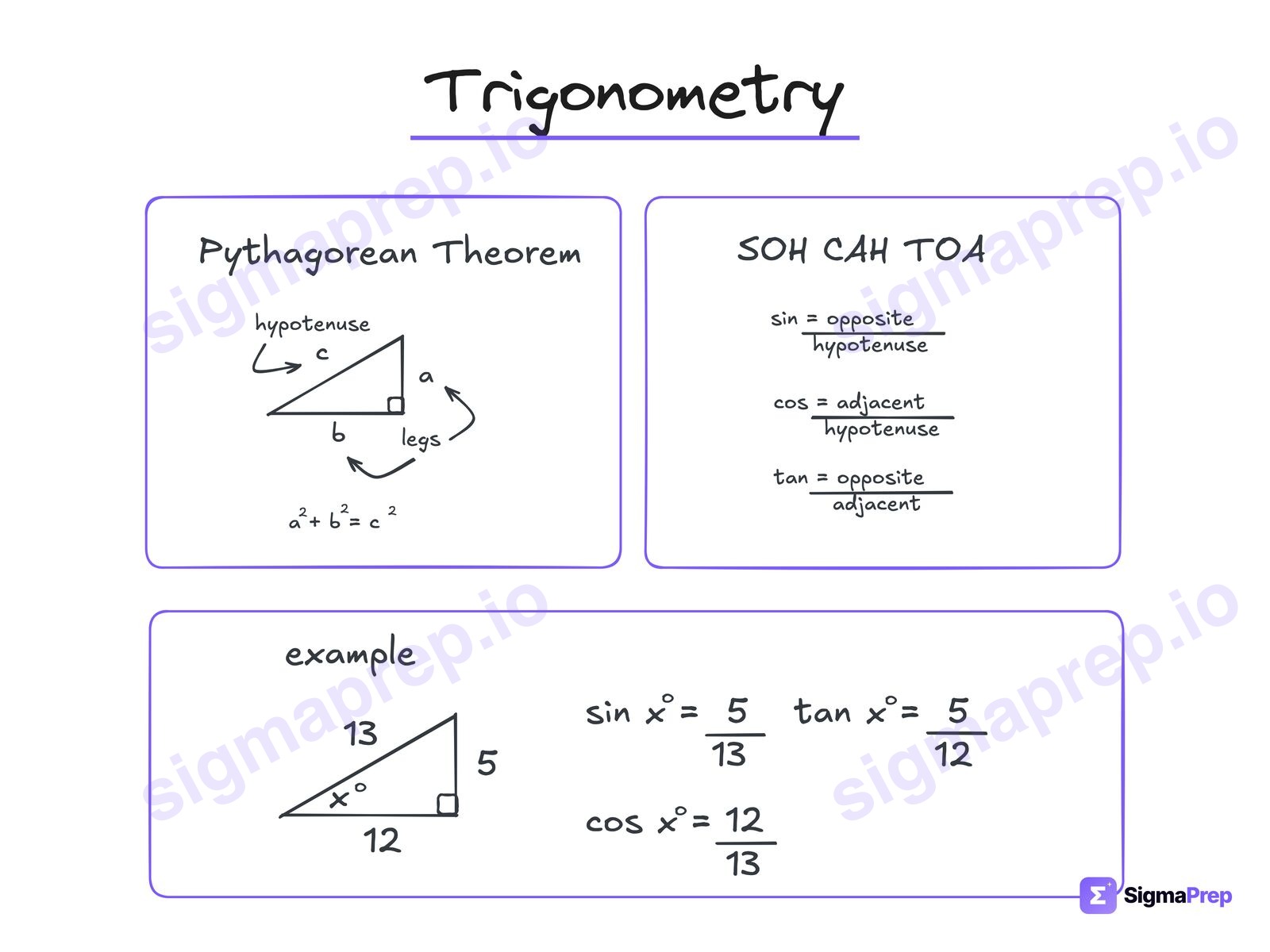
23. TrigonometrySOH CAH TOA and the Pythagorean theorem ONLY apply to right triangles. Use the Pythagorean theorem to find a missing side. Trig questions just want a ratio.Worked example in the app →
Trigonometry on the SAT is smaller than the word suggests. Inside Geometry and Trigonometry, about 15% of SAT Math, it is right triangles only: the Pythagorean theorem to find a side, SOH CAH TOA to write a ratio, and two special triangles. No unit circle, no identities beyond one. Sketch the triangle, label what you know, and the question is usually one line.
Sketch it
SOH CAH TOA and the Pythagorean theorem only apply to right triangles, and they almost always go together: one gives you the missing side, the other gives you the ratio they asked for. Draw the triangle, put the right angle where the question says, and label the sides. Half the wrong answers on this topic are ratios of the right numbers in the wrong positions.
The five ways the SAT asks it
1. Pythagorean theorem
Right triangles and trigonometry · Easyanswer D
A right triangle has legs with lengths of 7 centimeters and 13 centimeters. What is the length of this triangle's hypotenuse, in centimeters?
7² + 13² = 218, so the hypotenuse is the square root of 218. The choice 218 stopped before the square root. When the numbers are friendly it is a 3-4-5 or 5-12-13 in disguise; when they are not, Desmos takes the root.
2. Write the ratio
Right triangles and trigonometry · Easyanswer C
In right triangle PQR, angle R is a right angle, PR=28, and PQ=53. What is the value of sinQ?
Sine is opposite over hypotenuse. From angle Q, the opposite side is PR = 28 and the hypotenuse is PQ = 53, so sin Q = 28/53. The choice 53/28 is upside down. Label the sides relative to the angle they named, not the first one you see.
3. A ratio given, a side wanted
Right triangles and trigonometry · Mediumanswer C
In △DEF, ∠E is a right angle and the length of EF is 84 millimeters. If cosD=135, what is the length, in millimeters, of DE?
cos D = 5/13 means adjacent 5, hypotenuse 13, so the opposite is 12: a 5-12-13 triangle. The opposite side EF is 84, which is 12 × 7, so the whole triangle is scaled by 7 and DE = 5 × 7 = 35. Recognizing the triple saves the Pythagorean step entirely.
4. Special right triangles
Right triangles and trigonometry · Mediumanswer 7
In right triangle ABC, angle A is a right angle, angle C measures 30°, and BC=14. What is the length of AB?
In a 30-60-90 triangle the side opposite 30° is half the hypotenuse. BC is the hypotenuse, 14, and AB is opposite the 30° angle at C, so AB = 7. The 45-45-90 version has equal legs and a hypotenuse of leg times the square root of 2. Both are on the reference sheet, but knowing them cold is faster than finding them.
5. Sine and cosine of complementary angles
Right triangles and trigonometry · Hardanswer 0.96
In triangle PQR, cos(Q)=5014 and angle P is a right angle. What is the value of cos(R)?
cos Q = 14/50 means the side next to Q is 14 and the hypotenuse is 50, so the third side is 48. cos R is the side next to R over the hypotenuse, 48/50 = 0.96. The rule behind it: in a right triangle the two acute angles add to 90°, so the sine of one is the cosine of the other. When a question says cos Q = sin R, it is telling you Q + R = 90.
Try one
This is a real question from our Right Triangles and Trigonometry · Medium set. Solve it the fast way, then watch how I do it.
try one · Right triangles and trigonometry · Medium
In right triangle PQR, angle R is a right angle, PR=15, and QR=36. Which of the following has the same value as sinP?
Where the points actually go
A ratio written upside down, a side labeled from the wrong angle, and the square root that never got taken. Sketch and label, every time, and this becomes the most predictable skill in geometry.
The app has 322 right triangle and trig questions, 70 easy, 77 medium and 175 hard, every one with a video explanation. The free diagnostic shows whether this is where your points are going.
Common Questions
Right-triangle trig only: sine, cosine and tangent as side ratios (SOH CAH TOA), the Pythagorean theorem, the 30-60-90 and 45-45-90 special triangles, and the fact that the sine of an angle equals the cosine of its complement. No unit circle, no graphs of trig functions.
The two acute angles add to 90°, so the side adjacent to one is the side opposite the other. If cos Q = sin R for acute angles, then Q + R = 90°, which is how the hard questions hand you an equation.
In a 45-45-90 triangle the legs are equal and the hypotenuse is a leg times √2. In a 30-60-90 triangle the side opposite 30° is half the hypotenuse and the side opposite 60° is that half times √3. Both are on the reference sheet.
Yes, for the arithmetic: square roots from the Pythagorean theorem and solving x² + 14² = 50². Make sure the calculator is in degree mode if you ever evaluate an actual sine or cosine, which is rare on the test.
Want more SAT tips like this?
One article a week. No spam.
Ready to raise your SAT Math score?
Take the free Diagnostic Quiz and see where you stand. No payment required.