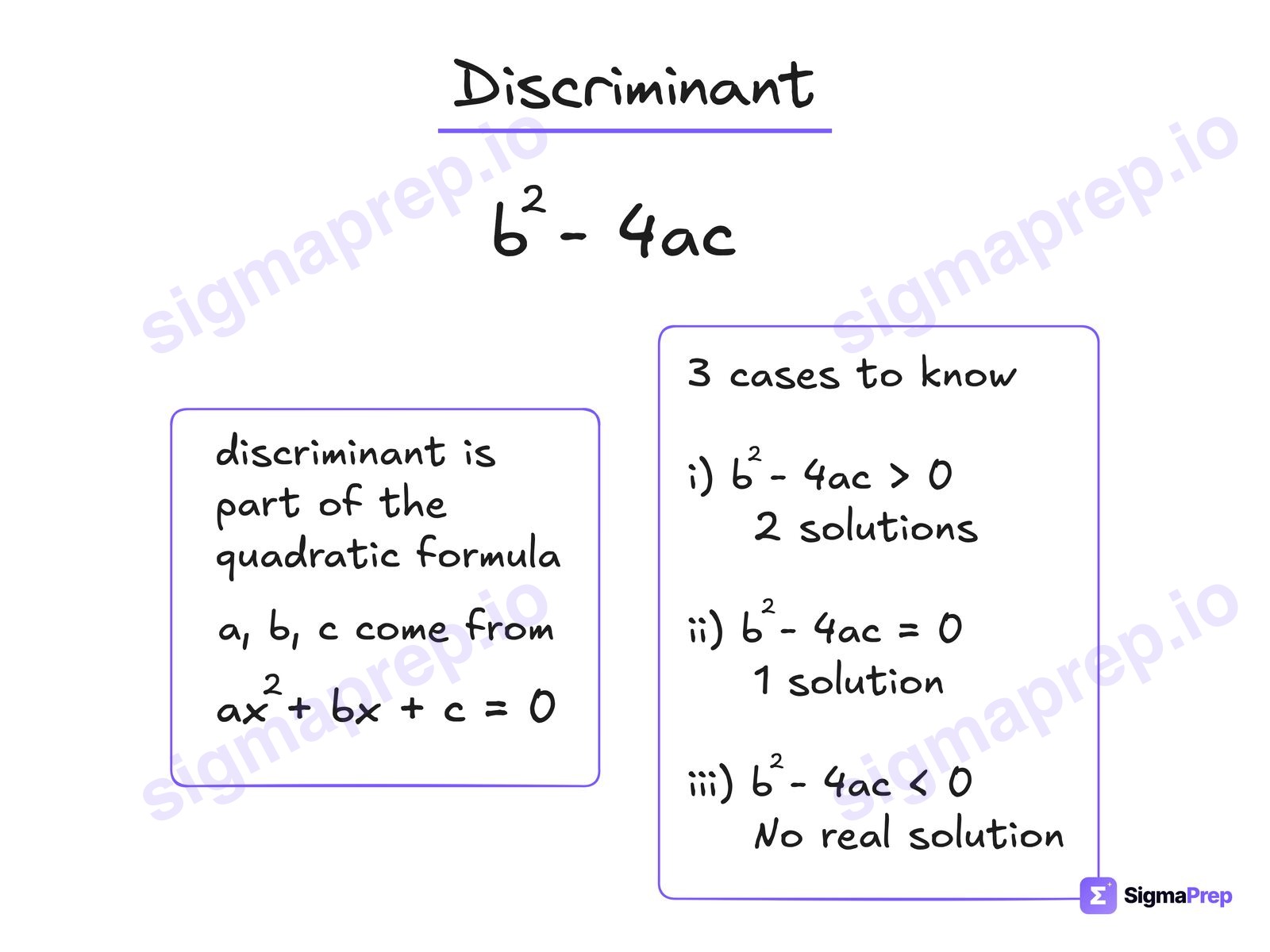
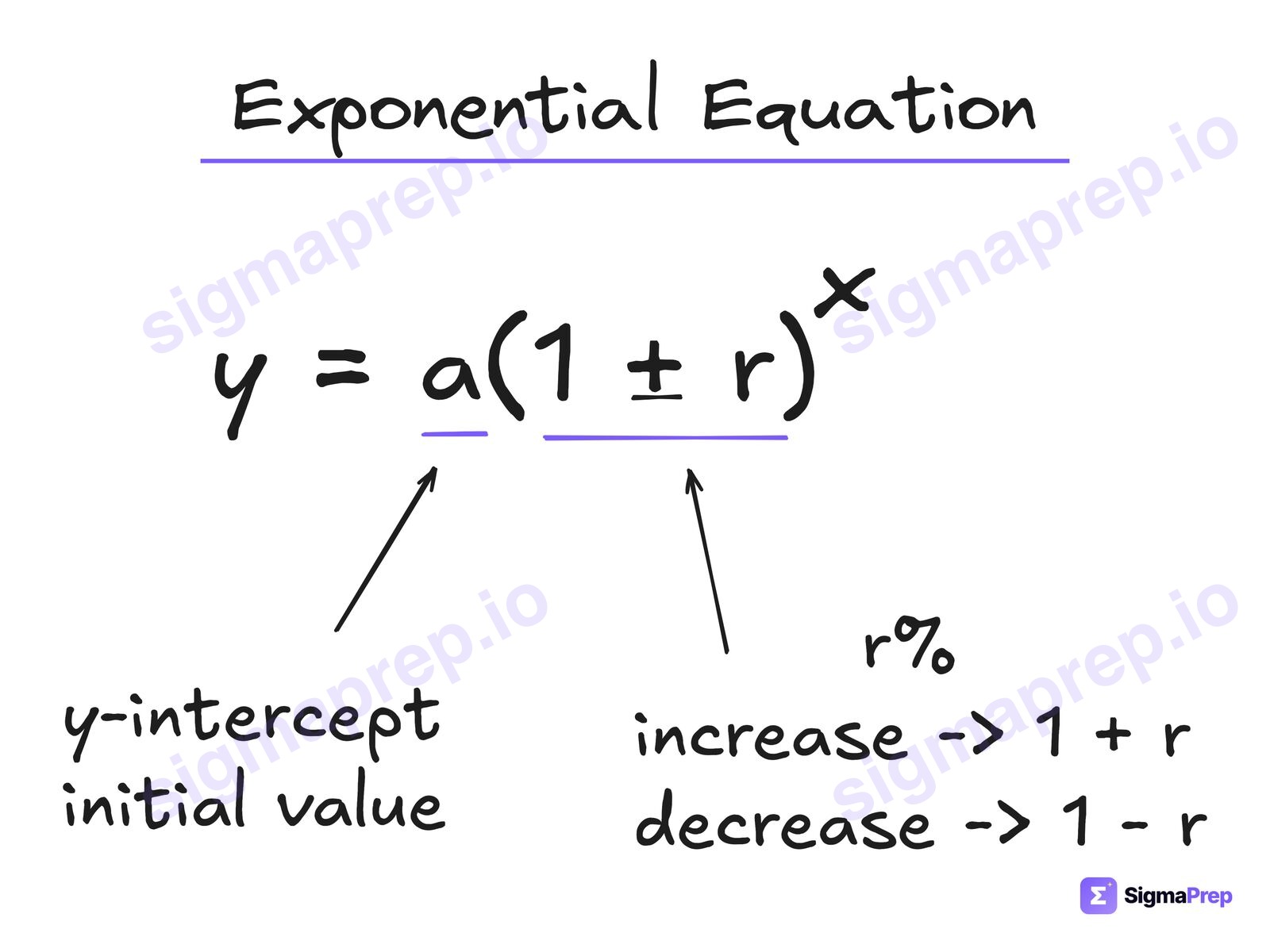
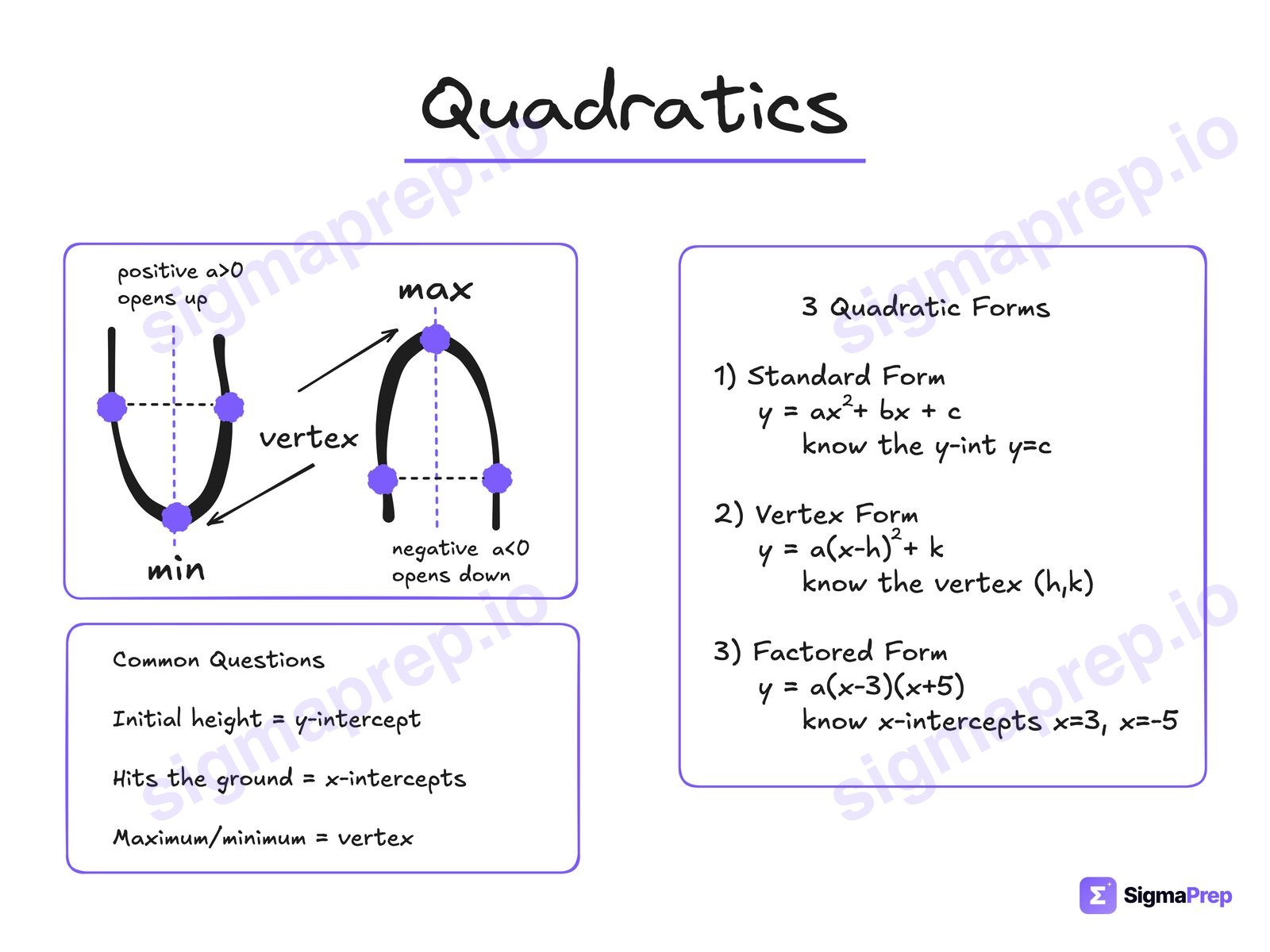
10. DiscriminantTwo things to spot: you need a quadratic, and a sentence telling you how many solutions. That is a discriminant problem. Know the 3 cases: greater than 0 for 2 solutions, equal to 0 for 1 solution, and less than 0 for no solution. Then let Desmos solve it.Worked example in the app →11. Exponential EquationTwo things to know: the number in front is the initial value, and the number inside the parentheses, with the exponent, represents the increase or decrease (usually in terms of percent).Worked example in the app →8. QuadraticsKnow the 3 quadratic forms and what information each one gives you. Know the common questions and what they represent in context. Understand symmetry through the vertex of a quadratic.Worked example in the app →
Advanced Math is roughly 35% of SAT Math, and it is where the hard module goes hunting. Quadratics with unknown constants, exponential models, rational functions, radical equations. When students tell me the second module "turned on them," these are almost always the questions they mean.
The good news is that the hard Advanced Math questions are not creative. The same twenty or so setups appear over and over, test after test, with new numbers and new packaging. We collected the 20 recurring types and solved all of them in one video:
What the 20 Questions Cover
The video is chaptered, so you can jump straight to any type. Grouped by what they actually test:
Constants that control solutions: a radical equation with exactly one solution, a quadratic with no real solutions, a system where a constant decides everything, a parabola and a line that meet exactly once. Five of the twenty are this one idea wearing different clothes.
Reading functions instead of solving them: a table of values that hands you the y-intercept if you see the pattern, an exponential whose maximum has to appear as a coefficient, a rational function reconstructed from its graph.
Exponential models: building the equation from a percent change, and a shifted exponential where you need the sum of two constants.
Structure questions: recognizing that k minus x is a factor, rewriting expressions until the answer falls out, the dew point formula solved for a buried variable.
Quadratic word problems: projectile height, a poster with a border, and the classic "quadratic through two points" that looks like algebra and dies instantly to regression.
That last word is the theme of the video. A surprising number of these have a long algebra path and a short Desmos path, including a regression trick most students have never seen. If Desmos on the SAT is new to you, start with the four core tricks and the regression walkthrough, then come back.
Constants that control solutions
Five of the twenty are this one idea in different clothes. The question hands you a constant and tells you how many solutions the equation has, and the number of solutions is always the discriminant in disguise.
Nonlinear equations and systems · Hardanswer 167
In the given equation, k is a constant. The equation has exactly one real solution. What is the minimum possible value of 4k?
Square both sides and it becomes an ordinary quadratic: x² − 83x + (1764 − k) = 0. Exactly one real solution means the discriminant is zero, so 83² = 4(1764 − k), and that lands on 4k = 167 directly. Notice the question asked for 4k, not k. That is the second trap, and it costs more points than the discriminant does.
Exponential models
Two moving parts, and the test attacks both: the growth factor and the starting value. Get either wrong and there is a choice waiting for you.
Nonlinear functions · Hardanswer D
A model estimates that at the end of each year from 2017 to 2027, the number of rabbits in a population was 120% more than the number at the end of the previous year. The model estimates that at the end of 2018, there were 220 rabbits in the population. Which equation represents this model, where n is the estimated number of rabbits t years after the end of 2017 and t≤10?
"120% more than" means the population is the old one plus another 120% of it, so the multiplier is 2.2, not 1.2. Then the 220 is the count at the end of 2018, which is t = 1 rather than t = 0, so the starting value is 220 divided by 2.2, which is 100. Look at the four choices: every one of them is a different combination of those two mistakes.
Quadratic word problems
These look like they need the formula and almost never do. A parabola is symmetric, and symmetry answers most of what gets asked about it.
Nonlinear functions · Hardanswer C
A quadratic function models a rocket's height, in meters, above the ground in terms of the time, in seconds, after it was launched. The model estimates that the rocket was launched from an initial height of 5 meters above the ground and reached a maximum height of 45.8 meters above the ground 4 seconds after the launch. How many seconds after the launch does the model estimate that the rocket will return to a height of 5 meters?
You are never told the equation and you do not need it. The rocket is at 5 metres at launch, the peak is at 4 seconds, and a parabola is a mirror about its peak. So it comes back to 5 metres 4 seconds the other side of the peak: 8 seconds. The 45.8 is in the question purely to make you reach for the vertex form.
Try one
A real question from our Nonlinear Functions set. Work it, then watch how I do it.
try one · Nonlinear functions · Medium
The function f is defined by f(x)=c(a)x, where c and a are positive constants. It is known that f(0)=20 and a=2. Which of the following is an equivalent form of f that shows f(0) as a coefficient or base?
How to Use the Video
Do not watch it straight through. Pause at each chapter, try the question yourself, then watch the solution and compare paths. If your way took ninety seconds and the video's way took twenty, that difference is the entire lesson. You are not learning new math. You are learning faster recognition of math you already know.
Watching a solution feels like progress. It is not, yet. The question that beat you cannot measure you again, because next time you will remember the answer instead of deriving it.
Every hard Advanced Math type in this video has fresh versions on Sigma Prep, same skill, same difficulty, new numbers and context, each with my video solution attached. Miss one, watch the fix, then drill its siblings until the recognition is automatic. It is free to start, no card required. Start free today!
Common Questions
Quadratics with unknown constants, exponential models, rational functions, radical equations, and above all the constants-that-control-solutions questions: a radical equation with exactly one solution, a quadratic with no real solutions, a system that touches once.
About 35% of the section, and it is where the harder second module concentrates its difficult questions, which is why students say Module 2 "turned on them."
Yes. The same twenty or so setups appear test after test with new numbers and packaging. Learn the setups and the hard module stops being a surprise.
Want more SAT tips like this?
One article a week. No spam.
Ready to raise your SAT Math score?
Take the free Diagnostic Quiz and see where you stand. No payment required.