SAT Math formula sheet · all 24 · Algebra · #1 of 24

Slope-intercept form on the SAT: How It Is Tested

Linear functions

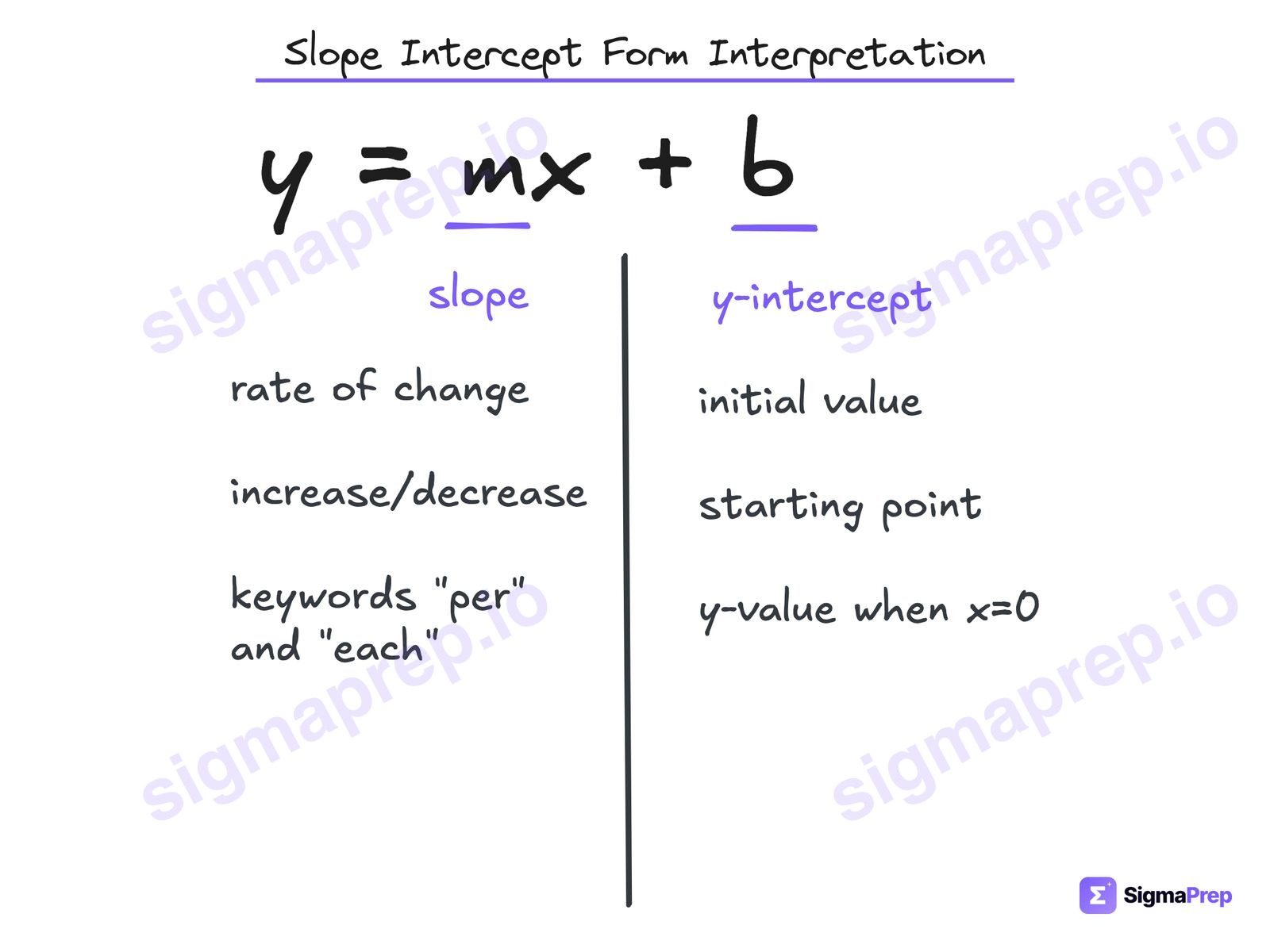
Slope-Intercept Form Interpretation diagram for the SAT: Slope is always attached to the variable, and the keywords are per and each. Slope is the change in y for ONE change in
What it is really testingSlope is always attached to the variable, and the keywords are per and each. Slope is the change in y for ONE change in x.

The question from the sheet

Hard
SAT Algebraanswer B
A container is being filled with water. The formula h=40+5th = 40 + 5t relates the height hh, in centimeters, of the water in the container to the time tt, in minutes, since filling began. Which of the following describes the meaning of the 55 in this context?
AThe time, in minutes, to reach a height of 4040 centimeters
The increase in the height, in centimeters, of the water for each one-minute increase in time
CThe height, in centimeters, of the water when filling began
DThe increase in time, in minutes, for each one-centimeter increase in the height of the water

How the diagram applies

  1. Match it to y=mx+by = mx + b: the slope mm is 55, the intercept bb is 4040.
  2. The slope is the rate of change: how much hh changes for each one-unit increase in tt. So 55 is centimeters per minute.
  3. 4040 is the starting point, the height when filling began. That is choice C, the other number.

Answer: B

That is 1 of 24.

The whole sheet is one page per formula, each one solved on a real SAT question. Print it, stick it on the wall, scan any diagram to get back here.

The PDF needs no account. The video, the clean diagrams and practice on this skill need a free one, and never a card.

All 24 diagrams

Common Questions

It comes up as an SAT linear functions question. Slope is always attached to the variable, and the keywords are per and each. Slope is the change in y for ONE change in x.

Match it to y = mx + b: the slope m is 5, the intercept b is 40. The slope is the rate of change: how much h changes for each one-unit increase in t. So 5 is centimeters per minute. 40 is the starting point, the height when filling began. That is choice C, the other number.

No. The SAT reference sheet is twelve geometry formulas and three notes, and Slope-Intercept Form Interpretation is not one of them. It is one of the 24 things the test expects you to know without being given them. See what the reference sheet does cover at /blog/sat-math-reference-sheet.