SAT Math formula sheet · all 24 · Problem-Solving and Data Analysis · #17 of 24

Probability on the SAT: How It Is Tested

Probability and conditional probability

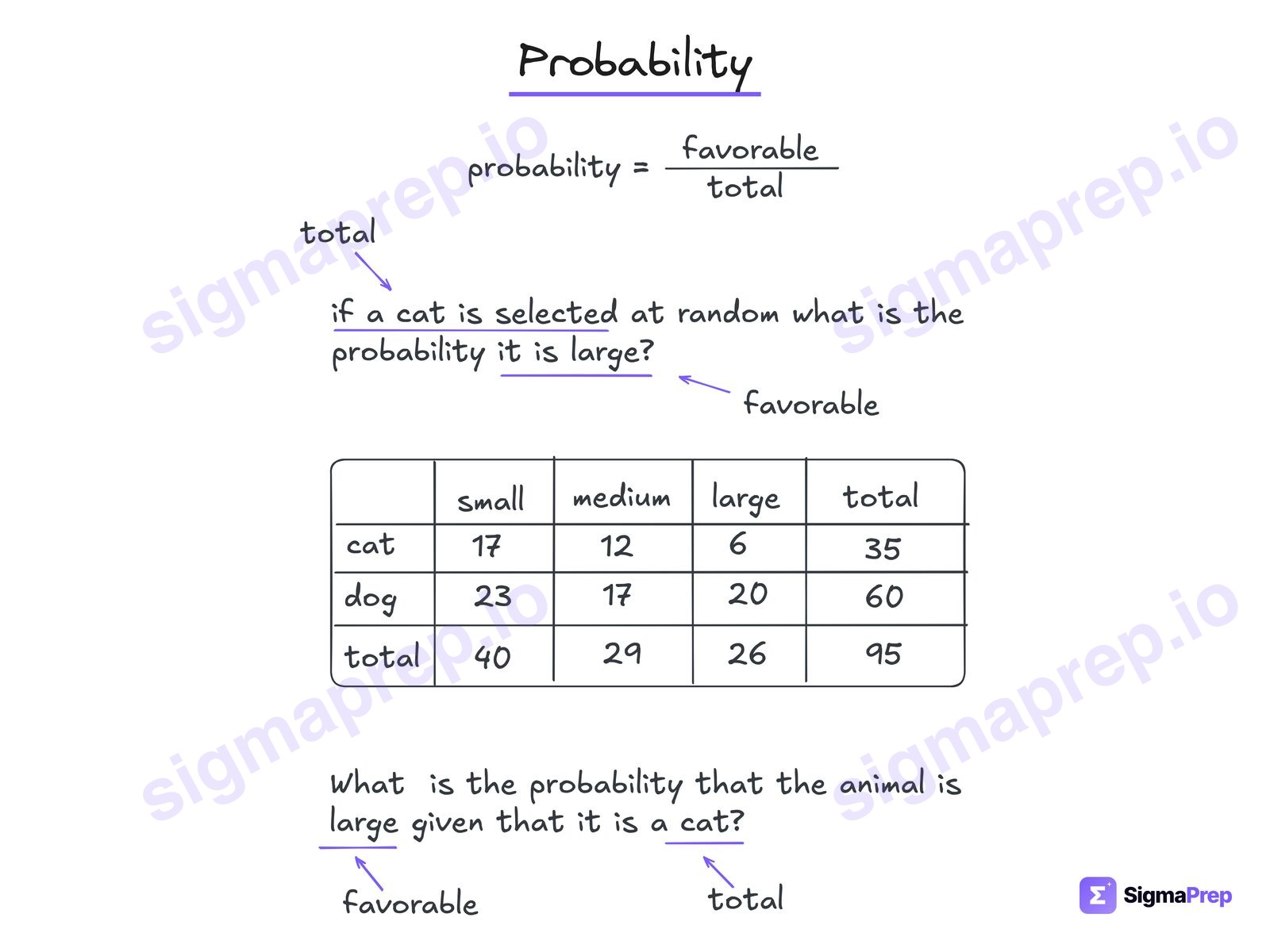
Probability diagram for the SAT: Probability just wants you to create a fraction. When you read these problems you need to know what the denominator is (
What it is really testingProbability just wants you to create a fraction. When you read these problems you need to know what the denominator is (the total) and what the numerator is (the favorable). The phrase "given that" swaps the total around.

The question from the sheet

Medium
SAT Problem-Solving and Data Analysisanswer 65/67
For 100100 bolts, the table summarizes the distribution by machine and length.
Length (millimeters)
MachineLess than 15151515 to 2525Greater than 2525
Machine 114149922
Machine 20012122121
Machine 31313292900
One of these bolts will be selected at random. What is the probability of selecting a bolt with a length that is less than or equal to 2525 millimeters, given that it was not made by Machine 2? (Express your answer as a decimal or fraction, not as a percent.)
Student-produced response: 65/67

How the diagram applies

  1. "Given that it was not made by Machine 2" shrinks the total to the Machine 1 and Machine 3 rows: 25+42=6725 + 42 = 67 bolts. The grand total of 100100 is gone.
  2. Favorable, inside those two rows only: length 25\leq 25 is 14+9+13+29=6514 + 9 + 13 + 29 = 65.
  3. 6567\dfrac{65}{67}

Answer: 65/67

That is 1 of 24.

The whole sheet is one page per formula, each one solved on a real SAT question. Print it, stick it on the wall, scan any diagram to get back here.

The PDF needs no account. The video, the clean diagrams and practice on this skill need a free one, and never a card.

All 24 diagrams

Common Questions

It comes up as an SAT probability and conditional probability question. Probability just wants you to create a fraction. When you read these problems you need to know what the denominator is (the total) and what the numerator is (the favorable). The phrase "given that" swaps the total around.

"Given that it was not made by Machine 2" shrinks the total to the Machine 1 and Machine 3 rows: 25 + 42 = 67 bolts. The grand total of 100 is gone. Favorable, inside those two rows only: length ≤ 25 is 14 + 9 + 13 + 29 = 65. 6567

No. The SAT reference sheet is twelve geometry formulas and three notes, and Probability is not one of them. It is one of the 24 things the test expects you to know without being given them. See what the reference sheet does cover at /blog/sat-math-reference-sheet.