SAT Math formula sheet · all 24 · Advanced Math · #10 of 24

The discriminant on the SAT: How It Is Tested

Nonlinear equations in one variable and systems of equations in two variables

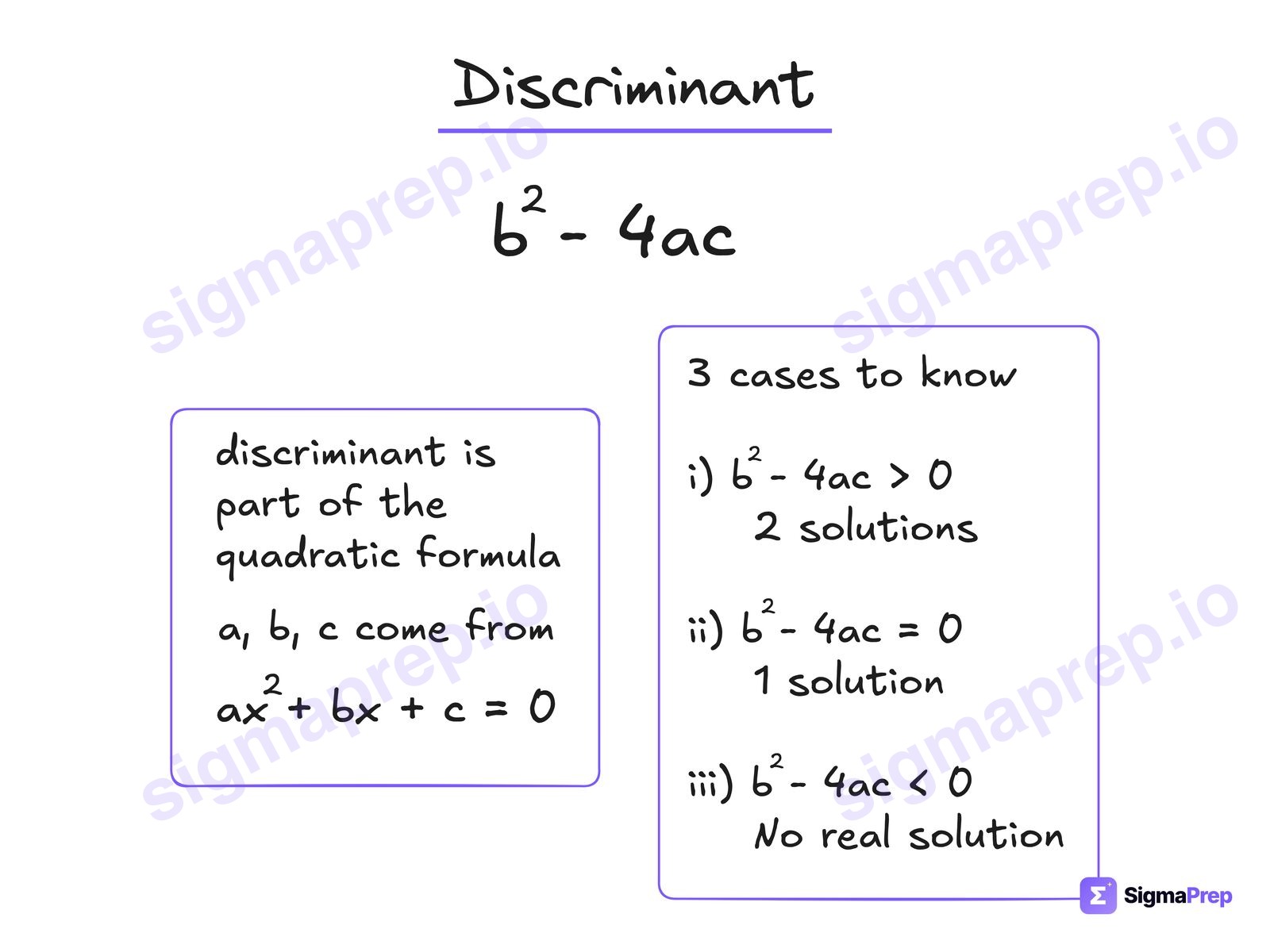
Discriminant diagram for the SAT: Two things to spot: you need a quadratic, and a sentence telling you how many solutions. That is a discriminant problem.
What it is really testingTwo things to spot: you need a quadratic, and a sentence telling you how many solutions. That is a discriminant problem. Know the 3 cases: greater than 0 for 2 solutions, equal to 0 for 1 solution, and less than 0 for no solution. Then let Desmos solve it.

What the discriminant is

For a quadratic in standard form, ax2+bx+c=0ax^2 + bx + c = 0, the discriminant is b2−4acb^2 - 4ac.

It is the part under the square root in the quadratic formula, x=−b±b2−4ac2ax = \dfrac{-b \pm \sqrt{b^2 - 4ac}}{2a}. That square root is why it decides how many solutions there are: a positive number has two square roots, zero has one, and a negative number has none that are real.

The SAT does not give you this. It is not on the reference sheet, so it has to be memorized.

The three cases

Greater than 0: two real solutions. The parabola crosses the x-axis twice. For x2−6x+5=0x^2 - 6x + 5 = 0, the discriminant is 36−20=1636 - 20 = 16, and the solutions are x=1x = 1 and x=5x = 5.

Equal to 0: exactly one real solution. The parabola touches the x-axis at its vertex and turns back. For x2−6x+9=0x^2 - 6x + 9 = 0, the discriminant is 36−36=036 - 36 = 0, and the only solution is x=3x = 3.

Less than 0: no real solutions. The parabola never reaches the x-axis. For x2−6x+10=0x^2 - 6x + 10 = 0, the discriminant is 36−40=−436 - 40 = -4.

How the SAT asks it

"Exactly one solution. What is the value of cc?" Set b2−4ac=0b^2 - 4ac = 0 and solve for the constant. That is the question on this page.

"Which equation has no real solutions?" Work out b2−4acb^2 - 4ac for each choice and pick the one that comes out negative.

A line and a parabola that meet at exactly one point. This is the same question in disguise. Set the two equations equal, move everything to one side, and set the discriminant to 0. For y=x2+3y = x^2 + 3 and y=2x+ky = 2x + k: x2−2x+3−k=0x^2 - 2x + 3 - k = 0, so 4−4(3−k)=04 - 4(3 - k) = 0 and k=2k = 2.

Mistakes that cost the point

Reading aa, bb and cc before everything is on one side. x2=6x−9x^2 = 6x - 9 has b=−6b = -6 and c=9c = 9 only after you rewrite it as x2−6x+9=0x^2 - 6x + 9 = 0.

Dropping a sign. When aa is negative, −4ac-4ac changes sign. In the question on this page a=−3a = -3, so −4(−3)(c)-4(-3)(c) is +12c+12c.

Squaring a negative bb wrong. b2b^2 is never negative: (−6)2=36(-6)^2 = 36.

The Desmos way

Type the quadratic as y=y = with a slider for the constant and count where the graph meets the x-axis. For "exactly one solution," drag the slider until the vertex just touches the x-axis and read off the value. It is a good check on the algebra even when you solve it by hand.

The question from the sheet

Hard
SAT Advanced Mathanswer B
In the given equation, cc is a constant. The equation has exactly one solution. What is the value of cc?
−3x2+24x+c=0-3x^{2} + 24x + c = 0
A-96
✓-48
C-32
D0

How the diagram applies

  1. Read off a=−3a = -3, b=24b = 24, c=cc = c. Everything is already on one side.
  2. Exactly one solution is case ii: b2−4ac=0b^{2} - 4ac = 0.
  3. 576−4(−3)(c)=576+12c=0576 - 4(-3)(c) = 576 + 12c = 0, so c=−48c = -48.

Answer: B

That is 1 of 24.

The whole sheet is one page per formula, each one solved on a real SAT question. Print it, stick it on the wall, scan any diagram to get back here.

The PDF needs no account. The video, the clean diagrams and practice on this skill need a free one, and never a card.

All 24 diagrams

Common Questions

It comes up as an SAT nonlinear equations in one variable and systems of equations in two variables question. Two things to spot: you need a quadratic, and a sentence telling you how many solutions. That is a discriminant problem. Know the 3 cases: greater than 0 for 2 solutions, equal to 0 for 1 solution, and less than 0 for no solution. Then let Desmos solve it.

Read off a = -3, b = 24, c = c. Everything is already on one side. Exactly one solution is case ii: b^2 - 4ac = 0. 576 - 4(-3)(c) = 576 + 12c = 0, so c = -48.

No. The SAT reference sheet is twelve geometry formulas and three notes, and Discriminant is not one of them. It is one of the 24 things the test expects you to know without being given them. See what the reference sheet does cover at /blog/sat-math-reference-sheet.

For a quadratic written as ax^2 + bx + c = 0, the discriminant is b^2 - 4ac. Positive means two real solutions, zero means exactly one, and negative means no real solutions.

The quadratic has exactly one real solution. Its graph touches the x-axis at the vertex without crossing it, and the solution is x = -b / (2a).

If the system is a line and a parabola, set the two equations equal, move everything to one side so you have a quadratic in standard form, and set its discriminant b^2 - 4ac equal to 0. Solve that for k.