There's no shortage of vague advice about improving your SAT score. "Practice more." "Study harder." "Learn the content." None of that tells you what to actually do tomorrow morning.
This is a concrete, step-by-step guide based on what we've seen work across hundreds of students. It's focused on SAT Math specifically because that's what we teach, and because math is the section where structured practice produces the most predictable improvement.
Step 1: Get a Baseline Score
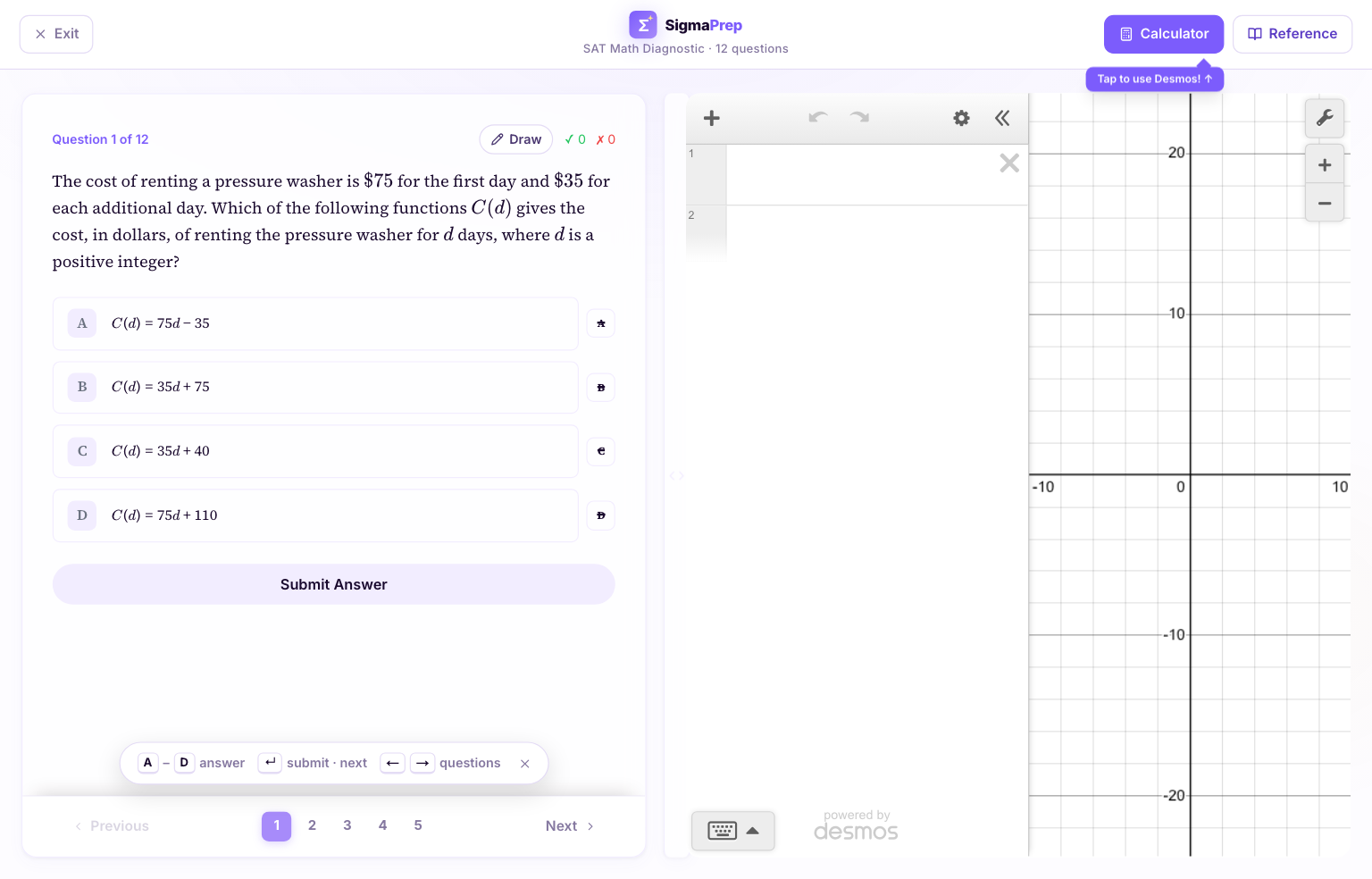
You can't improve if you don't know where you're starting. Take an official College Board practice test through Bluebook or our free Diagnostic Quiz to get a baseline. Do it under real conditions. Timed. No distractions. No looking things up.
Write down your math score. This is your starting point. Everything from here is measured against this number.
Step 2: Identify Your Weak Domains
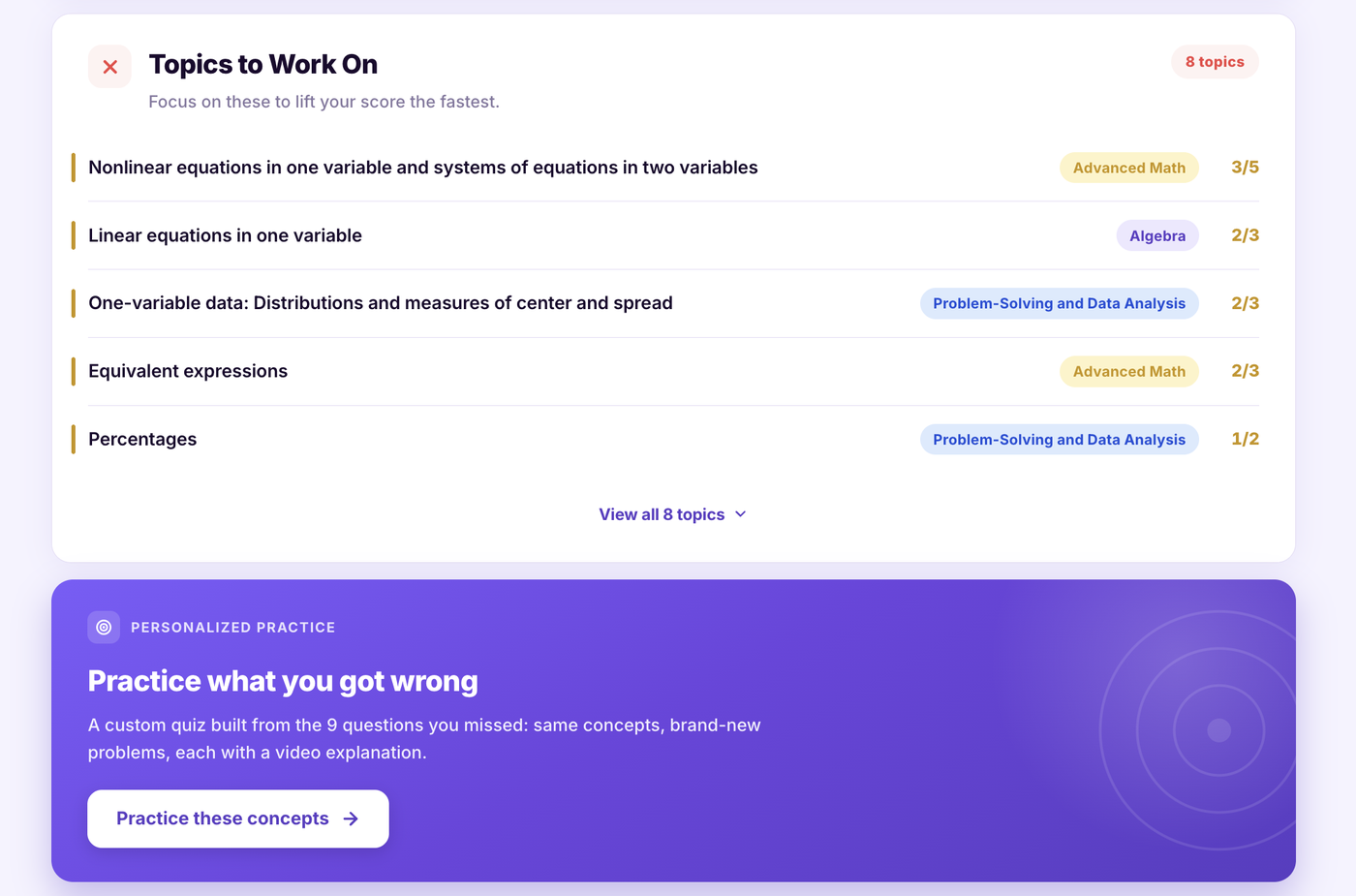
SAT Math covers four domains: Algebra, Advanced Math, Problem-Solving and Data Analysis, and Geometry and Trigonometry. Your baseline will show you which domains are dragging your score down.
Most students have 1-2 domains where they lose the majority of their points. The problem is that most students don't actually know what they got wrong beyond a vague sense of "math is hard." You need specifics. Which topics within each domain? Which difficulty level? That's where targeted improvement starts.
Step 3: Master Easy Questions First
This sounds obvious but almost nobody does it. Students want to jump to the hard questions because those feel like where the "real" improvement happens. That's backwards.
Easy questions are worth the same as hard questions. If you're missing easy questions due to careless errors, rushing, or shaky fundamentals you're leaving guaranteed points on the table. A student who gets every easy and medium question right but misses half the hard ones scores around 700. That's the 92nd percentile.
Go through each domain and practice only easy questions until you're getting them right consistently. Not sometimes. Every time. This builds the foundation everything else sits on.
Step 4: Move to Medium, Then Hard
Once easy is locked in, repeat the process with medium difficulty. Medium questions test the same concepts as easy ones but with an extra step, less obvious setups, or more complex numbers. If your easy foundation is solid, medium questions should click relatively quickly.
Hard questions come last. This is where the difficulty-separated practice matters most. You don't want to waste time on hard questions while you're still dropping easy ones. SAT Math feels impossible when you're trying to do everything at once. It's very manageable when you take it one level at a time.
Step 5: Learn From Every Wrong Answer
This is the single most important habit in SAT prep and the one most students skip.
When you get a question wrong don't just check the answer and move on. Understand why you got it wrong. Was it a concept you didn't know? A careless arithmetic error? Did you misread the question? Did you run out of time?
Each type of mistake has a different fix. Concept gaps need studying. Careless errors need slowing down. Misreading needs practice with SAT-specific wording. Time pressure needs a pacing strategy. If you treat all mistakes the same you'll keep making the same ones.
The best approach is to see the fastest correct method immediately after getting a problem wrong. Not just "the answer is C" but a full walkthrough showing the most efficient way to solve that type of problem. That's why video explanations beat answer keys.
Step 6: Master Desmos
This is the most underrated score booster on the SAT. The embedded Desmos graphing calculator can solve problems in seconds that would take 3-4 minutes by hand. Most students barely scratch the surface of what it can do.
Specifically learn how to:
- Graph equations and find intersections visually instead of solving algebraically
- Solve regression and data-fitting problems by entering tables directly into Desmos
- Test answer choices by plugging them in and seeing which one works
- Use sliders to explore how changing values affects equations
Desmos fluency can easily add 30-50 points to your math score because it turns time-consuming algebra problems into 15-second graphing problems. It's the closest thing to a legal cheat code on the SAT.
Step 7: Practice Consistently, Not Intensely
15-20 minutes a day beats a 3-hour weekend cram session. Your brain retains math patterns through spaced repetition, not marathon study sessions. Daily practice builds the automatic pattern recognition you need on test day when you're under time pressure.
Set a realistic schedule. Every day or every other day. Same time if possible. Most students see meaningful improvement in 6-8 weeks of consistent daily practice. That's not a long time. But it has to be consistent.
Step 8: Take a Second Practice Test
After 3-4 weeks of focused practice, take another official practice test. Compare your score to your baseline. Look at which domains improved and which still need work. Adjust your focus accordingly.
This cycle of practice → test → adjust → practice is how scores go up predictably. Use official College Board tests for this first. Once you have worked through those, Sigma Prep has 24 timed practice tests modeled on real SATs with video walkthroughs for every question.
Realistic Score Improvement Expectations
Based on what we've seen with our students:
- 50-80 point improvement: Very achievable in 4-6 weeks with consistent practice. This is mostly cleaning up easy/medium mistakes and getting more comfortable with the format.
- 100-150 point improvement: Typical with 2-3 months of focused work. Requires mastering fundamentals and building Desmos fluency.
- 150-200+ point improvement: Possible with 3-4+ months. Requires systematic work through all difficulty levels and significant time on hard questions.
The curve flattens as you go higher. Going from 550 to 650 is faster than going from 650 to 700 which is faster than going from 700 to 750. Each jump requires more precision and fewer mistakes.
What to Do Right Now
Don't overthink it. Start with Step 1.
Take the free Diagnostic Quiz to get your baseline across all four SAT Math domains. It takes about 15 minutes. From there you'll know your starting score, your weak spots, and exactly where to focus first.
Then open the Practice page, pick your weakest domain, start with Easy, and begin working through problems. Watch the video when you get one wrong. Do this for 15-20 minutes. Repeat tomorrow. That's the whole system.
Here's what it looks like.