Short answer. Yes, 700 is a good SAT Math score. It is higher than about 92% of test takers and above the middle range at most colleges. At the most selective engineering and Ivy-level schools, the middle half of admitted students sit above 750, so there it reads as average rather than strong.
How many can you miss? On the digital SAT you have to be routed into the harder second module for 700 to be possible at all. From there, most forms land at 700 with roughly 6 to 9 wrong out of 44. The exact number moves a little from test to test.
Fresh numbers: nine students sent us their August 2026 scores, Math 690 to 790, every retaker up.
When students and parents hear "700 on SAT Math" they usually think of it as a stretch goal. Something only naturally gifted math students can hit. That's not true. A 700 is absolutely achievable for any student who's willing to practice consistently and the path to getting there is simpler than most people realize.
Let's break down what a 700 actually means, what it gets you, and the specific strategy to get there.
Key findings
- A 700 on SAT Math is the 92nd percentile: higher than 92% of all test takers.
- The national average SAT Math score is about 508, so a 700 is nearly 200 points above average.
- A 700 takes roughly 37 of 44 questions correct: you can miss about 7 and still get there.
What a 700 SAT Math Score Actually Means
A 700 on SAT Math puts you in the 92nd percentile. That means you scored higher than 92% of everyone who took the test. For context the national average SAT Math score is about 508. A 700 is nearly 200 points above that.
In terms of raw performance you need to get approximately 37 out of 44 questions correct. That means you can miss 7 questions and still hit 700. You don't need a perfect score. You don't even need to be close to perfect. You just need to be solid on the fundamentals and pick up some of the harder ones.
You can check that against your own last practice test with the SAT Math score calculator. Put in how many you got right and it estimates the section score, and shows how many misses each target still allows.
Sitting at a different score? The same breakdown exists for 600, 650 and 750.
What a 700 Gets You Into
This is the part that surprises most families. A 700 on math makes you competitive at a huge percentage of US colleges.
Top public universities like University of Michigan, UVA, UCLA, Georgia Tech, and University of Florida have middle 50% SAT Math ranges that typically fall between 610 and 720. A 700 puts you right in the sweet spot or above average at most of these schools.
Top 25-50 private universities like Boston College, NYU, Villanova, Wake Forest, and similar schools. A 700 is competitive or above their median at many of these.
State schools and regional universities where a 700 makes you a standout applicant from a testing perspective. The average math score at most state schools is in the 500-600 range.
The reality is a 700 SAT Math score opens the door to the vast majority of colleges in the country. The only tier where it falls short is the very top. Ivy League and top 10 schools typically want 750+ with middle 50% ranges of 730-800. But even there a 700 puts you in the conversation and most of those admissions decisions come down to the full application, not just test scores.
The Strategy: You Don't Need to Master Everything
Here's what most students get wrong. They think scoring 700 means being great at all of SAT Math. Every topic. Every difficulty level. That's not how it works.
We can put numbers on that. Our free practice test has been completed by 380 students, and we graded all 14,567 answers to see which questions actually get missed. Miss rates ran from 4% on the friendliest questions to 61% on the worst one, and the misses were not spread evenly across topics. A handful of question types account for most of the damage. Free-response questions are about a quarter of the test but half of the ten most-missed questions. You do not need to be strong everywhere. You need to stop losing points in the few places everyone loses them, and we published the full ranking.
The digital SAT Math section has 44 questions across two modules. Based on difficulty they break down roughly like this:
- 14 easy questions
- 16 medium questions
- 14 hard questions
To hit 700 you need about 37 correct. Here's the math on the simplest path to get there:
- Get all 14 easy questions right: 14
- Get all 16 medium questions right: 16
- Get 7-8 of the 14 hard questions right: 7
That's 37. That's a 700.
Read that again. You can miss half the hard questions and still score 700. The key is nailing the easy and medium questions. Those 30 questions are your foundation. If you get those right consistently and pick up roughly half the hard ones you're there.
Why This Is More Achievable Than People Think
The easy and medium SAT Math questions test core concepts. Linear equations, ratios, percentages, basic geometry, reading data from tables and graphs. This isn't advanced calculus. It's the math most students already learned in school but may not have practiced enough to be consistent under test conditions.
The gap between "I kind of know this" and "I get this right every time" is just practice. Seeing enough problems. Recognizing the patterns. Building speed so you don't run out of time.
In our experience working with students any student who puts in consistent practice on easy and medium difficulty problems can learn to get those right reliably. It doesn't require being naturally talented at math. It requires repetition and learning from mistakes.
This is exactly why Sigma Prep separates practice by difficulty level. You can focus exclusively on Easy problems until you're getting them all right. Then move to Medium. Then tackle Hard once your foundation is locked in. You're never wasting time on problems that are too far above your current level and you're never stuck doing problems you've already mastered.
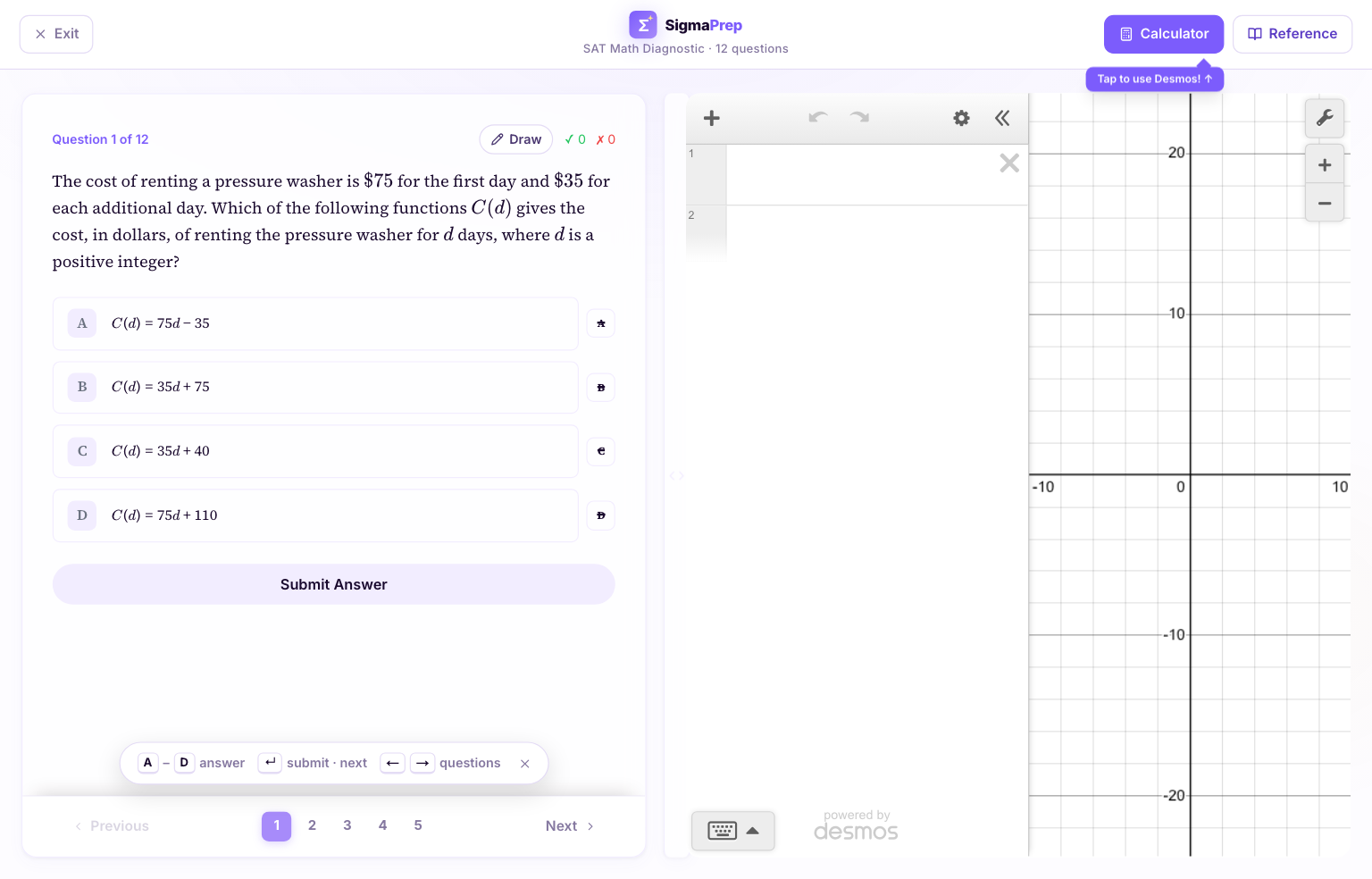
Here's what that looks like. Start with the free diagnostic: twelve real SAT Math questions across all four domains, with the same Desmos calculator you get on test day. No account needed.
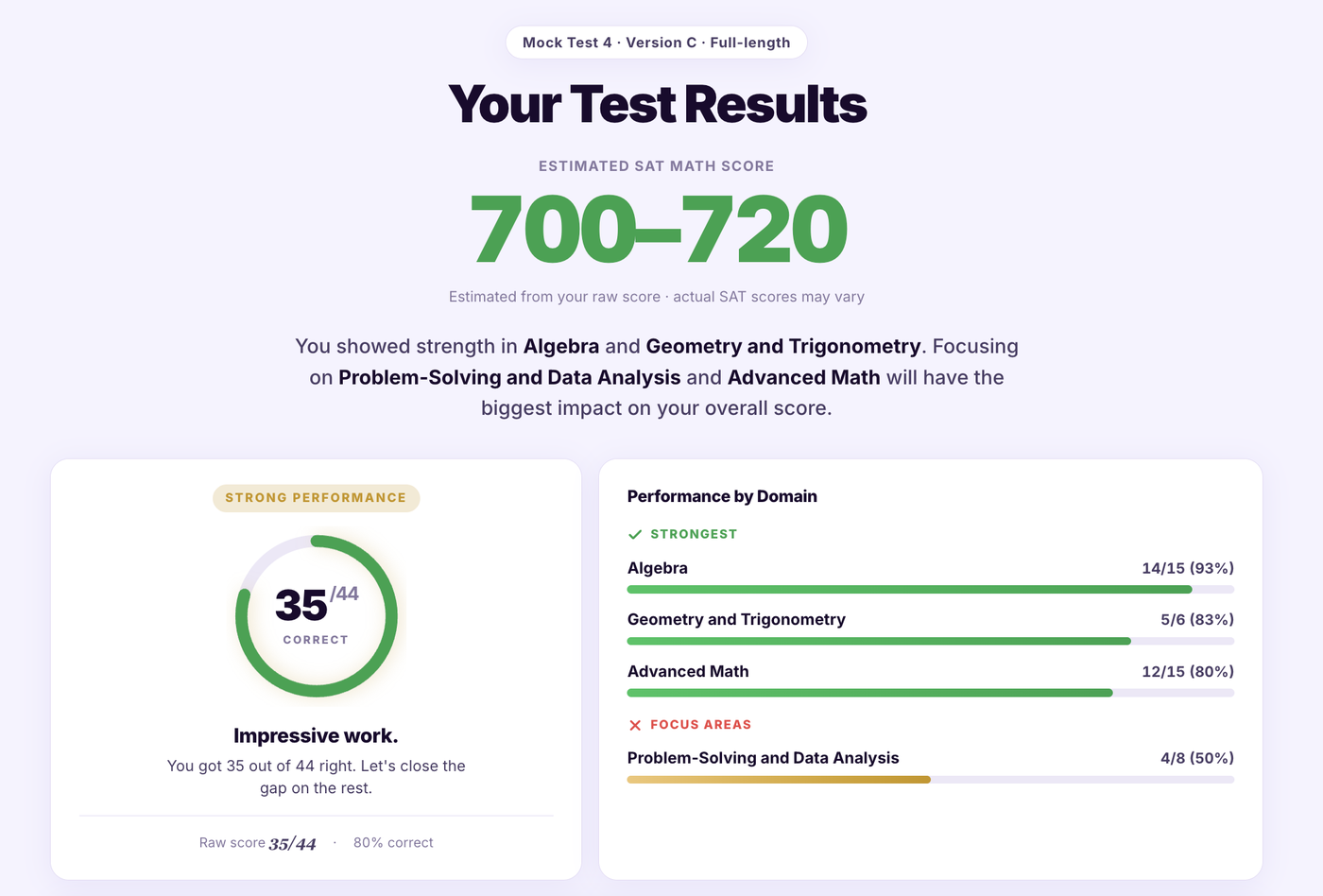
Every test and quiz ends the same way: an estimated 200 to 800 score, and the domain that is costing you the most points. For a student chasing 700, this is the number that matters, because it tells you which easy and medium questions you are still leaking.
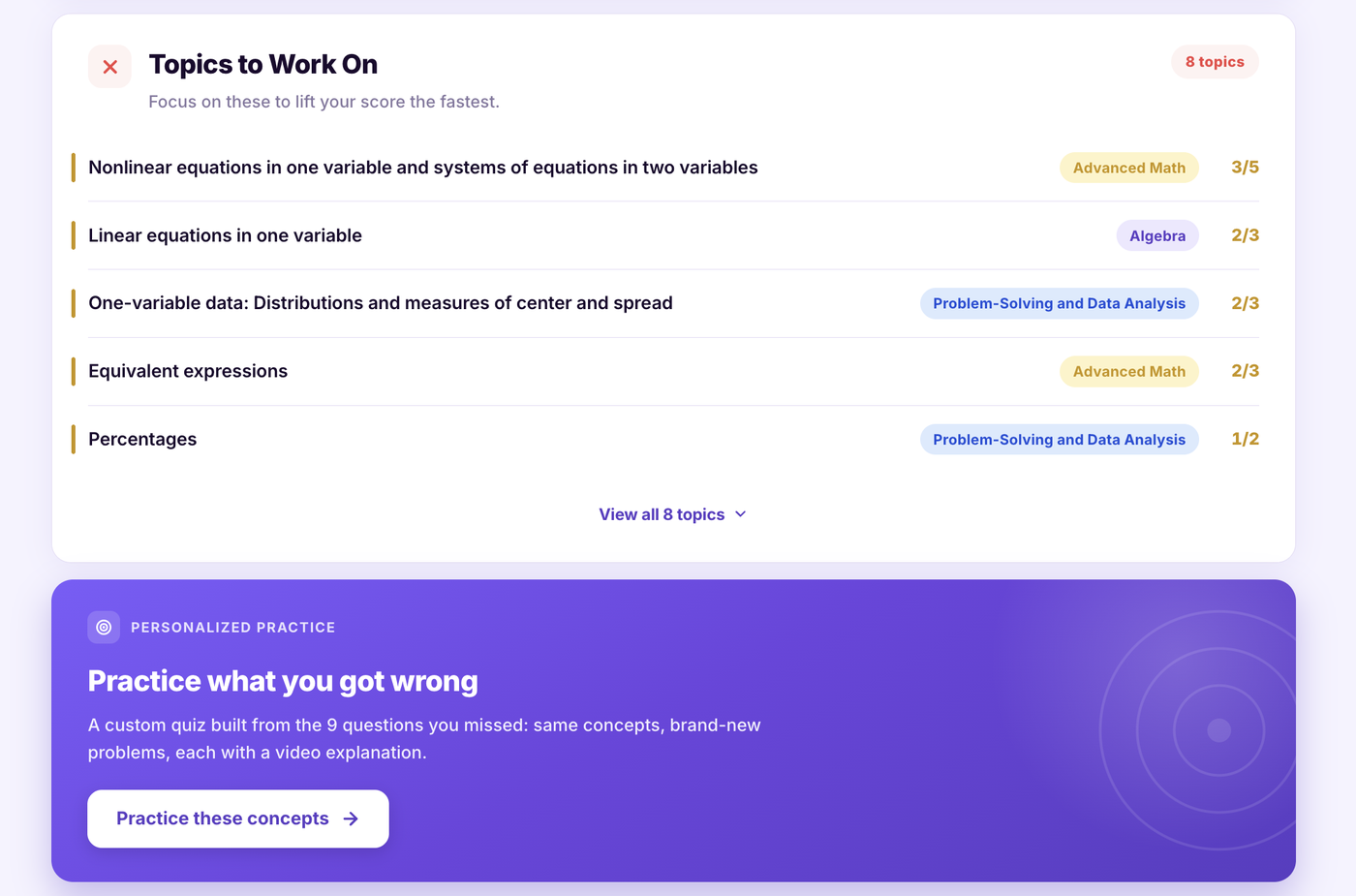
Then the app builds your next practice set from the questions you missed: same concepts, brand-new problems, a video explanation on each one. That loop, miss it, watch it, do a fresh one, is the whole method for getting easy and medium questions to "every time."
What About the Hard Questions?
You only need about half of them. But which half?
Not all "hard" questions are equally hard. Some are only hard because they combine two concepts you already know. Others require creative thinking or techniques you may not have seen before. The trick is recognizing which hard problems are within your reach and which ones to skip or guess on.
Two things that make hard questions significantly more manageable:
1. Master Desmos. The SAT gives you an embedded Desmos graphing calculator for every math question. Most students barely use it beyond basic arithmetic. But if you know how to use Desmos properly it can solve hard questions in seconds that would otherwise take 3-4 minutes of algebra. Regression problems, systems of equations, finding intersections, testing answer choices by graphing. We teach this in our video lessons and it's a genuine cheat code.
The single most-missed question in our data is a good example of the opposite problem. It asks for the surface area of two identical rectangular prisms glued into one solid, and 61% of students got it wrong. There is no hard algebra in it. Gluing the prisms together hides two faces, and most students add the two surface areas and never subtract them. That is not a math gap, it is a question-type gap, and it is exactly the kind of thing that separates a 650 from a 700.
2. Practice hard questions separately. Once you've mastered easy and medium you can focus your entire practice time on just hard questions. Sigma Prep lets you do exactly this. Filter to Hard difficulty and grind through them. Every question you get wrong has a video showing the fastest solving method so you're not just seeing what the answer is. You're seeing how to think about that type of problem.
Beyond 700: The Path to 750-800
Going from 700 to 750+ is a real jump. At 750 you're in the 96th percentile and you can only miss about 3-4 questions total. This means mastering nearly all the hard questions which requires deeper problem solving skills and more creative approaches.
It's absolutely possible but it's a grind. The improvement curve gets steeper the higher you go. Going from 550 to 650 might take a month of focused practice. Going from 650 to 700 might take another month. Going from 700 to 750 could take two months even with consistent daily practice.
If your child is aiming for Ivy League or top 10 schools the 750+ range is the target. It requires mastering the hard questions, having a strong Desmos strategy, and building enough speed to have time for every question. Here's a realistic timeline for different score jumps.
But here's the important thing. Even if your child's eventual target is 750+ the path still starts with mastering easy and medium first. Nobody jumps straight to hard. The fundamentals are the foundation and 700 is the milestone that proves the foundation is solid.
The Bottom Line
A 700 SAT Math score is not a dream score reserved for math prodigies. It's a realistic achievable target for any student who:
- Practices consistently (even 15-20 minutes a day works)
- Focuses on mastering easy and medium questions first
- Learns from their mistakes instead of just checking if they got the right answer
- Picks up some hard questions through Desmos mastery and pattern recognition
It puts you in the 92nd percentile. It makes you competitive at the vast majority of colleges. And it gives you a strong foundation if you decide to push higher.
Want to see where you stand right now? Take the free Diagnostic Quiz. Twelve questions, no card. It covers all four SAT Math domains and gives you a baseline score. From there you'll know exactly how far 700 is and what you need to focus on to get there.