You just got your SAT score back. Maybe it's lower than you hoped and you're thinking about retaking it. Maybe it's fine but you want to do better. Either way you're probably thinking the same thing: what do I need to work on?
You'd think the answer would be obvious. You took a test with 44 math questions. Just tell me which ones I got wrong and I'll study those topics. Right?
Not exactly.
The SAT Doesn't Tell You How Many You Got Wrong
This surprises a lot of people. When you get your SAT score report you do not see how many questions you answered incorrectly. You don't see which specific questions you missed. You get a scaled score between 200 and 800 and some general performance indicators. That's about it.
Even stranger, two students who both got 5 questions wrong could end up with completely different scores.
How is that possible?
The SAT's Scoring Algorithm
The digital SAT uses a section-adaptive format. The math section has two modules. Module 1 is the same difficulty for everyone. Based on how you do on Module 1, you either get a harder Module 2 or an easier Module 2.
If you do well on Module 1 you get routed to the harder second module. This is actually what you want because the harder module gives you access to higher scaled scores. If you struggle on Module 1 you get the easier second module which caps how high your score can go.
On top of that College Board uses a proprietary scoring algorithm based on something called Item Response Theory. Without getting too deep into it the basic idea is that not all wrong answers are weighted equally. Getting an easy question wrong is generally penalized more harshly than getting a hard question wrong. The algorithm considers the difficulty of each specific question when calculating your score.
So if you and your friend both missed 5 questions but you missed 3 easy ones and they missed 3 hard ones, their score will likely be higher than yours. Even though you technically got the same number right.
On a practice test you at least know your raw count, which is the one thing the official report never gives you. The SAT Math score calculator turns that count into an estimated section score, and gives a range rather than a single number for exactly the reasons above.
The Feedback You Actually Get
What College Board gives you after the test is a "Knowledge and Skills" breakdown. It shows four domains:
- Algebra (35% of the test, 13-15 questions)
- Advanced Math (35% of the test, 13-15 questions)
- Problem-Solving and Data Analysis (15% of the test, 5-7 questions)
- Geometry and Trigonometry (15% of the test, 5-7 questions)
For each domain you get a colored bar showing your performance level and a difficulty rating. That's the extent of it.
The problem? Even full bars don't mean you got everything right. Full bars indicate a performance level roughly in the 680-800 range. So you could have full bars in a domain and still have gotten questions wrong there. And you could have mostly full bars across the board and still be scoring well below where you want to be.
It's better than nothing but it's not exactly actionable. Knowing you're "medium" in Advanced Math doesn't tell you whether your weak spot is quadratics, exponentials, or polynomial division.
Why This Matters for Your Prep
Most students study for the SAT by doing practice tests and reviewing what they got wrong. That's a reasonable approach. But when the test itself barely tells you what you got wrong the review process is pretty limited.
You end up guessing. Maybe I need to work on geometry. Maybe it's the word problems. You don't really know so you study a little of everything and hope for the best.
This is the least efficient way to improve. You spend time on topics you already know while neglecting the specific subtopics that are actually costing you points.
What Focused Practice Looks Like
The better approach is to break SAT Math down by domain and subtopic and practice each one individually. Instead of "I need to get better at Advanced Math" it becomes "I need to work on nonlinear equations at the hard difficulty level."
That's how Sigma Prep is structured. Each of the four SAT Math domains is broken down into its specific subtopics. Within each subtopic you can practice at easy, medium, or hard difficulty. So if your SAT score report shows weakness in Advanced Math you can drill down into exactly which part of Advanced Math is giving you trouble.
Here's what it looks like.
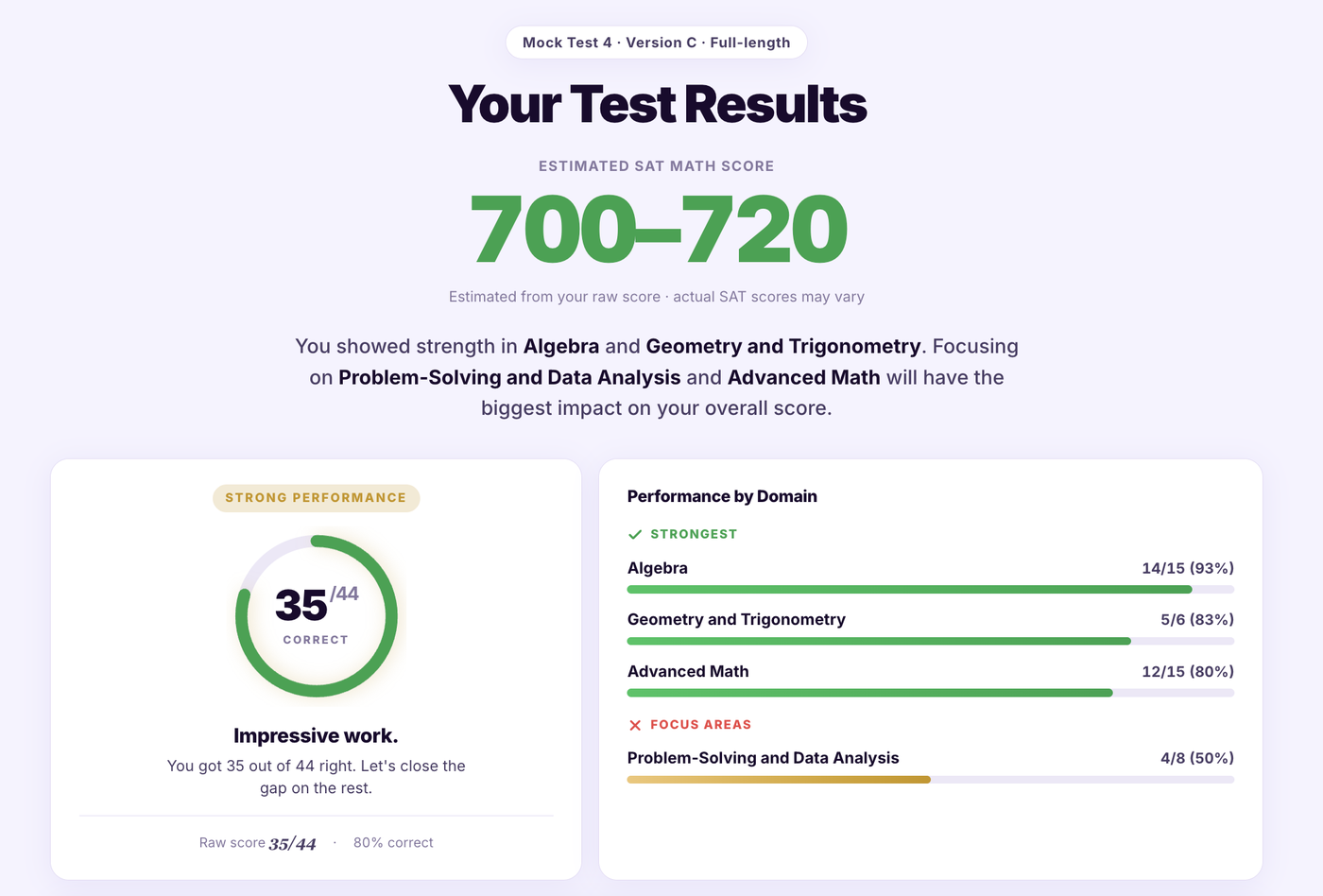
See how the practice tests work →
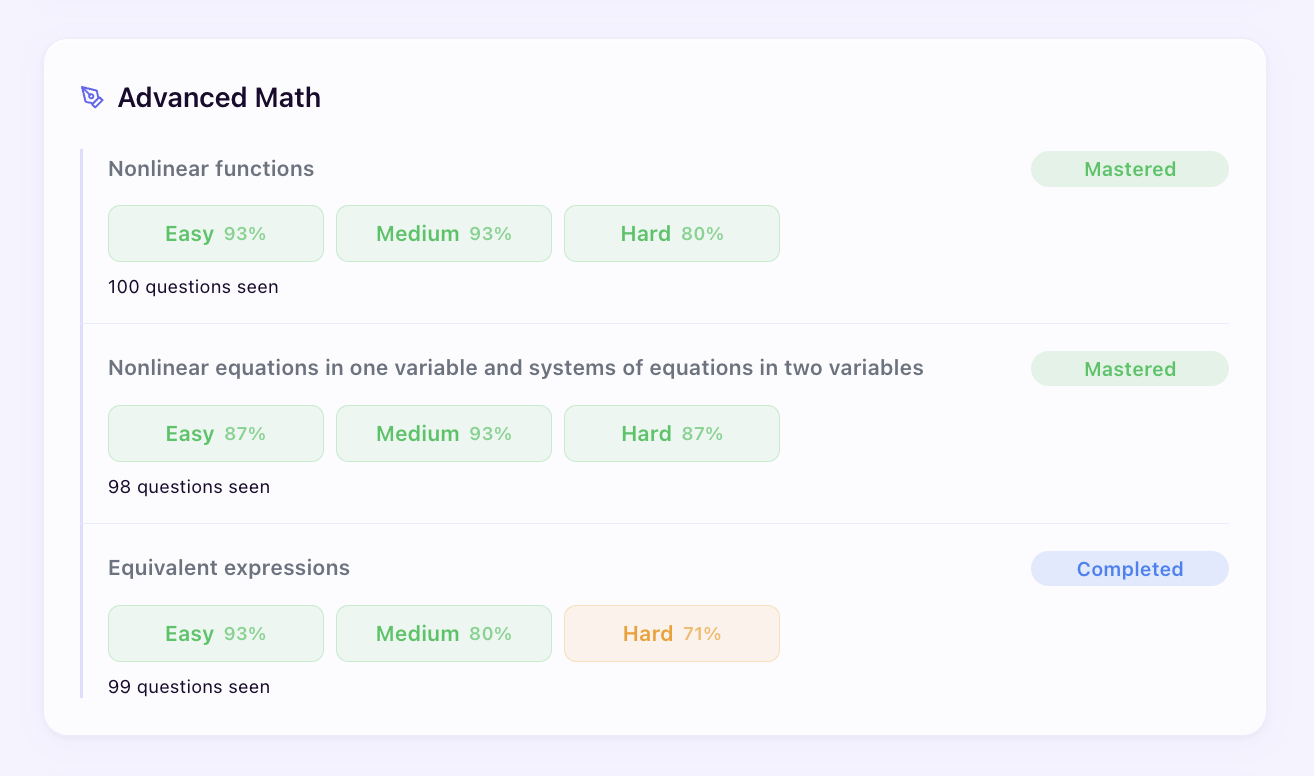
For example Advanced Math breaks into:
- Nonlinear functions (quadratics, exponentials, graphing)
- Nonlinear equations and systems (solving, substitution, elimination)
- Equivalent expressions (factoring, simplifying, manipulating)
Each one has its own set of practice problems at three difficulty levels with video explanations for every problem. So instead of vaguely reviewing "Advanced Math" you're targeting the exact skill at the exact difficulty level where you're losing points.
Turning Bad Feedback Into a Study Plan
Here's a practical way to use your limited SAT feedback:
- Look at your domain bars. Any domain that's not full is a priority. Start there.
- Pick your starting difficulty based on your score. If you're below 600, start with easy problems and work your way up. If you're in the 600 range, start with medium and then move to hard. If you're at 700+ you probably just need to focus on the hard ones.
- Track what you get wrong. Every wrong answer is a data point. Sigma Prep automatically bookmarks every question you get wrong so you can go back and review them anytime. No need to keep a notebook or try to remember what you missed.
The SAT won't give you this level of detail. But the right practice platform will.
Want to see exactly where your weak spots are? Take the free Diagnostic Quiz. It covers problems from across all four domains and shows you exactly which types you're getting right and which need work. When you get one wrong you'll see a video of the fastest way to solve it. No payment required.