If you've looked at SAT Math problems and thought "there's no way I can do this" you're not alone. Almost every student feels that way when they first see the test. The questions look complicated. The math seems hard. It feels like you need to be some kind of genius to get through it.
Here's the truth. The SAT is designed to look harder than it actually is.
Most Problems Are Only a Few Steps
This is the thing that surprises students most when they actually start prepping. The SAT is not a test that requires long complicated calculations. Most problems should only take a few steps to solve. If you're doing a ton of math and filling up your scratch paper with work you're probably approaching it wrong.
The test is designed to see if you understand the concept. If you do the answer usually comes pretty quickly. If you don't you end up going down a rabbit hole of calculations that leads nowhere.
That's the whole game. It's not about being good at hard math. It's about recognizing what the problem is actually asking and knowing the direct path to the answer.
Some Questions Don't Even Require Math
This one really gets students. There are problems on the SAT Math section that are really just reading comprehension questions dressed up with numbers. They give you a scenario, maybe a table or a graph, and ask you what it means. No calculations needed. Just read it, understand it, pick the answer.
But if you don't know that you might sit there trying to set up an equation or do some kind of calculation when the answer is literally just "read the graph." Students waste huge amounts of time on these because they assume every math question requires math.
Desmos Does the Heavy Lifting
For the problems that do require actual math the built-in Desmos calculator can handle most of them faster than you can solve them by hand. Systems of equations? Graph both lines. Quadratics? Plot it and read the answer off the graph. Functions? Plug it in and see.
About 80% of SAT Math problems can be solved faster with Desmos than with algebra. That means the amount of "real math" you actually need to do by hand is pretty small. If you know how to use the tool the test becomes dramatically easier.
Why It Feels So Overwhelming
There's a real reason the test feels harder than it is. When you're seeing problem types for the first time everything looks foreign. You don't recognize the patterns. You don't know the shortcuts. Every question feels like a new puzzle you've never seen before.
That's completely normal. It doesn't mean the math is beyond you. It means you haven't been exposed to enough SAT-specific problems yet to recognize the patterns.
Once you've practiced enough problems in each category something clicks. You start seeing a question and immediately thinking "oh this is a discriminant question" or "this is a slope from two points" or "I can just graph this." The panic goes away because you've seen it before. Maybe not that exact problem but that exact type of problem.
How to Get There Without Losing Your Mind
The key is to start easy and build up. Don't jump straight into hard problems. That's like trying to run a marathon on your first day of training. You'll just feel terrible and want to quit.
- Start with easy problems. These are the same concepts as the hard ones just presented more directly. You'll build confidence and learn the fundamentals without feeling overwhelmed.
- Move to medium. Same concepts but now they're worded differently or require one extra step. You'll notice the patterns from the easy problems showing up again.
- Then tackle hard. By this point you understand the concept. Hard problems just hide it under more layers. But you'll see through it because you know what's underneath.
That progression from easy to medium to hard is exactly how Sigma Prep is structured. Each topic has all three difficulty levels. You're never thrown into the deep end. You work your way there and by the time you get to the hard problems they don't feel impossible anymore because you've built up to them.
Here's what it looks like.
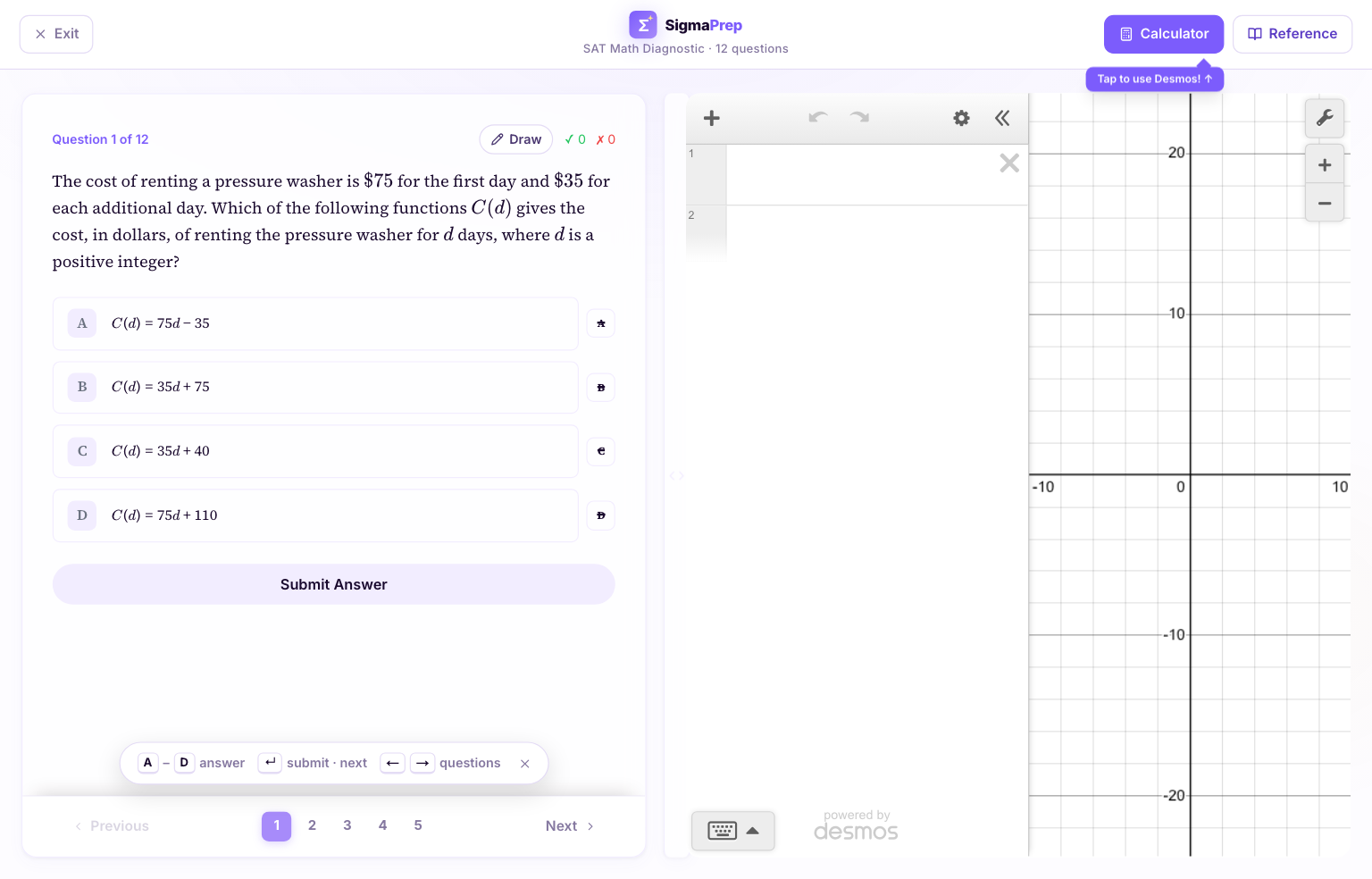
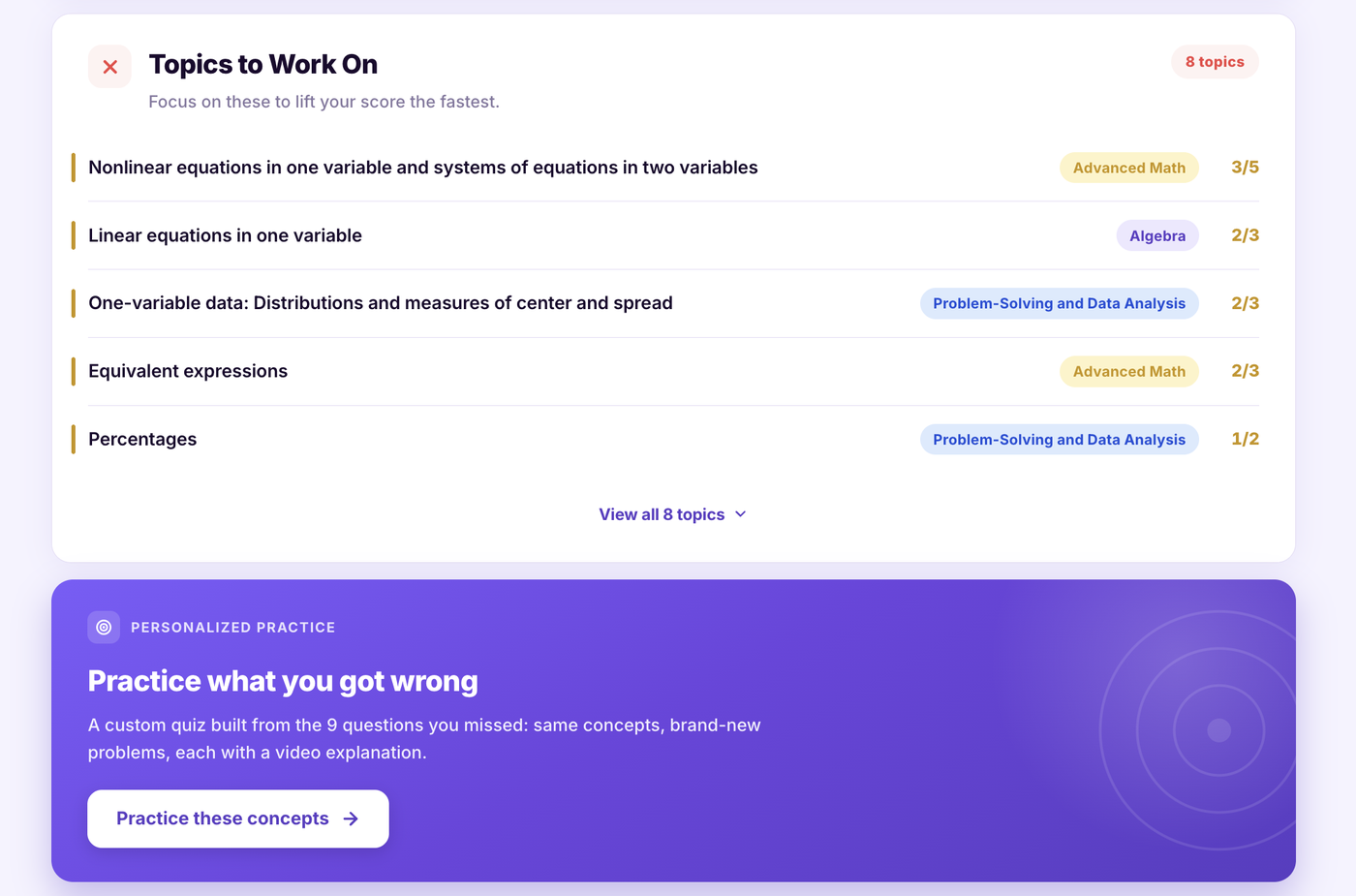
Try the free diagnostic → twelve questions, no card.
It's Not About Being Smart Enough
The SAT is not an intelligence test. It's a skills test. And skills can be learned. Every single problem type on the SAT Math section can be broken down, understood, and practiced until you can do it reliably.
The students who score 750+ aren't math geniuses. They're students who've seen enough problems to recognize the patterns and practiced enough to solve them quickly. That's all it is. Exposure and practice.
If it feels impossible right now that just means you haven't had enough exposure yet. That's fixable.
Want to start? Try the free Diagnostic Quiz. Some of the problems will probably feel hard. That's fine. When you get one wrong watch the video explanation. You'll see how simple the solution actually is once someone shows you the approach. That "oh, that's all it was?" feeling is what the whole prep process is about. No payment required.