Here's what I tell every student I work with. You don't need to grind for 2 hours straight. You need to do 15-20 minutes a day. That's it.
Most students hear "SAT prep" and picture sitting at a desk for hours doing practice problems until their brain melts. No wonder they procrastinate. Nobody wants to do that. I wouldn't want to do that. Even as an adult I don't have the patience to sit through a long lecture. I've been there.
But 15 minutes? That's one quiz. That's completely doable. And here's the thing. 20 minutes a day for a week is over 2 hours of total study time. That's the same as one of those grueling weekly sessions except it works way better.
Why Short Daily Practice Beats Long Weekly Sessions
There's actual science behind this. It's called spaced repetition. When you study something and then come back to it the next day your brain has to actively recall it. That act of recalling strengthens the memory. Do it again the next day and it gets stronger. And again. Each time the recall gets easier and the knowledge sticks longer.
When you cram everything into one long session you feel productive in the moment. You're seeing lots of problems, covering lots of topics. But by the next week most of it has faded. Your brain never had to recall it because you never gave it a gap to forget. So you're basically relearning the same things over and over.
This isn't an opinion. Research on memory and learning consistently shows that distributed practice (short sessions spread over time) produces better long-term retention than massed practice (long sessions done infrequently). For SAT prep specifically this means:
- A student who practices 20 minutes a day 5 days a week will remember more than a student who does 2 hours once a week
- They'll recognize problem types faster on test day because they've been seeing them regularly
- They'll make fewer careless mistakes because the methods are fresh not rusty
The Real Problem Isn't Motivation. It's Friction.
When parents say "my kid won't study" it's usually not that the kid is lazy. It's that the barrier to studying feels too high. Opening a textbook, finding where you left off, figuring out what to work on, reading long explanations when you get stuck. By the time you've set everything up you've already lost the motivation to start.
That's a friction problem not a motivation problem. And it's fixable.
Sigma Prep is designed specifically with this in mind. Open it up, pick a topic, start a quiz. You're doing problems within 30 seconds of logging in. No setup, no figuring out where you left off, no flipping through pages.
Get a question wrong? You don't have to go find the textbook chapter or search for an explanation. There's a video link right there. Watch a 1-2 minute explanation of how to solve that type of problem. Hit "Try Again" to retry a similar one. Done. Move on. (This learn-from-your-mistakes loop is the single most effective way to improve.)
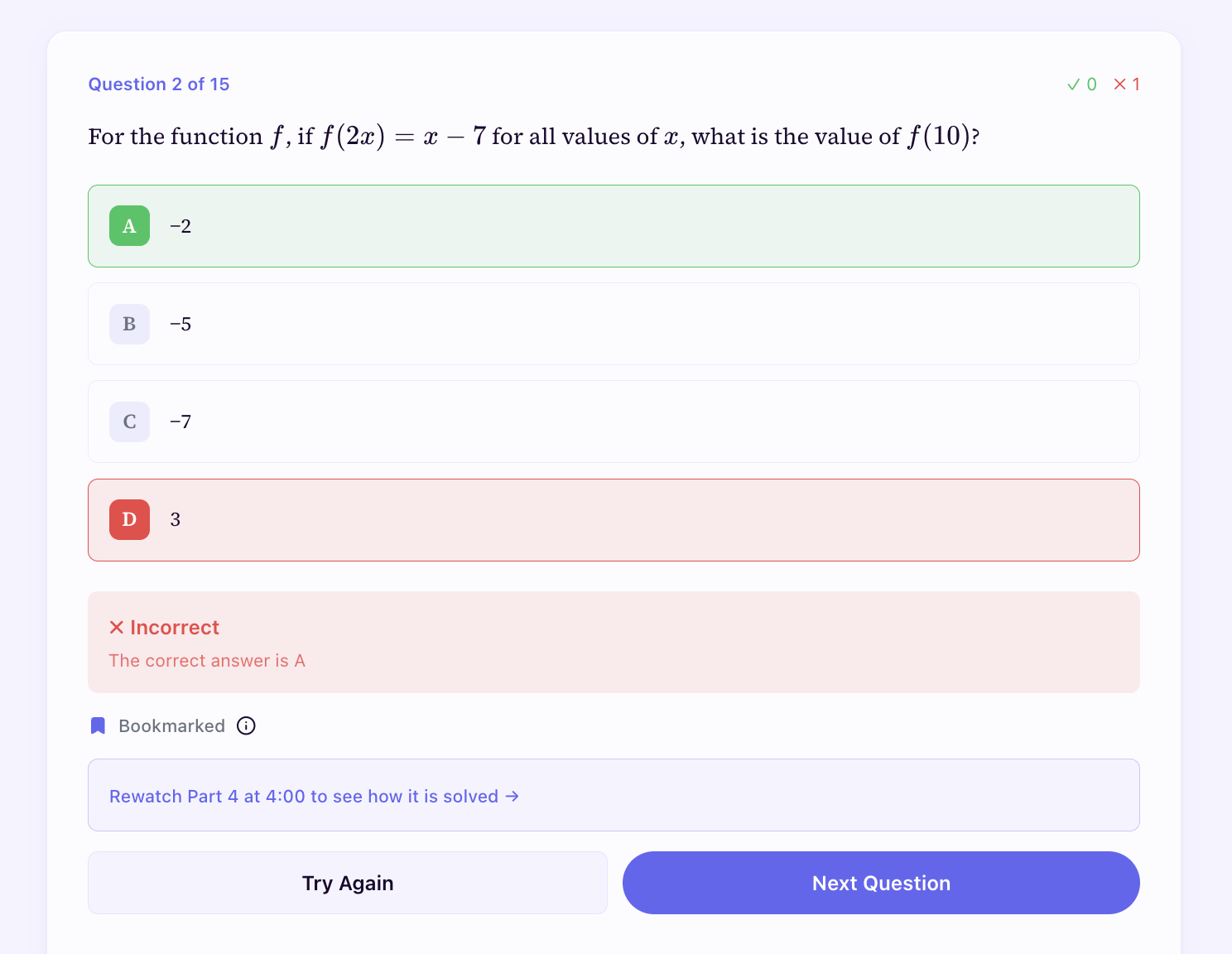
See it in action.
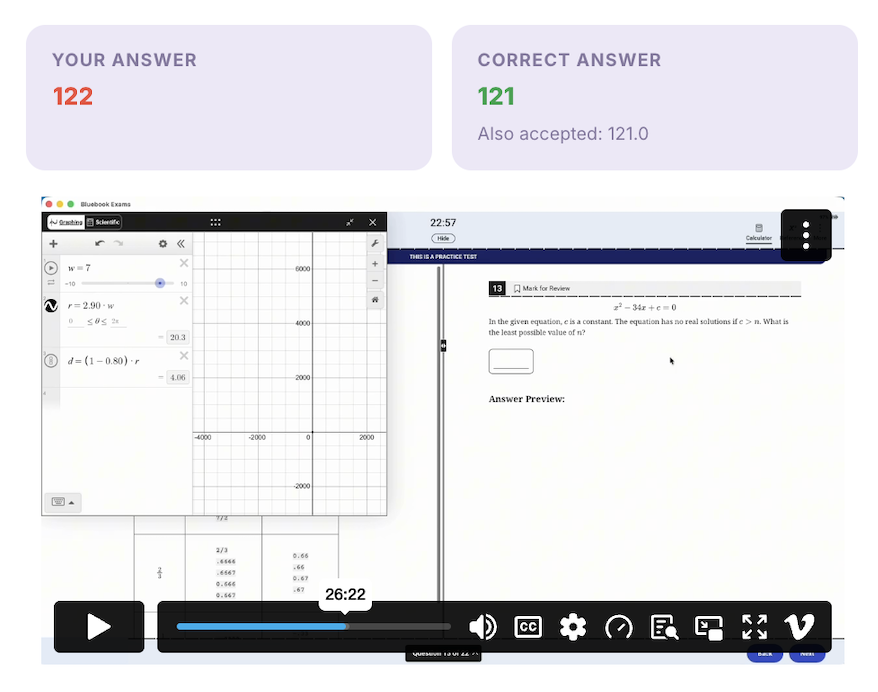
Try the free diagnostic → twelve questions, no card.
No long lectures. No 45-minute video lessons you have to sit through (although full topic video lessons are available in 8-12 minute parts if you want them). The default path is just practice, get feedback, learn from mistakes, repeat. Fifteen minutes and you're done for the day.
What About the Video Lessons?
Some students like to watch the full video lessons before practicing. That's fine and it's a great way to learn a topic from scratch. But we kept them short on purpose. Each lesson is broken into parts that run about 8-12 minutes each. Short enough to hold attention. You can watch one part, practice some problems, and come back tomorrow for the next part.
But honestly? A lot of students skip the lessons entirely and just jump straight into practice. When they get something wrong they watch the 1-2 minute explanation for that specific problem and that's enough to learn the concept. Different students learn differently and the platform works either way.
How Parents Can Help Without Nagging
Nobody wants to be the parent who asks "did you study today?" every single day. That gets old fast for both of you.
A better approach is to use the parent progress dashboard. You get a link you can check anytime. It shows a study activity heatmap so you can literally see which days your child practiced and how much they did. If you see consistent daily activity you know it's working. If you see gaps you have something specific to bring up.
Some parents find it helps to set up a simple agreement with their kid. "Practice for 15 minutes a day and I'll stay out of your hair about it." The dashboard lets you verify without hovering. And when you see a streak of consistent days you can recognize the effort. That positive reinforcement does more for motivation than any lecture about the importance of the SAT.
The Bottom Line
Your kid doesn't have a motivation problem. They have a "this feels like too much" problem. Make it small. Make it daily. Make it frictionless. Fifteen minutes a day, a few practice problems, learn from the mistakes, done. That's genuinely all it takes.
Over 3-4 months of that you're looking at 30+ hours of focused practice. Students improve 100-200 points with that kind of consistency. Not because they grinded for hours but because they showed up for minutes, every day.
Want to try the 15-minute approach? Start with the free Diagnostic Quiz. It takes about 15 minutes and your child will get immediate feedback on every problem. If they like the experience they can start doing a daily quiz. No payment required to try it.