Getting SAT Math Questions Wrong Isn't the Problem. Ignoring Them Is.
Σ
Sigma Prep
SAT Math Instructor · 10+ Years Experience
December 23, 2025·Updated September 7, 2026·9 min read
Here's something I tell every student I work with. I don't care if you got every single question wrong. Seriously. If you can go back, study the ones you missed, understand why you got them wrong, and explain how to solve 80% of them? You're going to do great.
Because next time you see those same types of problems you're much more likely to get them right. And maybe next time you only get 40% wrong. Master most of those and maybe the time after that it's only 10%. That's how improvement actually works. It's not about being perfect on your first try. It's about shrinking the list of things you don't know.
The problem is most students don't do this.
The Most Common SAT Math Mistakes I See
After 10+ years of tutoring I've seen the same mistakes come up over and over. These aren't rare edge cases. These are the ones that cost students points on almost every single test. If you're prepping for the SAT you will make some of these. The question is whether you'll catch them before test day.
1. Solving for the Wrong Variable
This one is painfully common. You solve a system of equations, get x = 3, feel great, bubble in C, and move on. But the question asked for 2x + 1. The answer was 7. You solved for x when they wanted an expression involving x. Students lose points on this all the time and it has nothing to do with math ability. It's a reading problem disguised as a math problem. Always re-read the question before you pick your answer.
One that asks for something other than x:
Linear equations in one variable · Hardanswer D
If 5x+8=17x+8, the value of x+8 is between which of the following pairs of values?
The SAT loves negative questions. "Which of the following is NOT a solution?" or "Which statement is NOT supported by the data?" Your brain is in problem-solving mode, you find an answer that works, and you pick it. But they asked for the one that doesn't work. I've watched students get a problem completely right mathematically and still miss it because they answered the opposite of what was asked. Circle the word NOT every single time you see it.
The word that flips the question:
Circles · Hardanswer B
A circle in the xy-plane has equation (x−2)2+(y+3)2=16. Which of the following points does NOT lie in the interior of the circle?
A problem gives you a rate in minutes and asks for the answer in hours. Or gives measurements in feet and asks for inches. Students solve the whole problem correctly with the wrong units and get an answer that's off by a factor of 60 or 12 or whatever the conversion is. The worst part is the wrong answer is almost always one of the choices. The SAT puts it there on purpose because they know students make this mistake.
Two conversions in one question:
Ratios, rates and units · Hardanswer B
The speed of a sled is increasing at a rate of 8.6 meters per second squared. What is this rate, in miles per minute squared, rounded to the nearest tenth? (Use 1 mile =1,609 meters.)
Students will spend 3 minutes doing algebra by hand on a problem that Desmos could solve in 15 seconds. Systems of equations, finding intercepts, checking which equation matches a graph, solving quadratics. The built-in Desmos calculator handles all of these. I've seen students who know how to use Desmos still default to pencil and paper because "it feels like cheating" or because they forget it's there under pressure. It's not cheating. It's on the test for a reason. Use it.
5. Rushing Through Word Problems and Missing Key Constraints
Word problems bury important information in the middle of the paragraph. "The company can produce at most 500 units per day" or "x must be a positive integer." Students skim, grab the numbers, set up an equation, and solve. They get a mathematically correct answer that violates one of the constraints they skipped over. Then they see their answer in the choices and pick it confidently. Slow down on word problems. Read every sentence. The constraint you missed is the whole point of the question.
Two constraints, both easy to skim past:
Percentages · Hardanswer 20.7
The number a is 130% greater than the number b. The number b is 85% less than 60. What is the value of a?
This sounds obvious but it's worth calling out because of how often it happens. You know the concept. You set up the equation right. And then you multiply 7 x 8 and get 54 instead of 56 and everything after that is wrong. Or you distribute a negative sign and miss one term. These aren't knowledge gaps, they're pressure mistakes. And they're the hardest to fix because students think "I just need to be more careful" without actually changing anything about how they work. The fix is to use Desmos for arithmetic whenever possible and to build in a quick sanity check before submitting: does this answer make sense given the problem?
7. Picking the Trap Answer That Solves Half the Problem
The SAT is really good at this. They design problems where if you do step 1 correctly but forget step 2 you get one of the wrong answer choices. It's not a random wrong answer. It's the answer you'd get if you stopped too early. For example a problem might ask for the total distance of a round trip. You calculate the distance one way, see your number in the choices, and pick it. But you needed to double it. The test makers know exactly where students stop short and they put that intermediate answer right there waiting for you.
Recognizing these patterns is half the battle. The other half is building the habit of catching them before you submit your answer. That only comes from practice, specifically from getting these wrong, understanding why, and training yourself to watch for them next time.
The half-solved trap: one of the wrong choices is exactly where a student stops early.
Nonlinear equations and systems · Hardanswer C
One solution to the given equation can be written as 1+k, where k is a constant. What is the value of k?
The Mistake Most Students Make With Their Mistakes
Here's what typically happens. A student takes a practice quiz or a practice test. They check their score. They feel good or bad about it. And then they move on to the next thing.
Maybe they glance at the ones they got wrong. Maybe they read the explanation once. But they don't actually sit with it. They don't try to understand why they got it wrong. They don't practice similar problems to make sure it actually clicked. They just keep going.
And then two weeks later they see the same type of problem on another quiz. And they get it wrong again. Same mistake, different numbers.
This is the single biggest waste of time in SAT prep. Repeatedly getting the same types of problems wrong because you never actually learned from the first time.
Why This Keeps Happening
It's not because students are lazy. It's because most study tools make it really hard to go back and review what you got wrong. Think about it:
On a practice test you might circle the ones you missed but then what? The test is done. You move on.
On most apps you finish a set of questions and the results disappear into some history page you never check.
Even if you write down what you got wrong, going back and finding similar practice problems on that specific topic is a pain.
And even when you do try to review, the explanations aren't great. The SAT's own feedback is surprisingly limited and College Board's practice tests give you text-only explanations that always show the algebraic way to solve it. Even when the problem could be solved in 10 seconds by plugging it into Desmos they'll walk you through the long algebraic approach. So you read it, kind of get it, and move on without ever learning the faster method.
The friction is too high so students skip the most important step.
What Actually Works
The students who improve the fastest are the ones who treat wrong answers as the starting point, not the end. When they get something wrong they:
Understand why. Not just "oh I picked the wrong answer" but understanding what the correct approach is and why their approach didn't work.
Watch or read an explanation. See how someone who knows this cold would solve it.
Try a similar problem. Not the same problem with the answer memorized. A different problem that tests the same concept but with different numbers and context.
Do it again later. Come back to that topic in a few days and see if it sticks.
If you do this consistently the list of things you get wrong shrinks fast. There are only so many types of problems on the SAT. It's a finite set of skills. Master them and you run out of things to get wrong.
How We Built This Into Sigma Prep
This is one of the things we thought about most when building the platform. We wanted to make the "learn from your mistakes" process as easy as possible so students would actually do it.
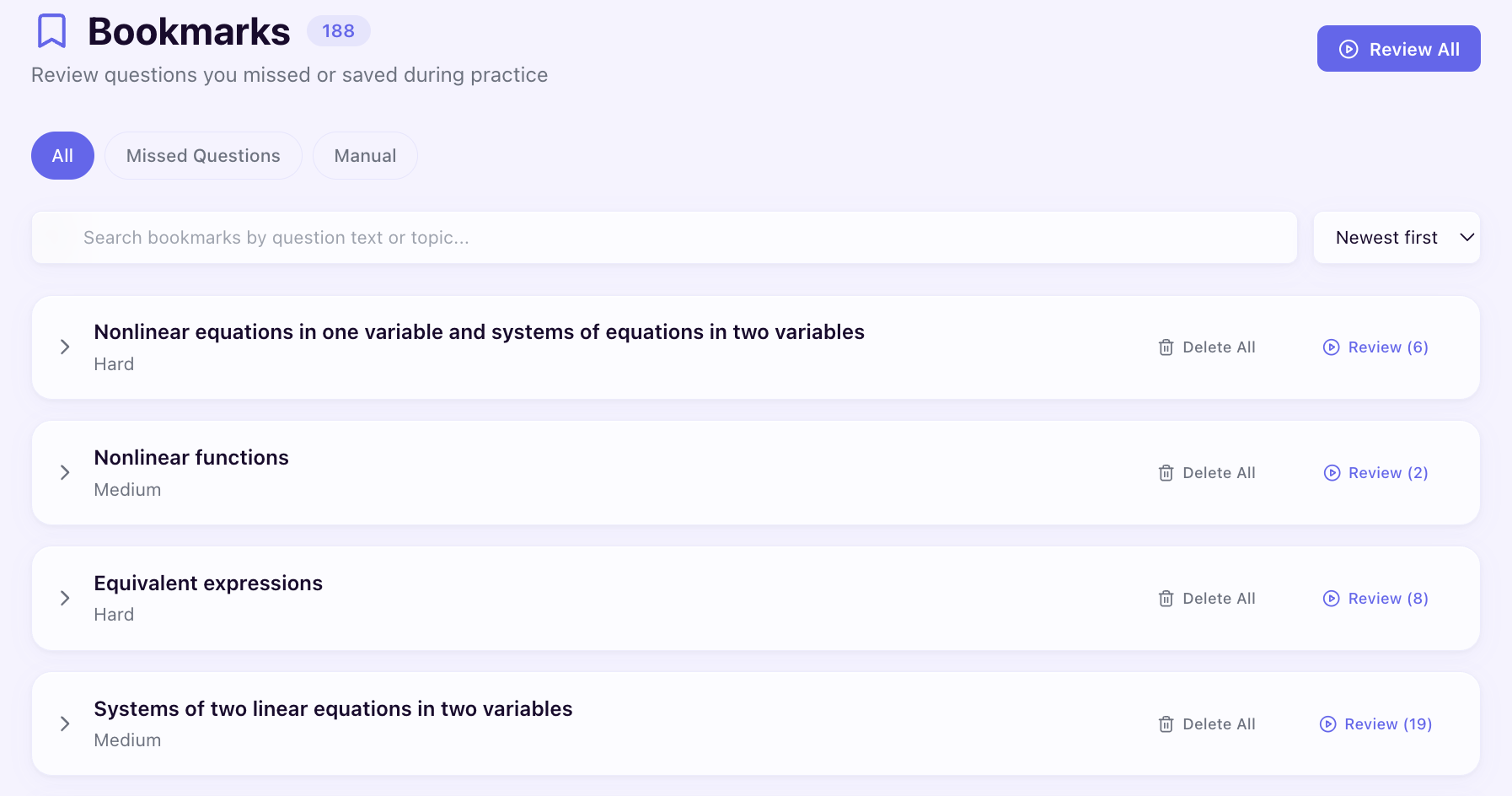
Auto-bookmarking. Every question you get wrong is automatically saved to your bookmarks. You don't have to write anything down or remember to screenshot it. It's just there waiting for you to review whenever you're ready. You can sort by newest, oldest, difficulty, or topic. You can even search by keywords if you remember a specific problem you want to find.
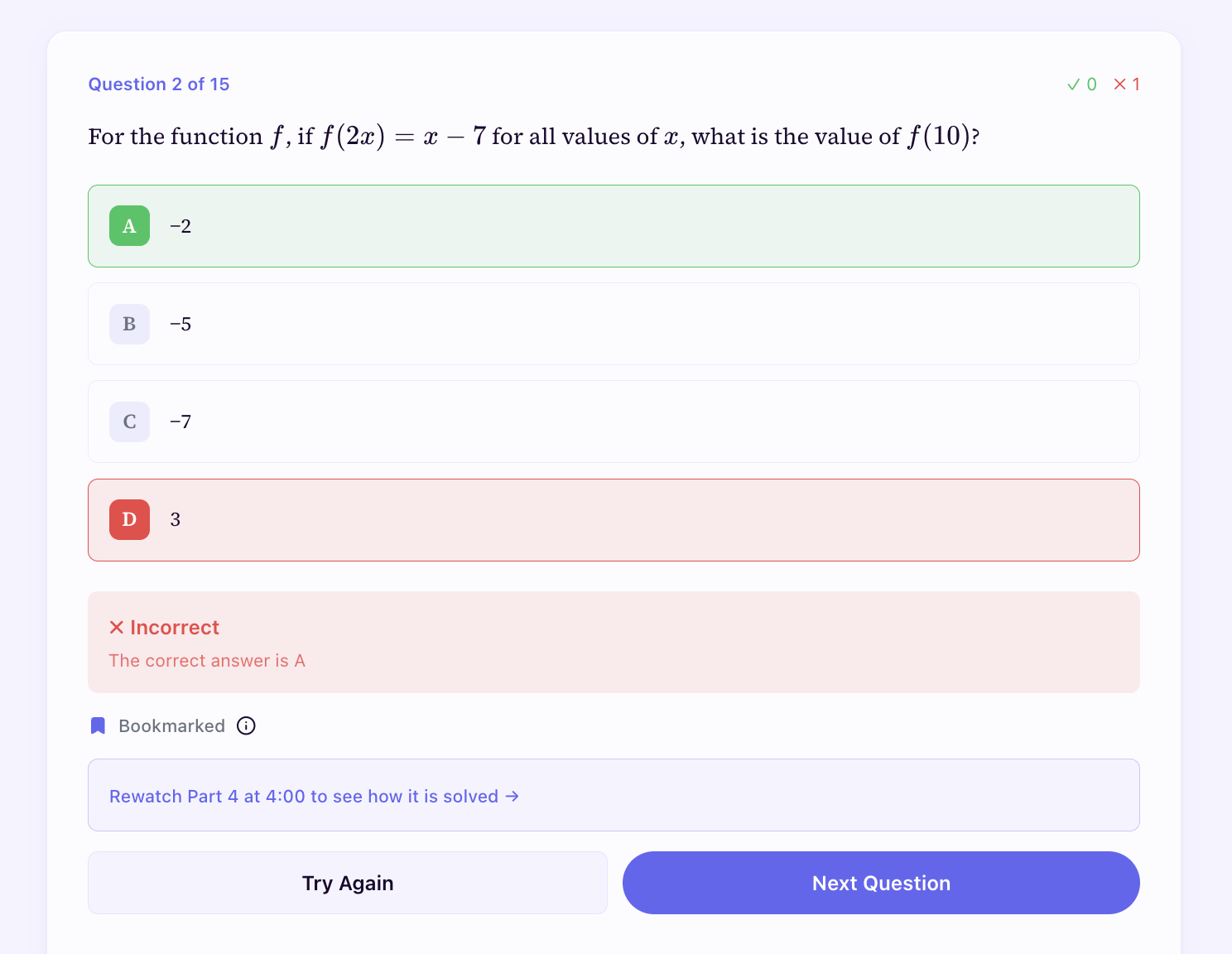
Video explanations for every problem. When you get a question wrong you can immediately watch a video showing the fastest way to solve that type of problem. Not a generic lesson on the topic. A video solving a nearly identical problem step by step so you can see exactly where your approach went wrong. And then you can hit "Try Again" right there to retry a similar problem on the spot. You find out immediately whether it clicked or not.
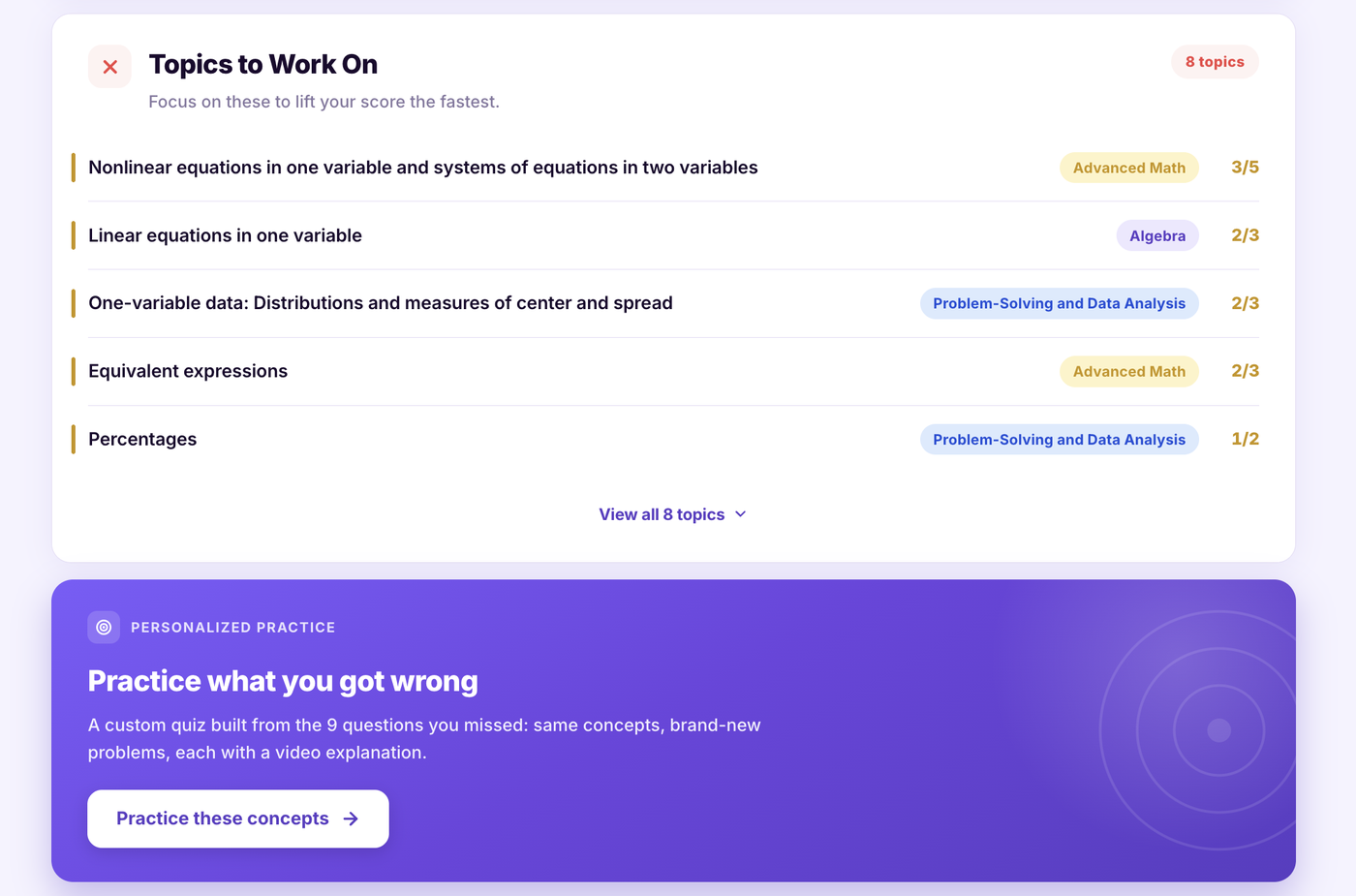
See this in action.
Topics to work on, ranked, and a practice set built from your misses.
Enough practice to actually master it. This is where having 7,000+ problems matters. For each subtopic at each difficulty level you can take about 5 different quizzes without seeing the same exact problem twice. Same type of question but different context and numbers every time. So you'll know if you actually learned it or if you just memorized one specific problem.
That's the difference between "I remember the answer to that question" and "I understand how to solve this type of problem." The first one is useless on test day. The second one is what raises your score.
The Math Behind Mastering Your Mistakes
Let's say you take a practice quiz and get 8 out of 15 right. That's 7 wrong. Feels bad right? But look at what happens if you actually study those 7:
You review all 7. You understand 5 of them after watching the explanations. 2 are still shaky.
Next quiz on the same topic you get 11 out of 15. Now only 4 wrong. And 2 of them are new types you haven't seen before.
You review those 4. Next quiz you get 13 out of 15.
One more round and you're at 14 or 15 out of 15.
That topic is now mastered. Move on to the next one. Repeat the process. Your score goes up not because you got smarter but because you systematically eliminated the things you didn't know.
Getting Things Wrong Is the Point
If you're getting every question right on your practice quizzes you're not being challenged enough. You're reinforcing what you already know which feels productive but isn't moving your score.
The questions you get wrong are the ones with all the value. They're showing you exactly what stands between your current score and your target score. The only waste is ignoring them.
Want to try this approach?Take the free Diagnostic Quiz. Get some questions wrong on purpose if you want to. Then watch the video explanations and see if you can understand how to solve them. That's the whole process. No payment required.
Common Questions
Solving for the wrong thing, such as finding x when the question asked for 2x + 1, and misreading negative questions like "which of the following is NOT." Both are reading errors dressed up as math errors, and both are fixed by re-reading the question before you answer. The biggest mistake of all is never going back to the problems you missed.
For every miss, figure out why: concept, misread, timing or careless. Then solve a fresh problem of the same type until you could explain the method to someone else. If you can explain 80% of your misses, your next test will show it.
No. Misses are your study list. Improvement is shrinking that list: get 40% wrong, master most of those, then 10%, then fewer. Being perfect on the first try was never the goal.
Want more SAT tips like this?
One article a week. No spam.
Ready to raise your SAT Math score?
Take the free Diagnostic Quiz and see where you stand. No payment required.