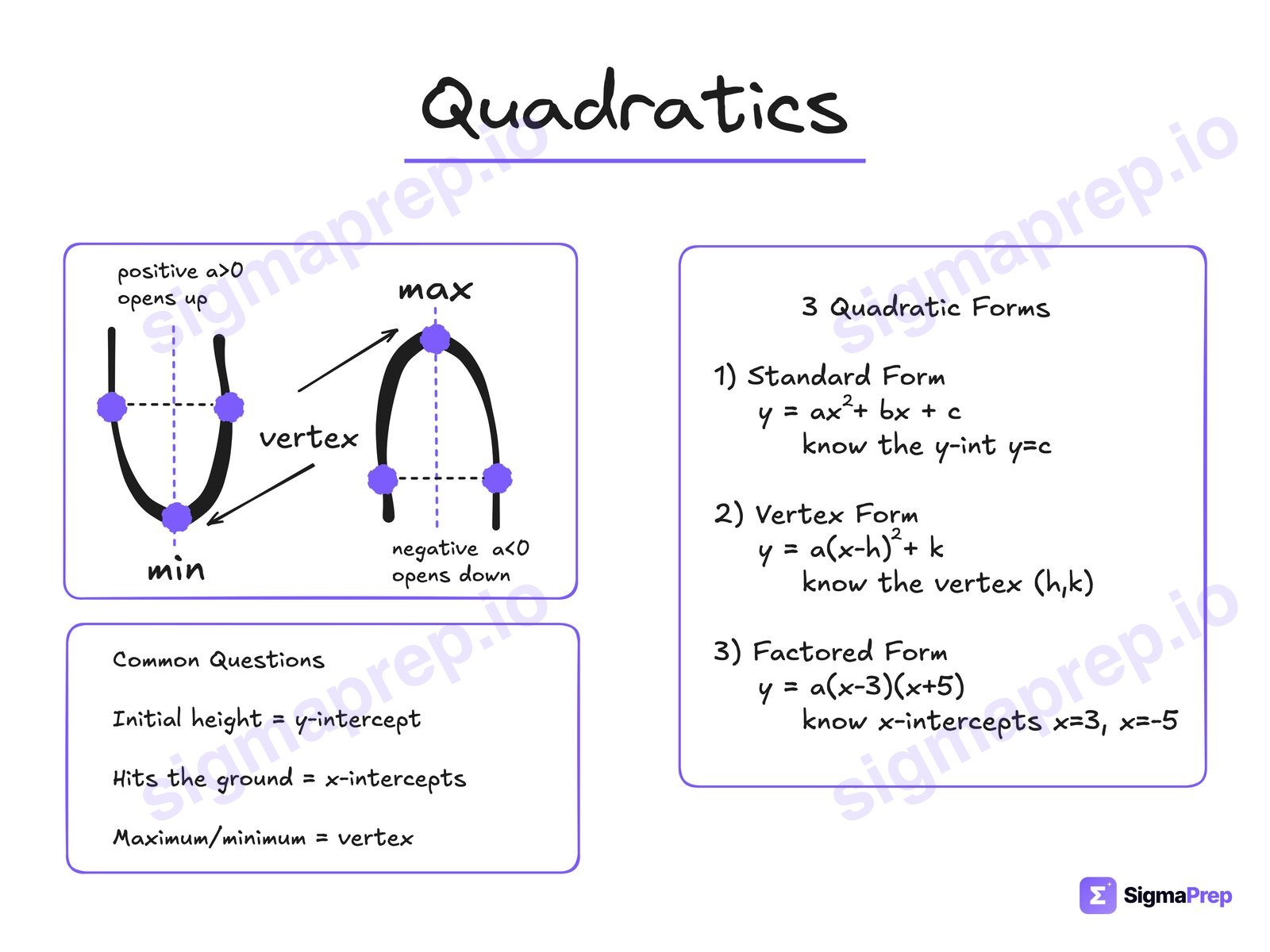
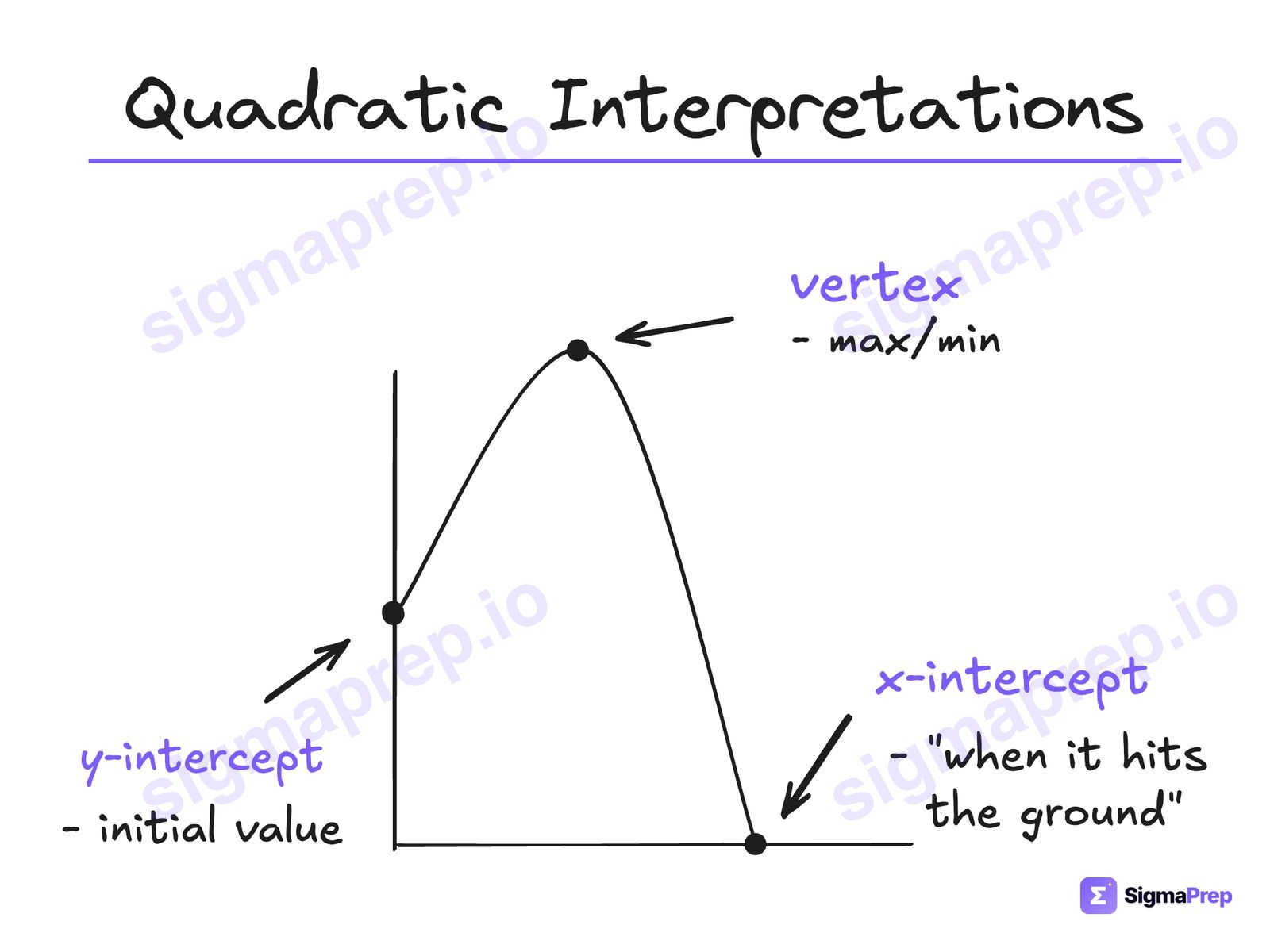
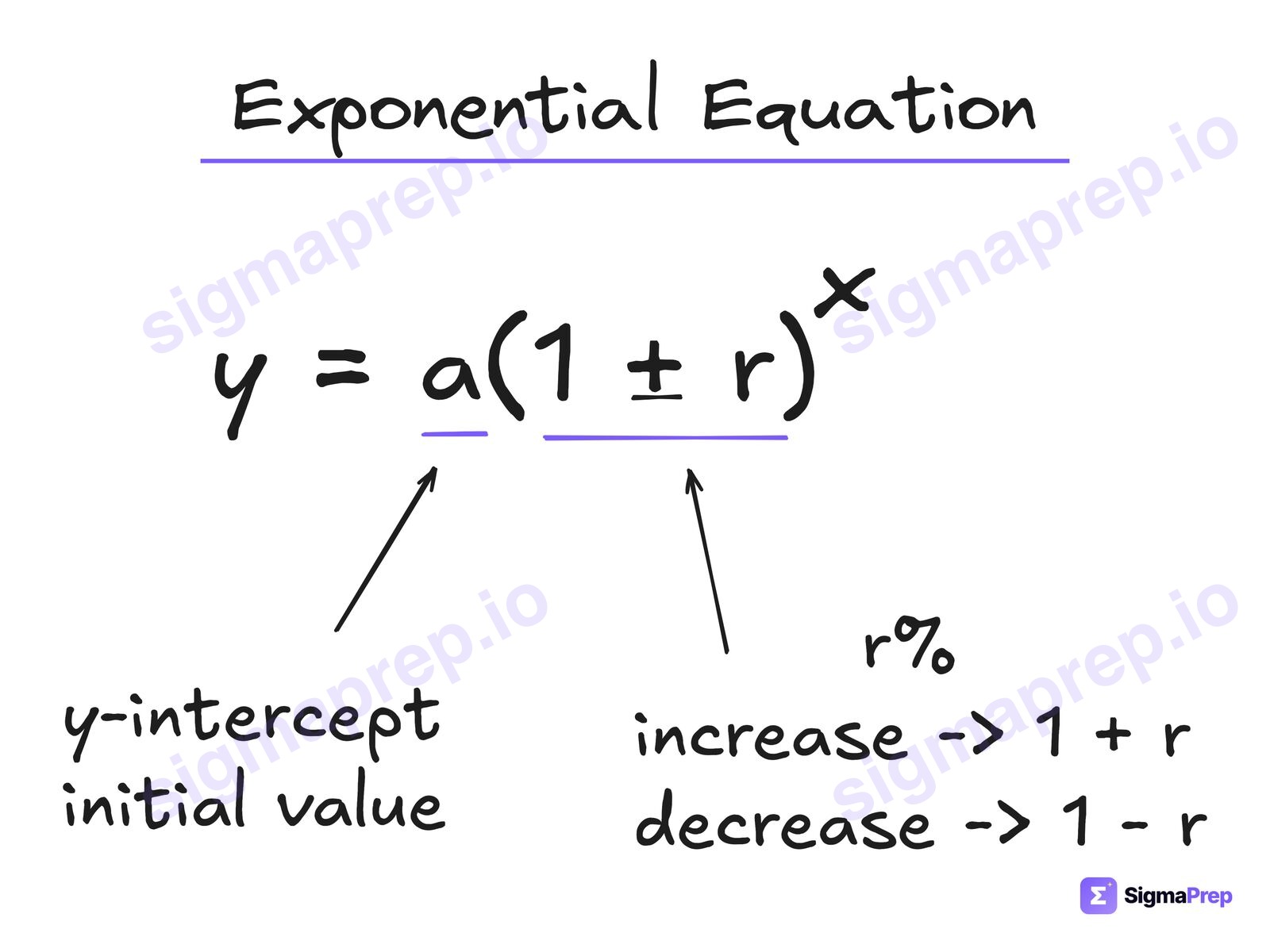
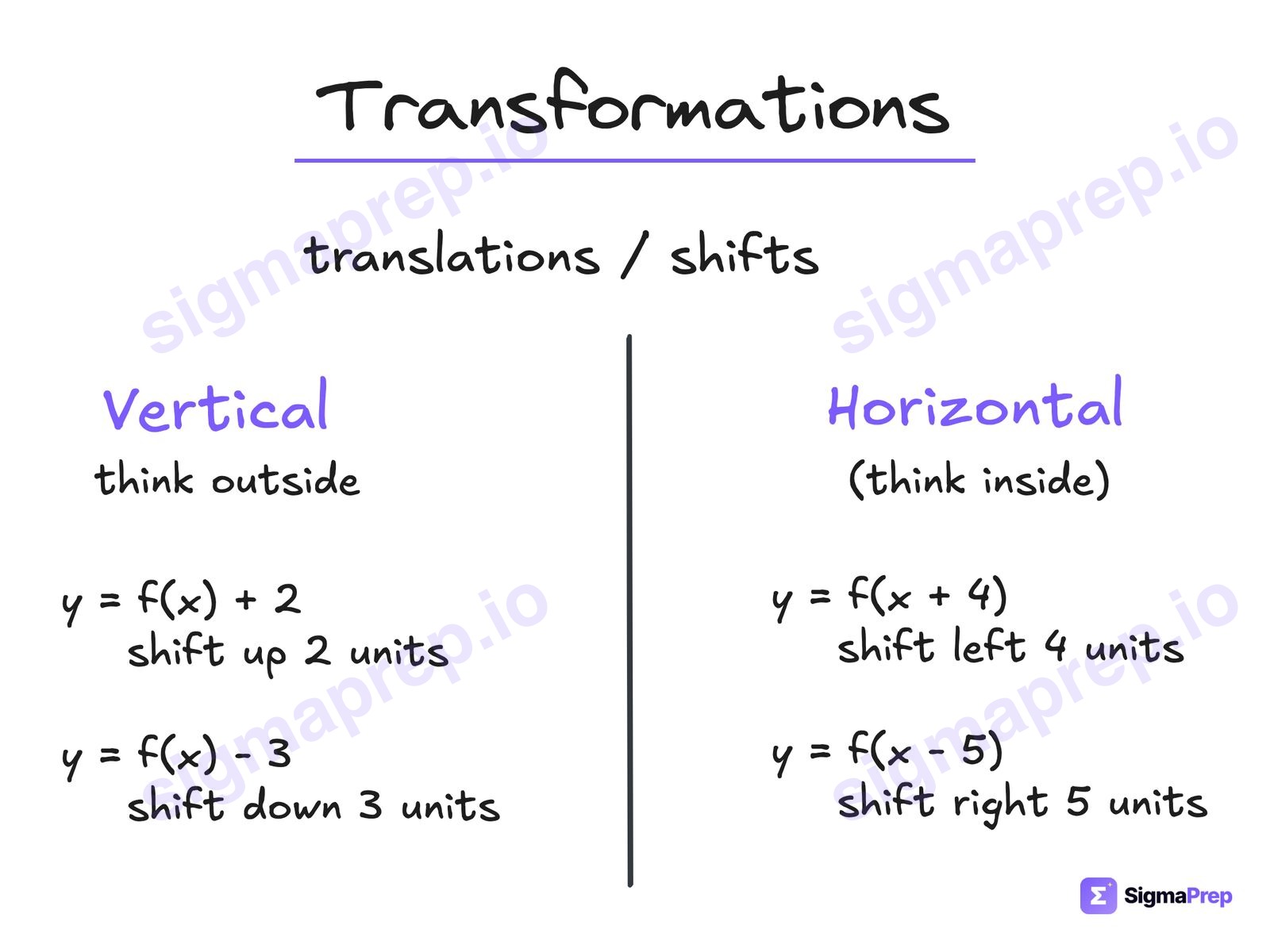
8. QuadraticsKnow the 3 quadratic forms and what information each one gives you. Know the common questions and what they represent in context. Understand symmetry through the vertex of a quadratic.Worked example in the app →9. Quadratic InterpretationsThree points they ask about: the y-intercept is the "starting value," the x-intercept is when it "hits the ground," the vertex is the "max or min." Those are the kinds of words to listen for; they are not always word for word.Worked example in the app →11. Exponential EquationTwo things to know: the number in front is the initial value, and the number inside the parentheses, with the exponent, represents the increase or decrease (usually in terms of percent).Worked example in the app →12. TransformationsThey only really test you on shifts. Vertical, think outside. Horizontal, think inside. Vertical is intuitive: f(x) + 5 means up 5. Horizontal is counterintuitive: f(x + 5) means left 5, not right 5.Worked example in the app →
Advanced Math is about 35% of SAT Math, 13 to 15 questions, and nonlinear functions are the biggest piece of it. The test is basically three functions: linear, quadratic and exponential. This skill is the second and third. Almost every question is one of six moves, and Desmos does the arithmetic on all of them if you know what to type.
The two sentences that sort them
Percent increase or decrease means exponential: the number in front is the starting value and the number in the parentheses is 1 plus or minus the rate. Anything about a maximum, a minimum, or "hits the ground" means quadratic, and the three points they ask about are the y-intercept (starting value), the x-intercept (when it hits zero), and the vertex (the max or min).
The six ways the SAT asks it
1. Evaluate the function
Nonlinear functions · Easyanswer A
The function f is defined by f(x)=7+x. What is the value of f(196)?
Plug in and simplify: the square root of 196 is 14, plus 7 is 21. Type f(196) into Desmos if you do not trust the arithmetic. The only way to miss it is to forget the 7.
2. Write the exponential model
Nonlinear functions · Mediumanswer D
A blog has 2,500 visitors. The blog owner expects the number of visitors to increase by 5% each month for the next 18 months. Which equation best models this situation, where v is the estimated number of visitors m months from now?
"Increase by 5% each month" is the sentence. Starting value 2,500, growth factor 1 + 0.05, exponent is the months: v = 2,500(1.05)^m. The wrong choices use 0.05, 1.5 or 5 as the factor. If it were a decrease of 5%, the factor would be 0.95. That one rule covers every exponential question on the test.
3. Where the vertex is
Nonlinear functions · Hardanswer C
The function f is defined by the given equation. For what value of x does f(x) reach its minimum?
Factored form hands you the x-intercepts, 30 and 34, and a parabola is symmetric, so the vertex sits exactly halfway between them at x = 32. No expanding, no formula. When the zeros are not visible, type the function into Desmos and click the vertex. Read the question twice: they usually want the x-value, and the y-value is sitting right next to it as a trap.
4. Interpret the vertex, the intercept, or the zero
Nonlinear functions · Hardanswer D
The given function f(x) gives a metal ball's height above the ground f(x), in inches, x seconds after it started moving on a track, where 0≤x≤20. Which of the following is the best interpretation of the vertex of the graph of y=f(x) in the xy-plane?
f(x)=161(x−5)2+4
AThe metal ball's height was 5 inches when it started moving
BThe metal ball's minimum height was 5 inches
CThe metal ball's height was 4 inches when it started moving
Vertex form: the vertex is (5, 4), so the minimum height is 4 inches, reached at 5 seconds. Two choices say "minimum," and only one uses the height. The x-coordinate is seconds and the y-coordinate is inches; the trap is picking the 5. Same structure every time: y-intercept is the starting value, x-intercept is when it hits the ground, vertex is the max or min.
5. Transformations
Nonlinear functions · Hardanswer C
The function f is defined by the given equation. The function g is defined by g(x)=f(x+3). For what value of x does g(x) reach its minimum?
They only really test shifts. Outside the parentheses is vertical and intuitive: f(x) + 5 is up 5. Inside is horizontal and backwards: f(x + 3) is left 3, not right. The minimum of f is at x = −7, so the minimum of g is at −10. Or type both functions into Desmos and click the minimum of g, which takes ten seconds and cannot go wrong.
6. The x-intercepts from factored form
Nonlinear functions · Mediumanswer 3
In the xy-plane, what is an x-intercept of the graph of the given equation?
Each factor set to zero is an intercept: x = −9 or x = 3. Either one counts as an answer here. The sign flips just like the circle equation: (x + 9) gives −9. If the function is not factored, Desmos shows both crossings the moment you type it in.
Try one
This is a real question from our Nonlinear Functions · Medium set. Solve it the fast way, then watch how I do it.
try one · Nonlinear functions · Medium
The equation y=3(2)x+5 relates the variables x and y. For the ordered pairs (1,11), (2,17), and (3,a), what is the value of a?
Where the points actually go
Using 0.05 instead of 1.05, shifting right when the question says left, and answering with the wrong coordinate of the vertex. None of it is hard math. It is a set of conventions, and conventions stick through repetition, not explanation.
The app has 700 nonlinear function questions, 182 easy, 210 medium and 308 hard, every one with a video explanation. The free diagnostic shows whether this topic is where your points are going.
Common Questions
Starting value times (1 + rate) to the power of the time variable for growth, (1 − rate) for decay. "2,500 visitors increasing 5% per month" is v = 2,500(1.05)^m. The number in front is always the value at time zero.
If the function is factored, the vertex is halfway between the two x-intercepts. If it is in vertex form a(x − h)² + k, the vertex is (h, k). Otherwise type it into Desmos and click the highest or lowest point.
Shifts it 3 units to the left. Changes inside the parentheses are horizontal and go the opposite direction of the sign; changes outside, like f(x) + 3, are vertical and go the way the sign says.
Nonlinear functions are the largest skill in Advanced Math, which is about 35% of the Math section, 13 to 15 questions. Expect several per test, with the interpretation and transformation versions in the harder second module.
Want more SAT tips like this?
One article a week. No spam.
Ready to raise your SAT Math score?
Take the free Diagnostic Quiz and see where you stand. No payment required.