By Test 9, one score means less than the spread of your last three. Scores of 680, 730 and 690 do not mean you improved and then got worse. They mean you are scoring around 700, and your result moves 20 or so points either way from one sitting to the next.
That movement is normal, and it is not always about what you know. Each test has its own curve, you might make one or two more careless mistakes on one day than another, and a guess or two can go your way on one test and not the next. So a dip does not mean your prep stopped working, and a jump does not mean you have locked in a new score. Watch the range over several tests.
Then review Test 9 the usual way: for each miss, decide whether it was a type you did not know or a point you gave away, and use the clips below for the first kind. The full review method is in the Test 4 post.
All 44 Practice Test 9 Math Questions, One at a Time
Every math question from official Practice Test 9, in order, as it appears in the walkthrough. Each one has the correct answer, how it's solved, and a clip of just that question.
Module 1
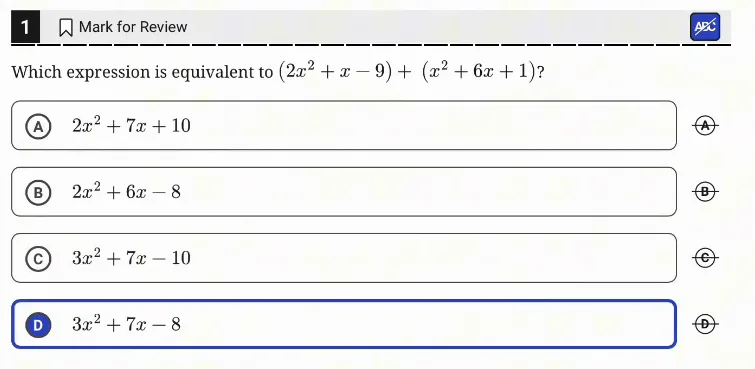
1
Practice Test 9, Module 1, Question 1Equivalent expressions
Answer D
How it's solved: Combine like terms by hand. Graphing the expression and the choices in Desmos shows which one overlaps.
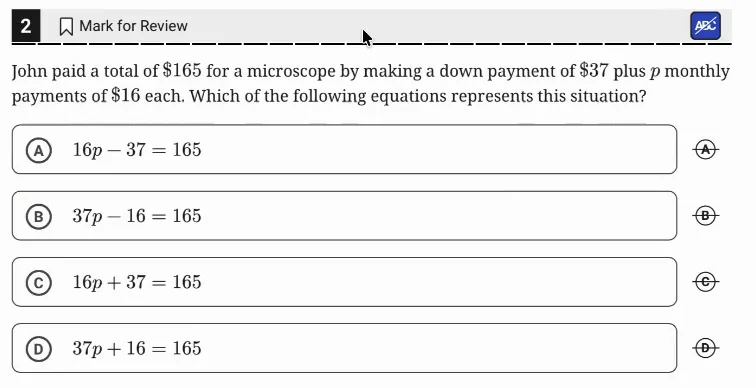
2
Practice Test 9, Module 1, Question 2Linear equations in one variable
Answer C
How it's solved: Translate the sentence: a one-time amount plus the per-period amount times the count equals the total.
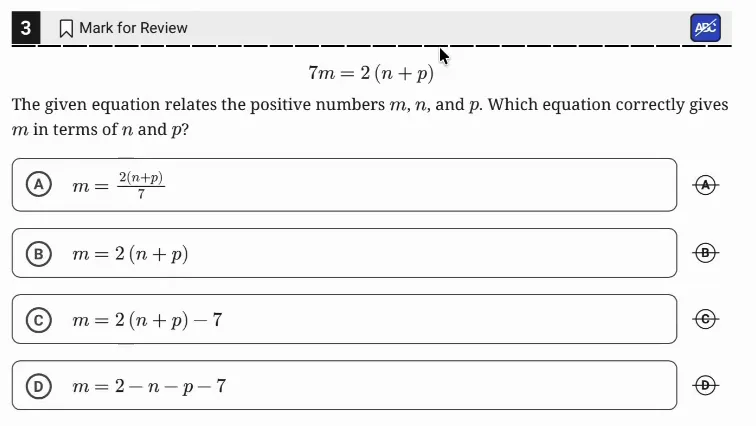
3
Practice Test 9, Module 1, Question 3Nonlinear equations in one variable and systems of equations in two variables
Answer A
How it's solved: Divide both sides by the coefficient to isolate the requested variable.
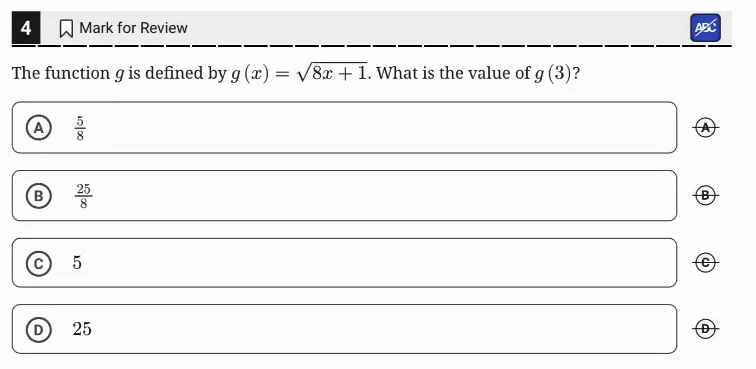
4
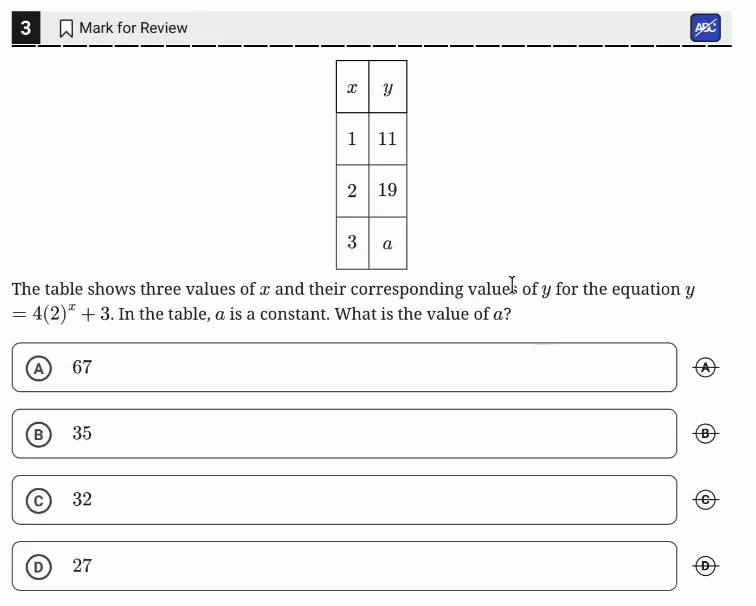
Practice Test 9, Module 1, Question 4Nonlinear functions
Answer C
How it's solved: Define the function in Desmos and evaluate it at the given input.
5
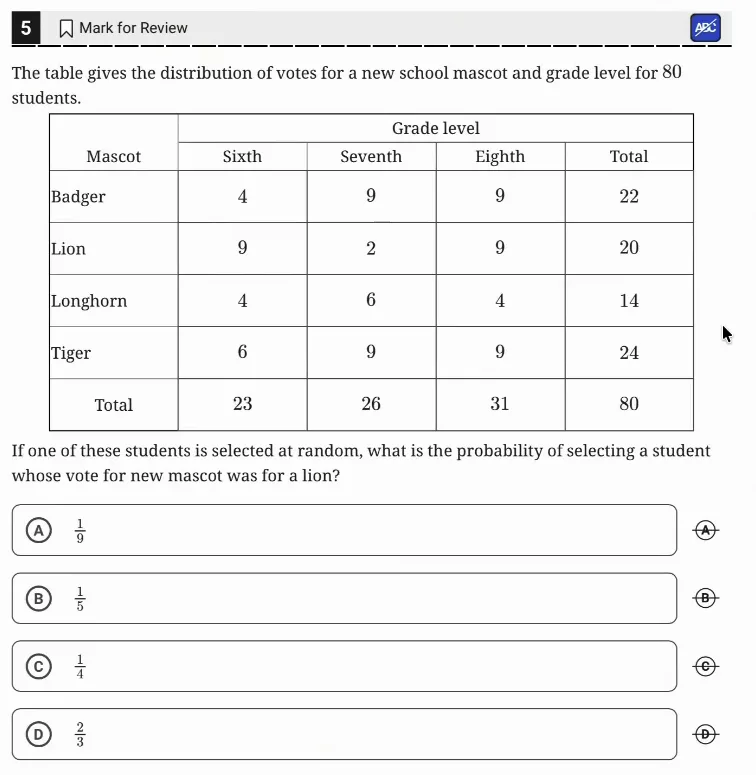
Practice Test 9, Module 1, Question 5Probability and conditional probability
Answer C
How it's solved: Probability is favorable over total. Read the matching cell from the table, put it over the grand total, and reduce.
6
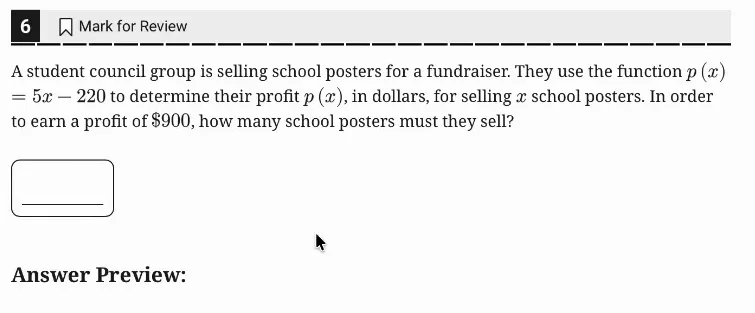
Practice Test 9, Module 1, Question 6Linear functions
Answer 224
How it's solved: Set the profit function equal to the target amount and let Desmos solve for x.
7
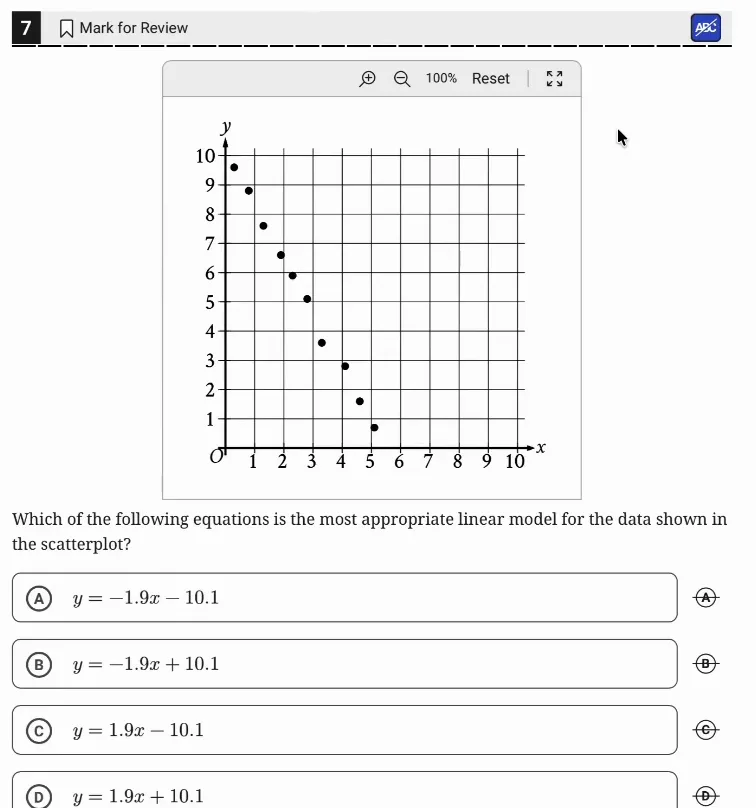
Practice Test 9, Module 1, Question 7Two-variable data: models and scatterplots
Answer B
How it's solved: Estimate two points on the trend, add a Desmos table, and run a linear regression. Pick the closest equation.
8
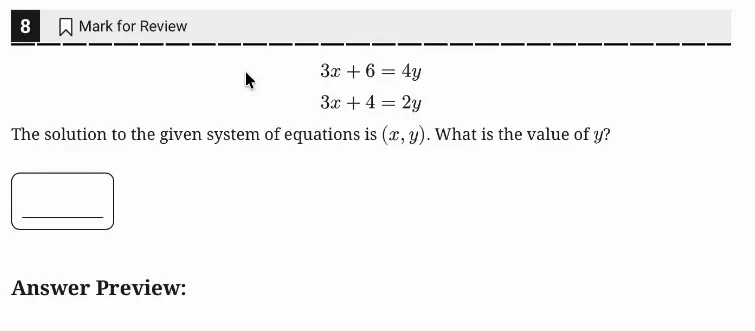
Practice Test 9, Module 1, Question 8Systems of two linear equations in two variables
Answer 1
How it's solved: Desmos handles it: enter both equations as written and read the y-coordinate of the intersection.
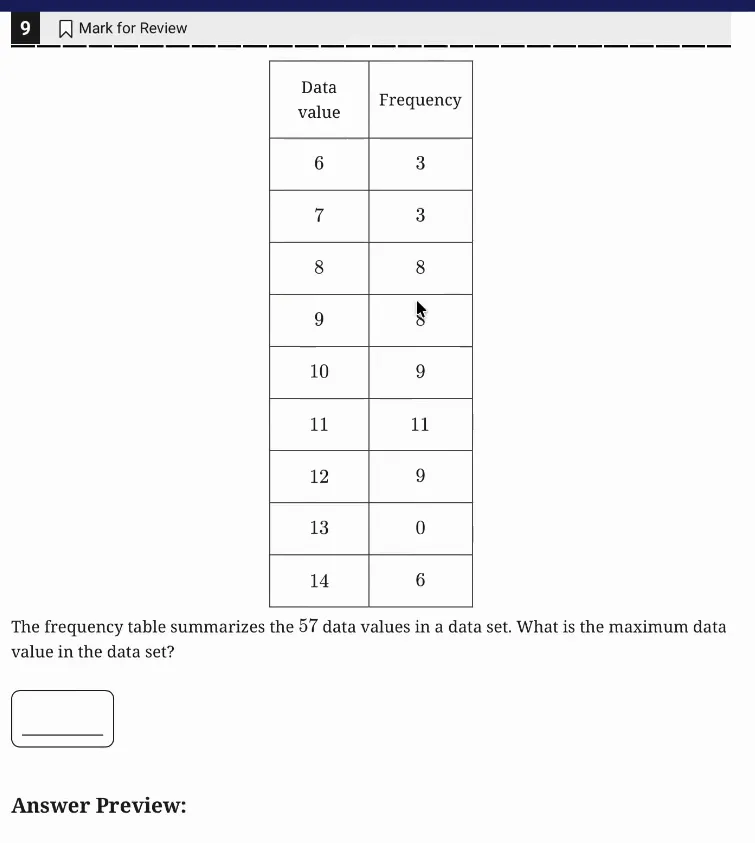
9
Practice Test 9, Module 1, Question 9One-variable data: distributions and measures of center and spread
Answer 14
How it's solved: Frequency counts how often each value appears. The largest value with a nonzero frequency is the maximum.
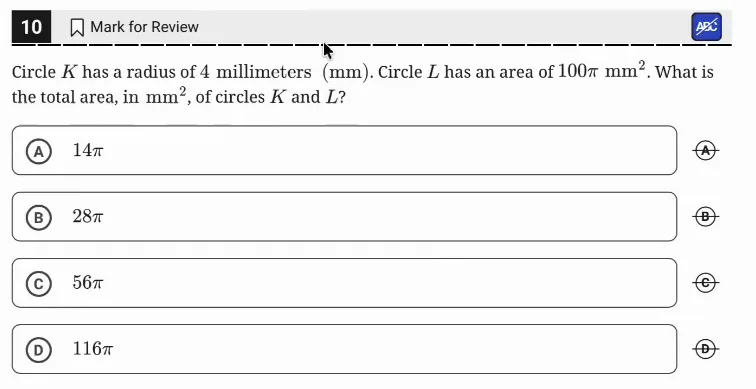
10
Practice Test 9, Module 1, Question 10Area and volume
Answer D
How it's solved: Use pi r squared for the circle with a known radius, then add the other circle's area.
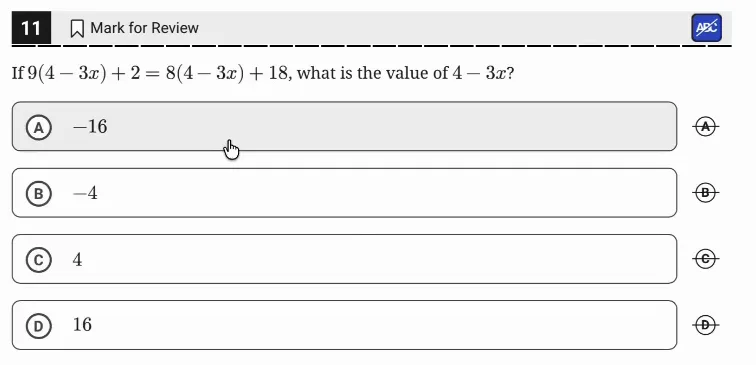
11
Practice Test 9, Module 1, Question 11Linear equations in one variable
Answer D
How it's solved: Type the equation into Desmos to find x, then evaluate the requested expression. Treating that expression as one unit also works algebraically.
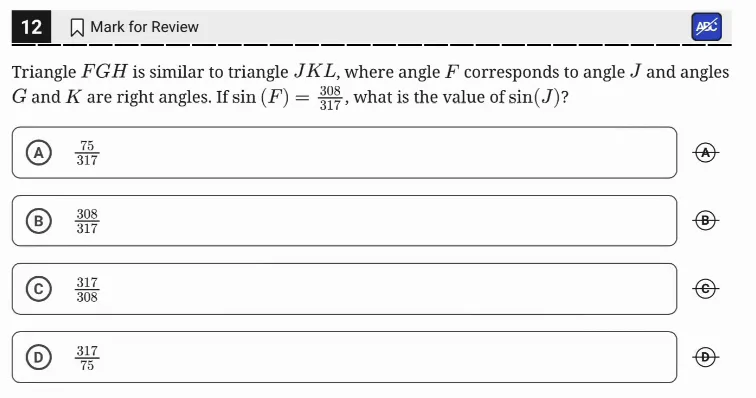
12
Practice Test 9, Module 1, Question 12Right triangles and trigonometry
Answer B
How it's solved: Similar triangles have equal trig ratios for corresponding angles, so the sine carries over directly.
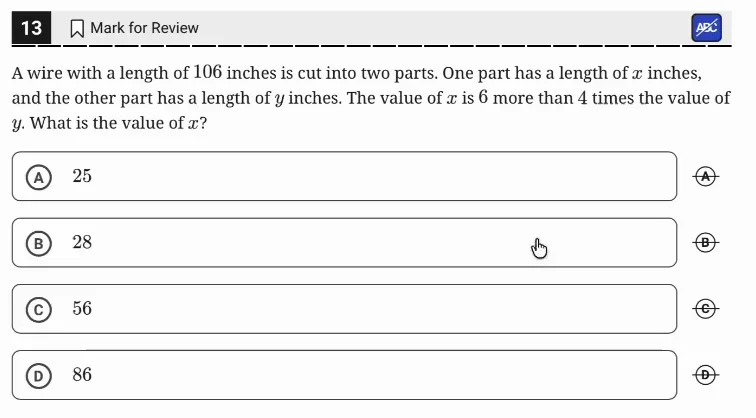
13
Practice Test 9, Module 1, Question 13Systems of two linear equations in two variables
Answer D
How it's solved: Two unknowns means a system. Write one equation from the total and one from the comparison, then graph and read the intersection.
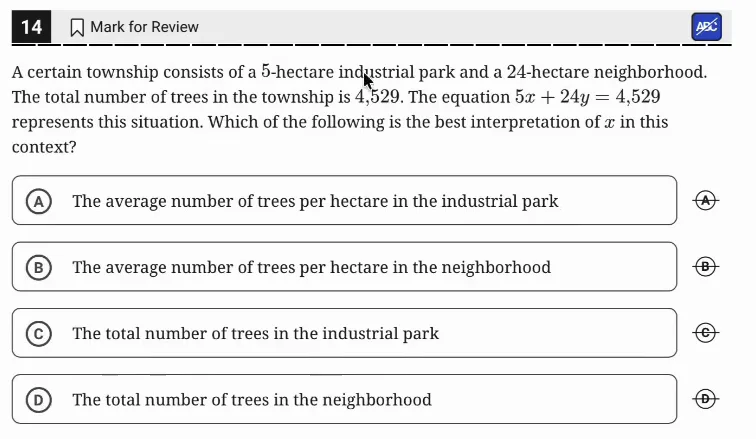
14
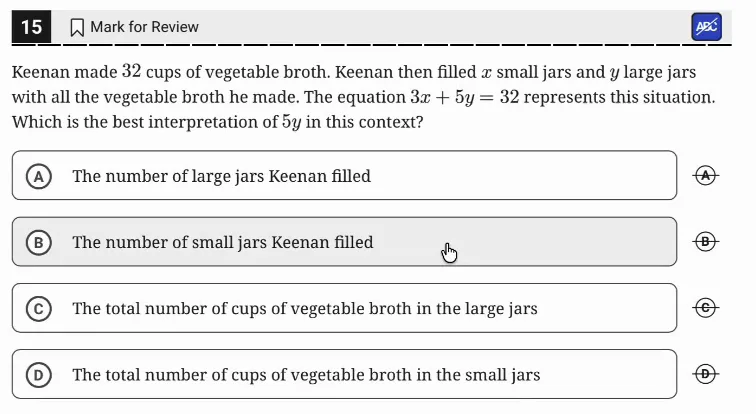
Practice Test 9, Module 1, Question 14Linear equations in two variables
Answer A
How it's solved: Match units: each term must count the same thing as the total, then pair the variable with the category its coefficient describes.
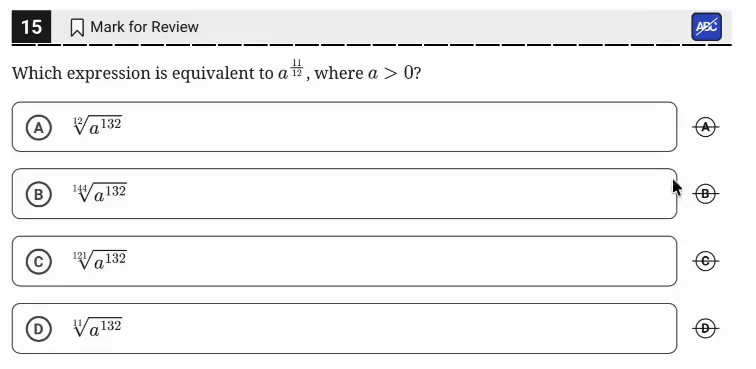
15
Practice Test 9, Module 1, Question 15Equivalent expressions
Answer B
How it's solved: Rewrite each radical choice in exponent form (power over root) and reduce. Graphing in Desmos with x in place of the letter also confirms.
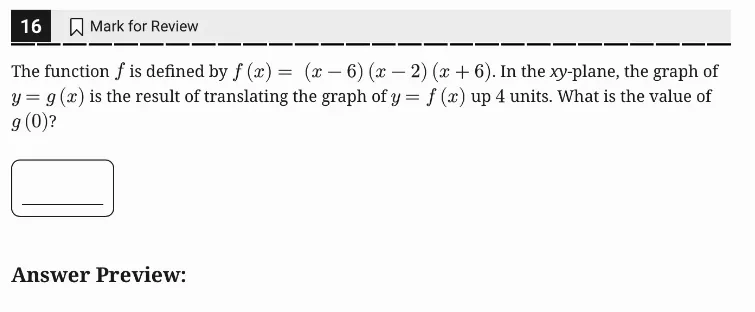
16
Practice Test 9, Module 1, Question 16Nonlinear functions
Answer 76
How it's solved: Define the function in Desmos, write the new function as the original plus the vertical shift, and evaluate at zero.
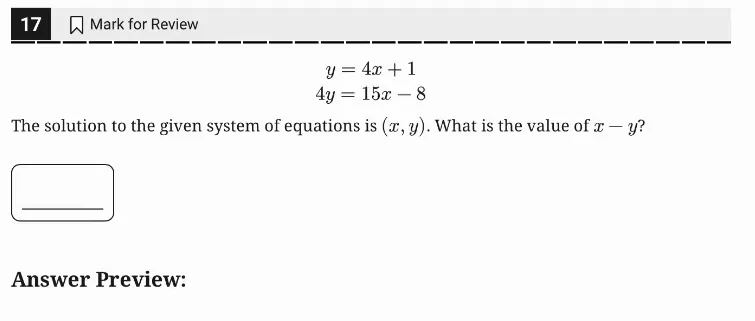
17
Practice Test 9, Module 1, Question 17Systems of two linear equations in two variables
Answer 35
How it's solved: Graph the system in Desmos, click the intersection, and compute x minus y from that point.
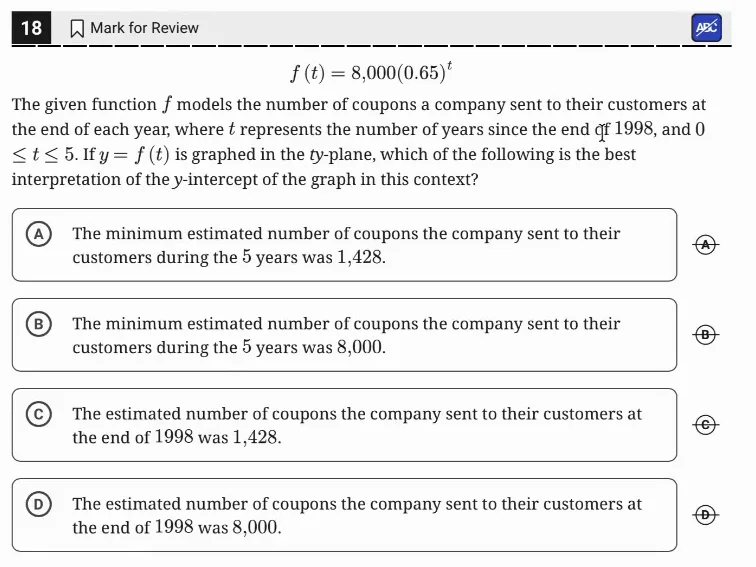
18
Practice Test 9, Module 1, Question 18Nonlinear functions
Answer D
How it's solved: In this exponential form the coefficient is the starting value, and the y-intercept means zero time has passed. Match both ideas to a choice.
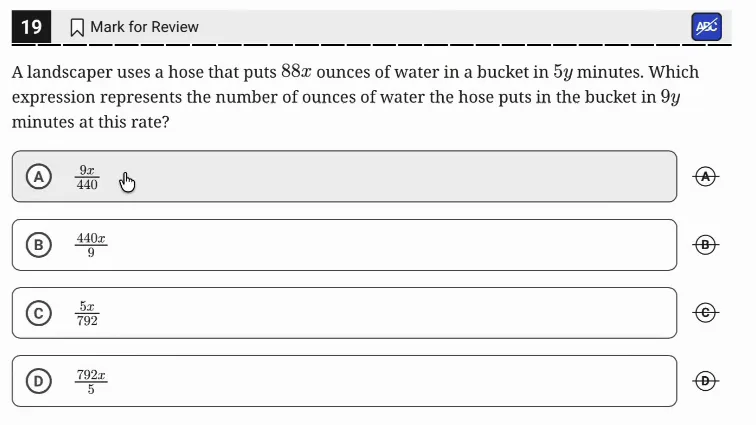
19
Practice Test 9, Module 1, Question 19Ratios, rates, proportional relationships, and units
Answer D
How it's solved: Set up a proportion of amount over time and multiply both sides by the new time. The time variable cancels.
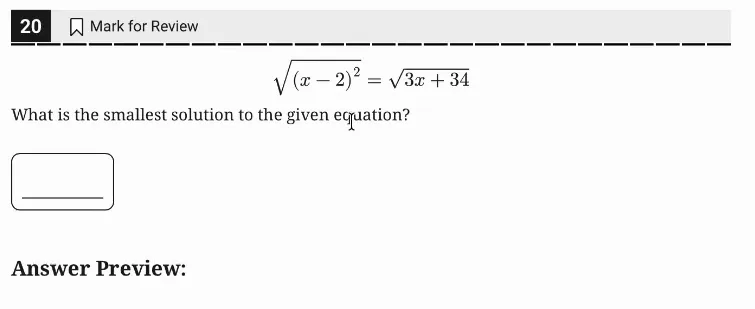
20
Practice Test 9, Module 1, Question 20Nonlinear equations in one variable and systems of equations in two variables
Answer -3
How it's solved: Enter the equation in Desmos as written. Each vertical line is a solution, so zoom in on the smaller one.
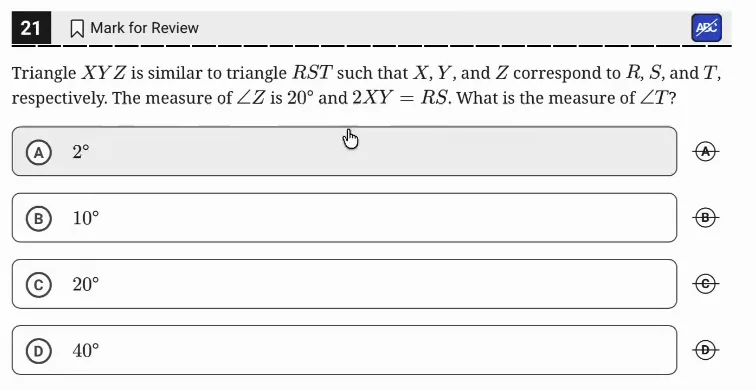
21
Practice Test 9, Module 1, Question 21Lines, angles, and triangles
Answer C
How it's solved: Similar triangles have equal corresponding angles. The side ratio is irrelevant here.
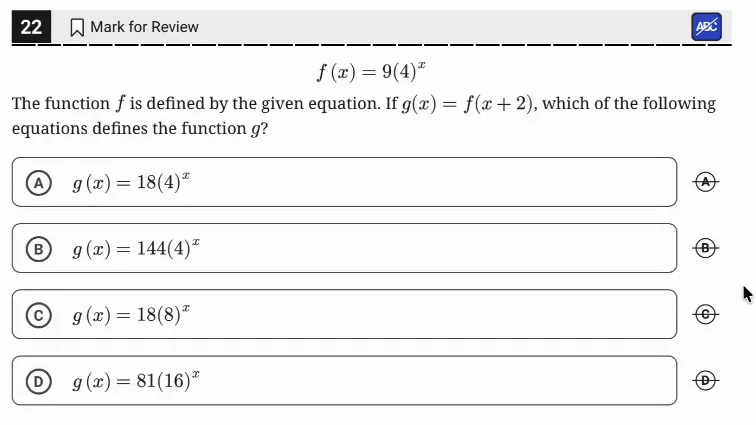
22
Practice Test 9, Module 1, Question 22Nonlinear functions
Answer B
How it's solved: Graph the shifted function in Desmos and test each choice until one lies exactly on top of it.
Module 2
1
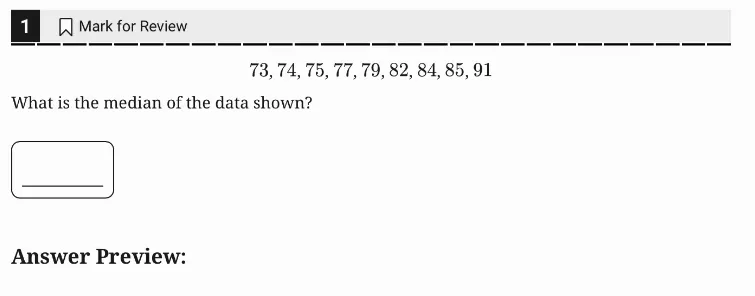
Practice Test 9, Module 2, Question 1One-variable data: distributions and measures of center and spread
Answer 79
How it's solved: Use Desmos's median function on the list, or find the middle value since the data is already sorted.
2
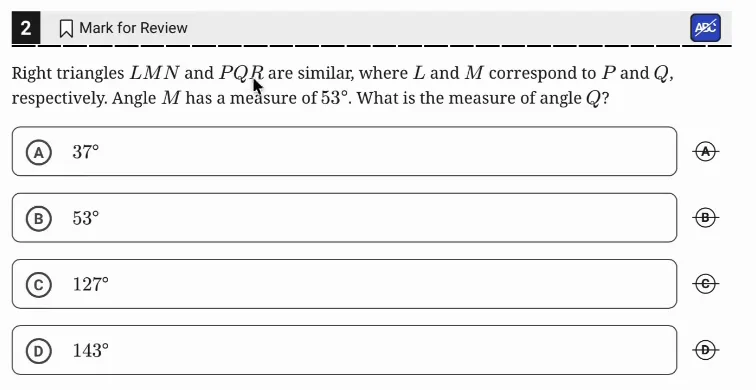
Practice Test 9, Module 2, Question 2Lines, angles, and triangles
Answer B
How it's solved: Corresponding angles in similar triangles are equal, so no calculation is needed.
3
Practice Test 9, Module 2, Question 3Nonlinear functions
Answer B
How it's solved: Substitute the missing x-value into the equation in Desmos to get the y-value.
4
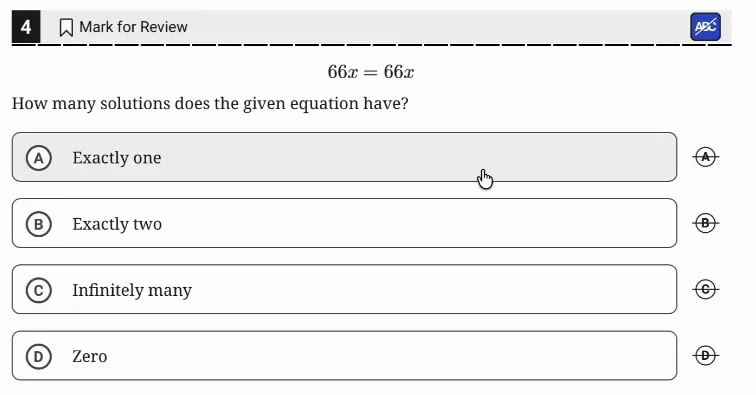
Practice Test 9, Module 2, Question 4Linear equations in one variable
Answer C
How it's solved: Both sides are identical, so there are infinitely many solutions. Graph each side separately in Desmos to see them coincide.
5
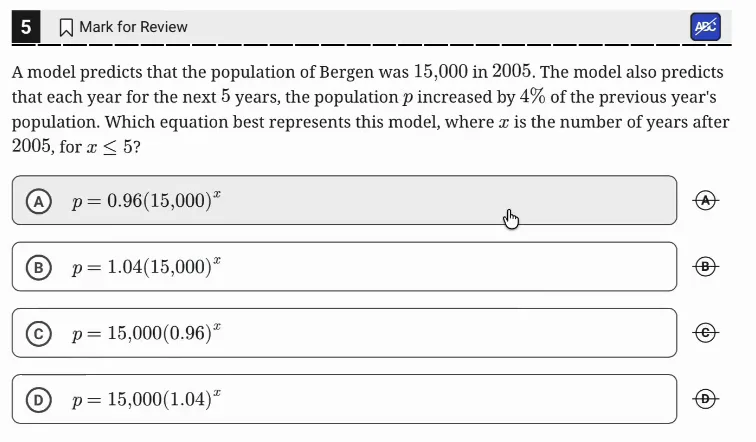
Practice Test 9, Module 2, Question 5Nonlinear functions
Answer D
How it's solved: The coefficient is the starting amount and the base is 1 plus the growth rate as a decimal.
6
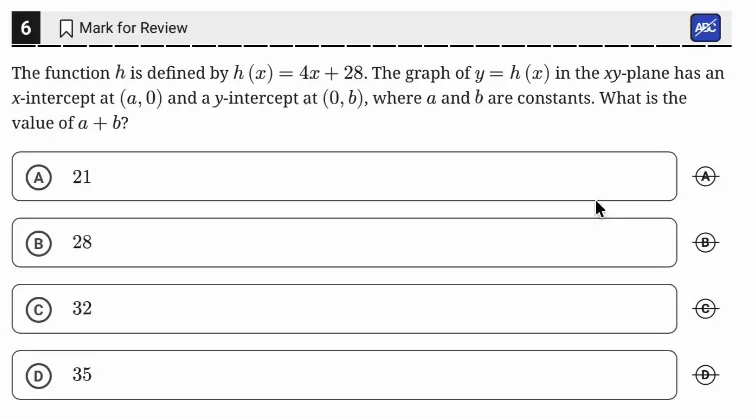
Practice Test 9, Module 2, Question 6Linear functions
Answer A
How it's solved: Graph the function in Desmos, click both intercepts, and add the two values.
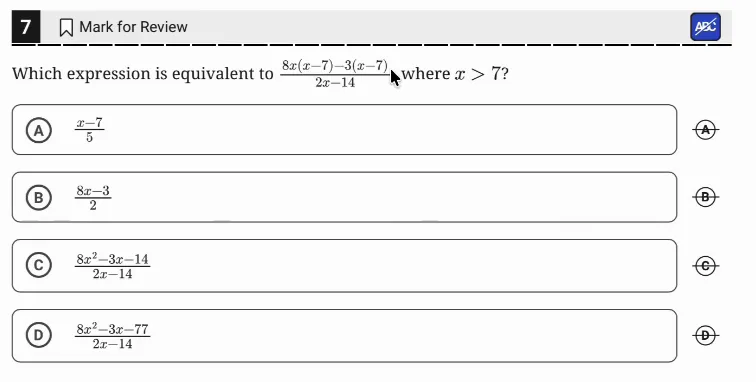
7
Practice Test 9, Module 2, Question 7Equivalent expressions
Answer B
How it's solved: In Desmos, graph the given expression, then try each choice until one overlaps it exactly.
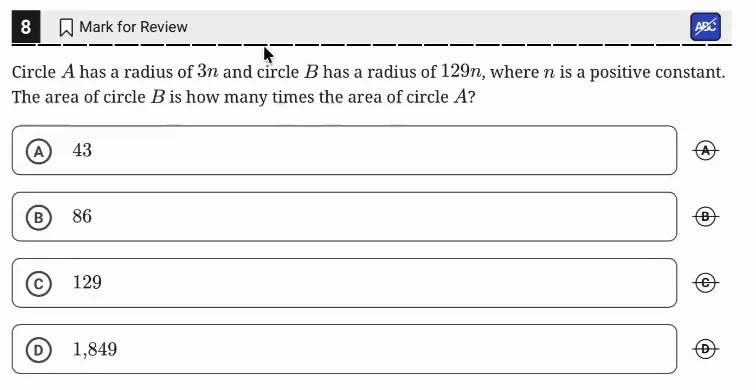
8
Practice Test 9, Module 2, Question 8Area and volume
Answer D
How it's solved: Area scales with the square of the radius. Divide the radii, then square the ratio to avoid the trap choice.
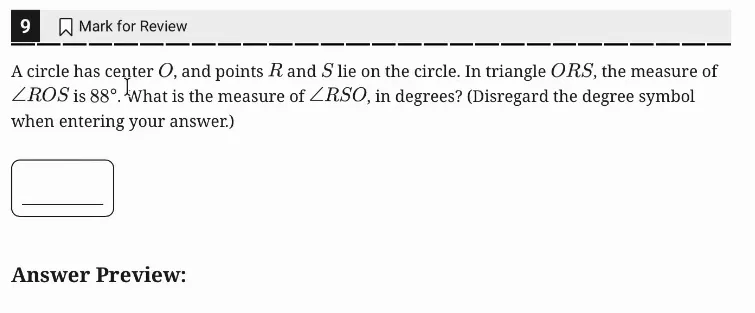
9
Practice Test 9, Module 2, Question 9Circles
Answer 46
How it's solved: Sketch the circle and triangle. Two radii make it isosceles, so subtract the vertex angle from 180 and halve.
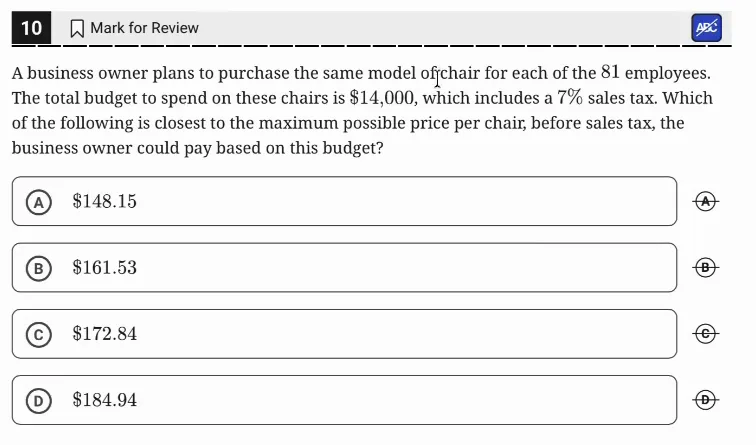
10
Practice Test 9, Module 2, Question 10Linear inequalities in one or two variables
Answer B
How it's solved: Use final equals original times 1 plus the percent, with the original written as a count times the unknown per-item value. Desmos solves it.
11
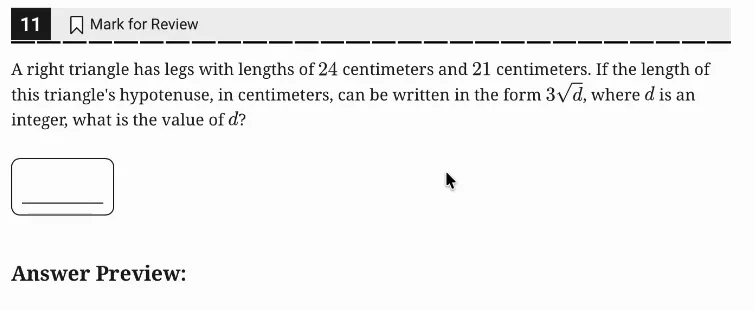
Practice Test 9, Module 2, Question 11Right triangles and trigonometry
Answer 113
How it's solved: Apply the Pythagorean theorem in Desmos, with x standing in for the unknown under the radical, and read the solution.
12
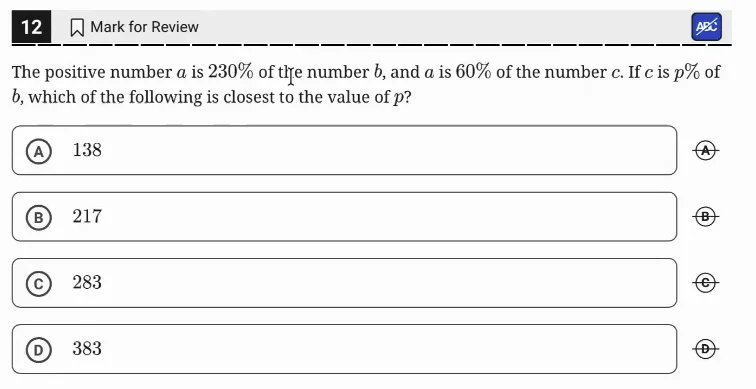
Practice Test 9, Module 2, Question 12Percentages
Answer D
How it's solved: Translate each percent statement into an equation, solve for the needed ratio, and let Desmos compute it from any test value.
13
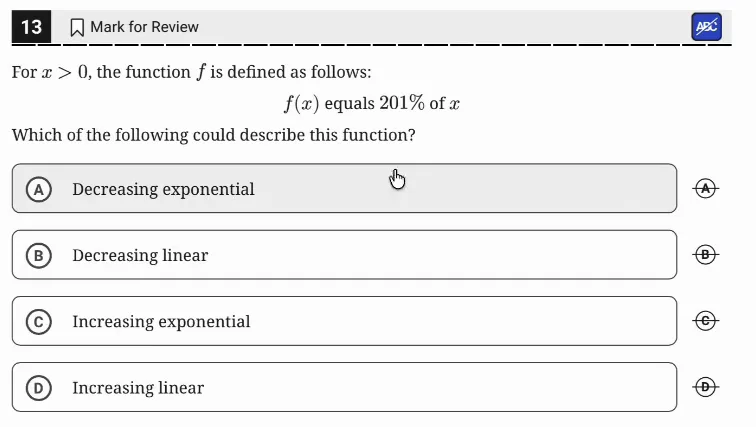
Practice Test 9, Module 2, Question 13Two-variable data: models and scatterplots
Answer D
How it's solved: Translate the definition into an equation. It's a constant times x, so it's increasing linear, not exponential.
14
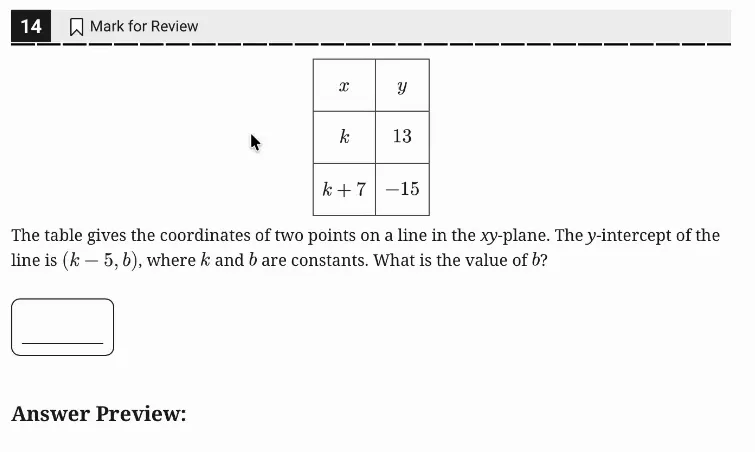
Practice Test 9, Module 2, Question 14Linear equations in two variables
Answer 33
How it's solved: A y-intercept has an x-coordinate of zero, which fixes the constant. Then plug the points into a Desmos regression and read the intercept.
15
Practice Test 9, Module 2, Question 15Linear equations in two variables
Answer C
How it's solved: Units must match the total, so that term is the total amount tied to the category its variable counts.
16
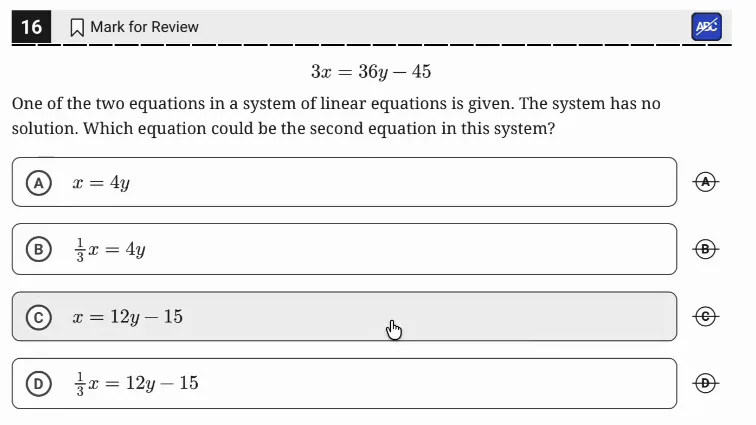
Practice Test 9, Module 2, Question 16Systems of two linear equations in two variables
Answer B
How it's solved: No solution means parallel lines. Graph the given line in Desmos and find the choice that stays parallel.
17
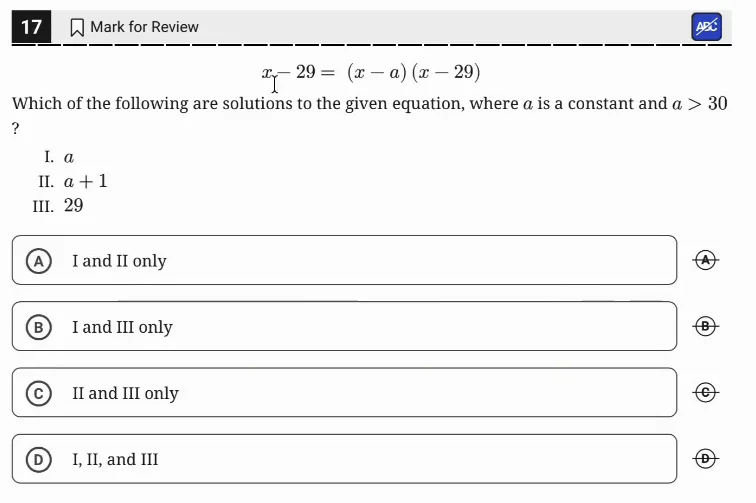
Practice Test 9, Module 2, Question 17Nonlinear equations in one variable and systems of equations in two variables
Answer C
How it's solved: Give the constant a value that fits the condition, graph in Desmos, and express the solutions in terms of that constant.
18
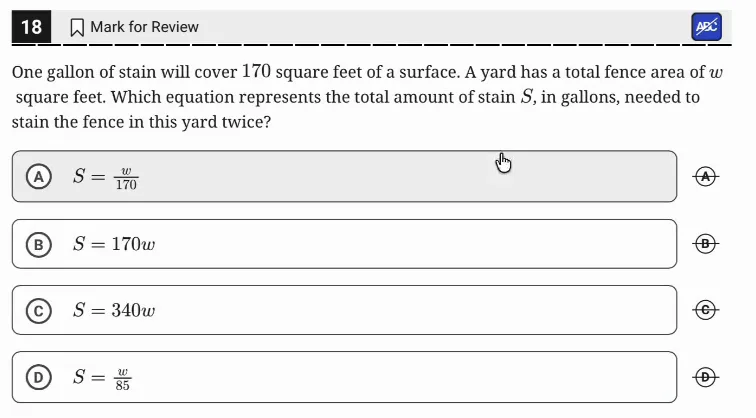
Practice Test 9, Module 2, Question 18Linear functions
Answer D
How it's solved: Plug in a known pair of values from the setup, adjusted for the repeat condition, and check which equation holds.
19
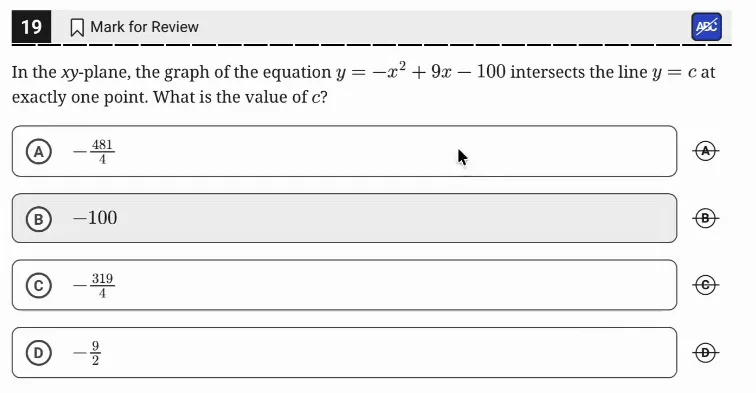
Practice Test 9, Module 2, Question 19Nonlinear equations in one variable and systems of equations in two variables
Answer C
How it's solved: Since it's multiple choice, graph the parabola in Desmos and test each horizontal line, keeping the one that touches at a single point.
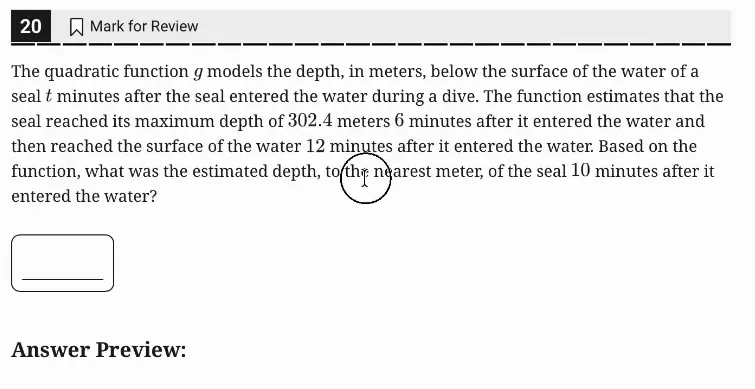
20
Practice Test 9, Module 2, Question 20Nonlinear functions
Answer 168
How it's solved: Use the vertex and symmetry to get a third point, run a quadratic regression in Desmos, then evaluate at the requested time.
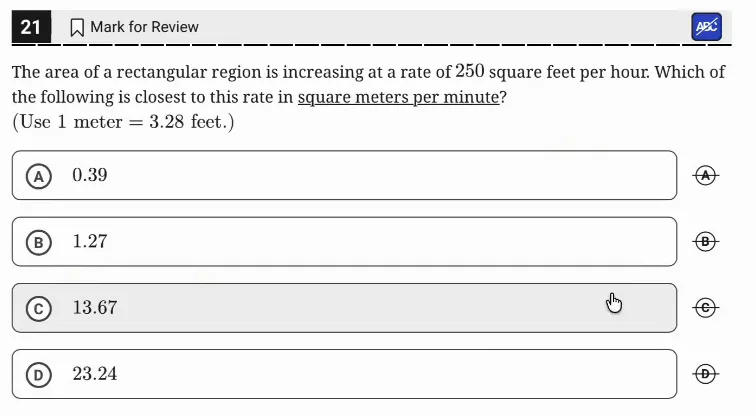
21
Practice Test 9, Module 2, Question 21Ratios, rates, proportional relationships, and units
Answer A
How it's solved: Dimensional analysis. Square the length conversion factor because the units are squared, which avoids the trap answer.
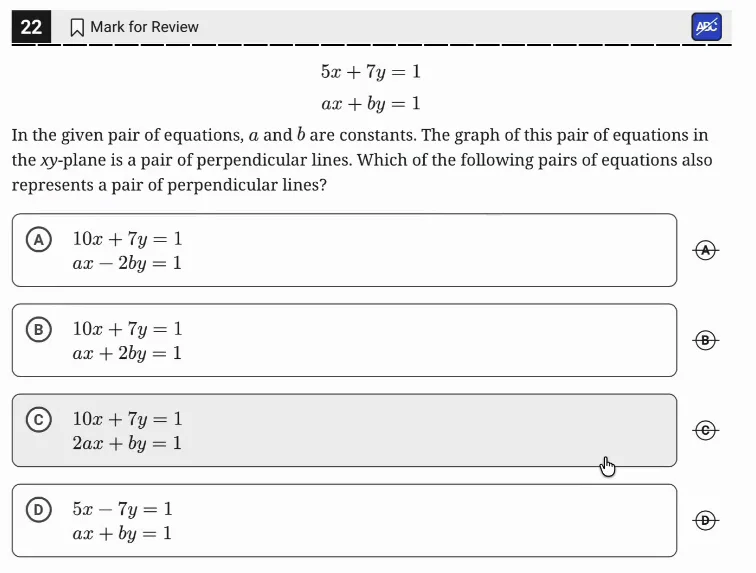
22
Practice Test 9, Module 2, Question 22Linear equations in two variables
Answer B
How it's solved: Find the slopes, use the opposite reciprocal to pin down the constants, then graph the choices in Desmos to spot right angles.
Practice Test 9 Answer Key and Scoring
The video shows how to get each answer. The official answer key comes from College Board:
In Bluebook and My Practice. Bluebook shows your score as soon as you submit. Your full results are in My Practice: every question, your answer, the correct answer and a written explanation.
On paper. College Board also posts a printable version of Practice Test 9 with an answer key, answer explanations and a scoring guide on its SAT Suite site.
Use My Practice to find which questions you missed, then come back here for the fastest way to solve them. To see what a given number of misses does to your score, use how many you can miss on SAT Math.
After Test 9
Sigma Prep's mock of Test 9 comes in three versions with new problems on the same blueprint, video explanation on every question. The Test 4 mock is free: full-length timed practice tests. Start free today!
Common Questions
After you submit Practice Test 9 in Bluebook, your full results are in My Practice on the College Board site: every question, your answer, the correct answer and a written explanation. College Board also posts a printable version of Practice Test 9 with an answer key, answer explanations and a scoring guide. The video on this page adds the fastest way to solve each one.
On this page. Every one of the 44 math questions from Bluebook Practice Test 9 has its own section, from Module 1 Question 1 to Module 2 Question 22, with the correct answer, the skill it tests, how it is solved, and a video clip of just that question. The full walkthrough video above solves all 44 in order, often with Desmos rather than algebra.
Take the test timed in Bluebook first, score it, and pull out every question you missed or guessed on. Then jump to only those questions in the video and ask one thing for each: could I have recognized this setup, and did I know the move? Do not watch all 47 minutes like a movie.
Not as a measurement, because memory inflates the score. Sigma Prep Test 9 mirrors the official test question for question with fresh problems, in three versions, so you can check whether the skills are really there.
Want more SAT tips like this?
One article a week. No spam.
Ready to raise your SAT Math score?
Take the free Diagnostic Quiz and see where you stand. No payment required.