Sort Your Misses: Didn't Know It vs. Careless Mistake
A few tests into your prep, not all misses mean the same thing anymore. Pile one is questions you genuinely did not know how to solve. Pile two is questions you knew cold and got wrong anyway: misread the stem, dropped a sign, answered x when they asked for 2x.
The walkthrough is for pile one. Jump to those questions and steal the setup and the move. But if pile two is more than a question or two, that is the more urgent finding, because once you are scoring 600 or above, every careless mistake costs 10 to 20 points. The fix for pile two is not more content. It is slowing down on the read and checking what the question actually asked before you answer.
All 44 Practice Test 6 Math Questions, One at a Time
Every math question from official Practice Test 6, in order, as it appears in the walkthrough. Each one has the correct answer, how it's solved, and a clip of just that question.
Module 1
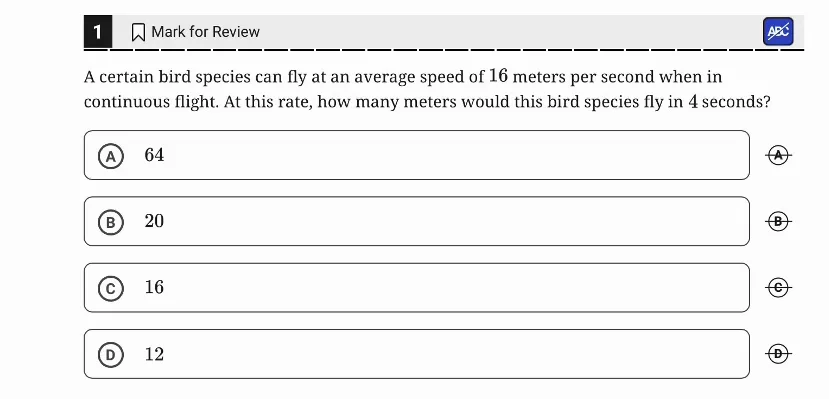
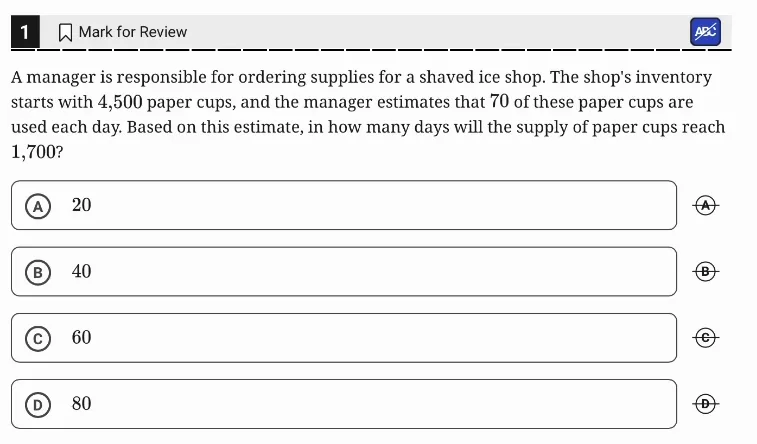
1
Practice Test 6, Module 1, Question 1Ratios, rates, proportional relationships, and units
Answer A
How it's solved: Mental math: multiply the rate by the elapsed time to get the total distance.
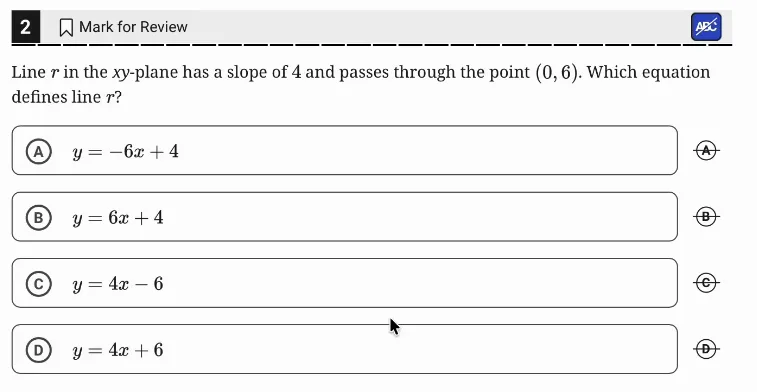
2
Practice Test 6, Module 1, Question 2Linear equations in two variables
Answer D
How it's solved: Read the slope and y-intercept straight from the given information and plug them into slope-intercept form.
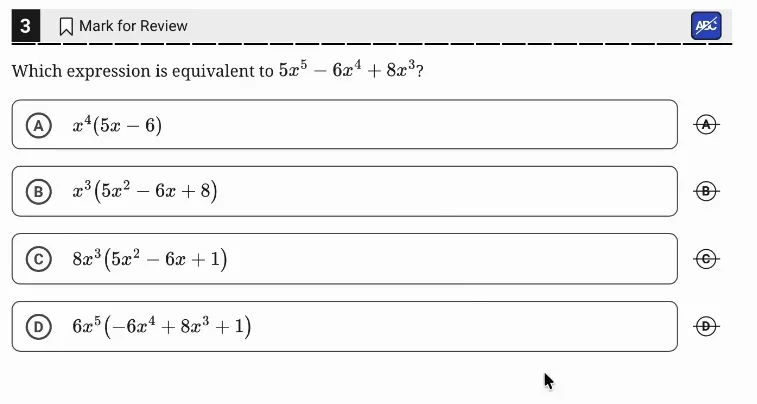
3
Practice Test 6, Module 1, Question 3Equivalent expressions
Answer B
How it's solved: Factor out the greatest common factor by eye, then confirm in Desmos by checking which choice draws the same graph as the original.
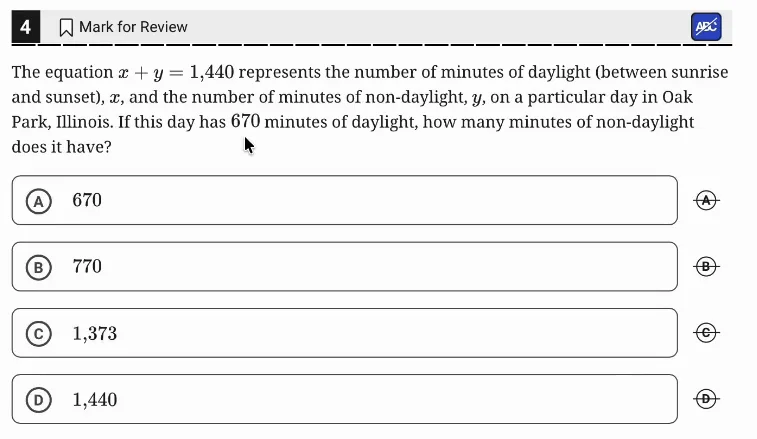
4
Practice Test 6, Module 1, Question 4Linear equations in two variables
Answer B
How it's solved: Substitute the given value for x and let Desmos solve for y, or subtract mentally.
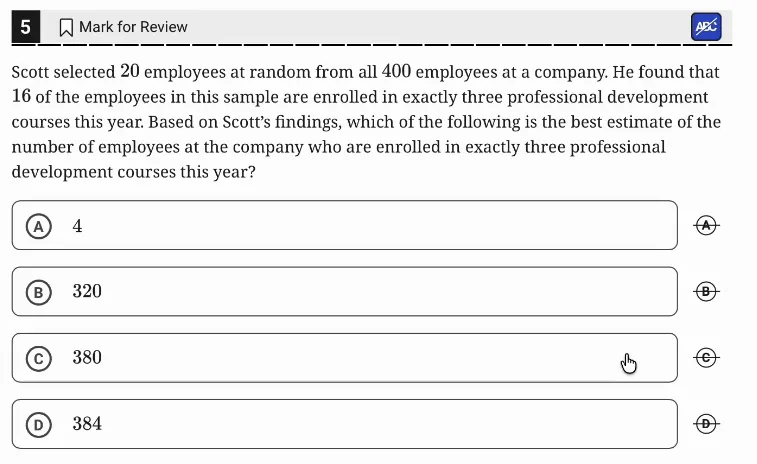
5
Practice Test 6, Module 1, Question 5Inference from sample statistics and margin of error
Answer B
How it's solved: Set up a proportion from the sample fraction and scale it up to the whole population, solving it in Desmos.
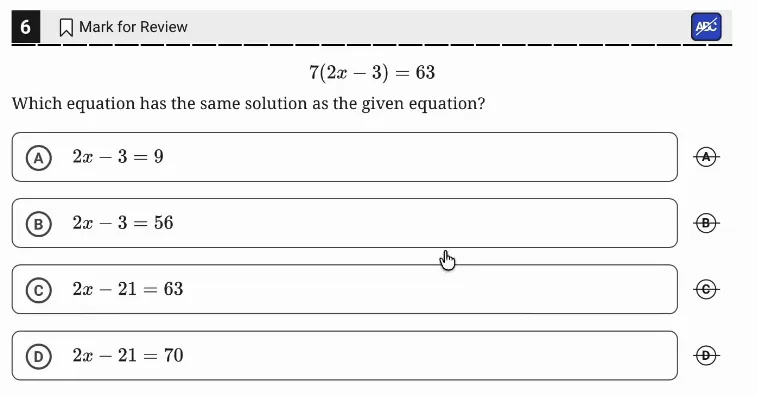
6
Practice Test 6, Module 1, Question 6Linear equations in one variable
Answer A
How it's solved: Divide both sides by the outside factor to spot the match, or type each equation into Desmos and pick the one with the same solution.
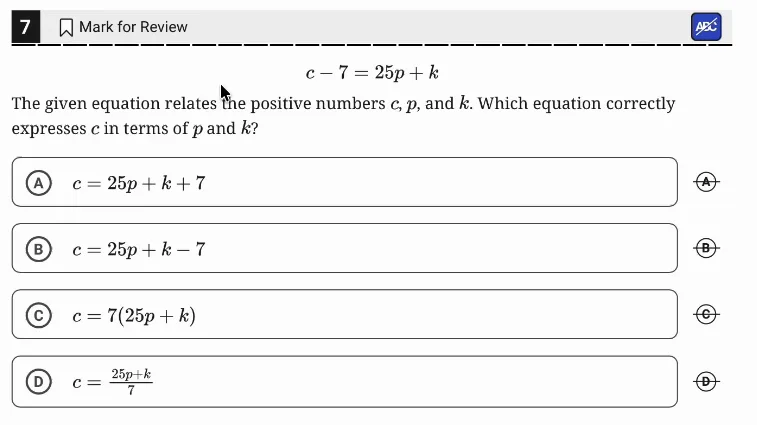
7
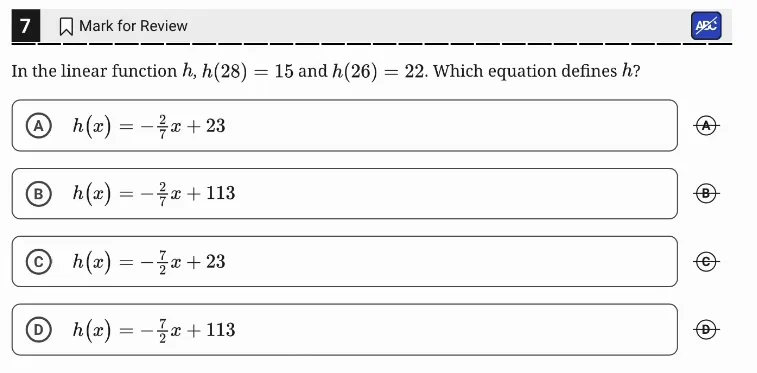
Practice Test 6, Module 1, Question 7Nonlinear equations in one variable and systems of equations in two variables
Answer A
How it's solved: Isolate c with one algebra step by moving the constant to the other side.
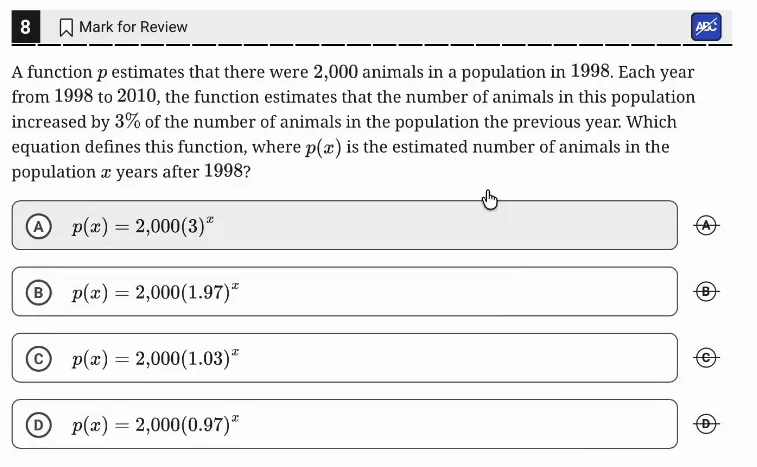
8
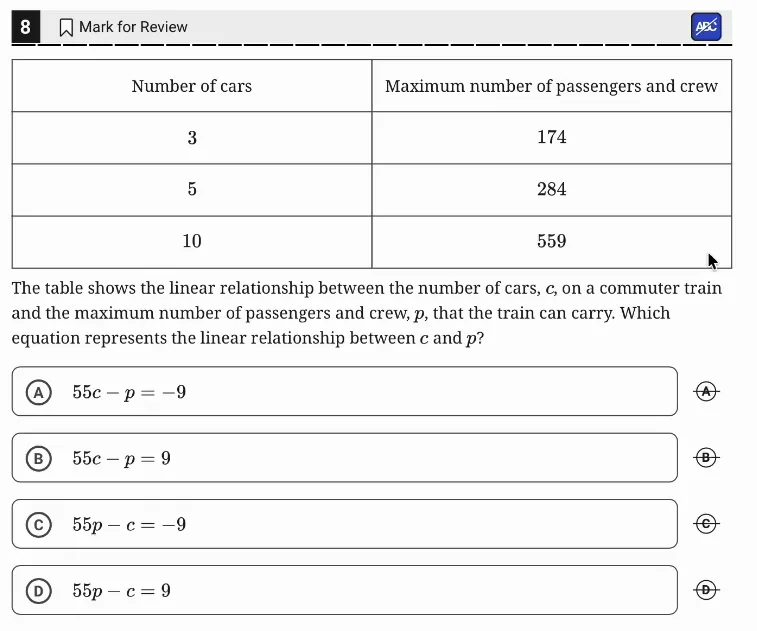
Practice Test 6, Module 1, Question 8Nonlinear functions
Answer C
How it's solved: Recognize exponential growth: keep the initial value out front and write the growth factor as one plus the percent in decimal form.
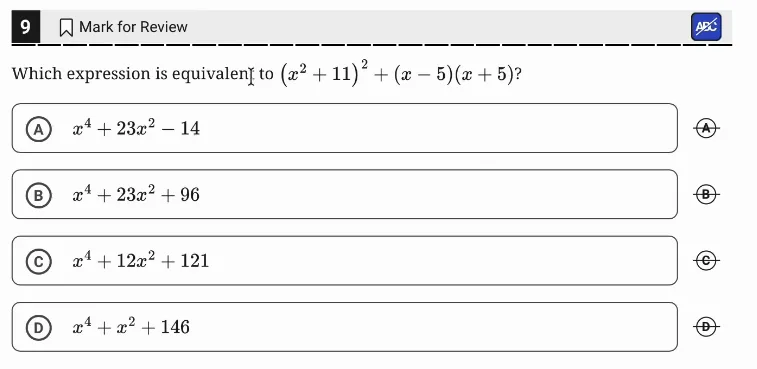
9
Practice Test 6, Module 1, Question 9Equivalent expressions
Answer B
How it's solved: Graph the original expression in Desmos, then enter answer choices until one traces exactly the same curve.
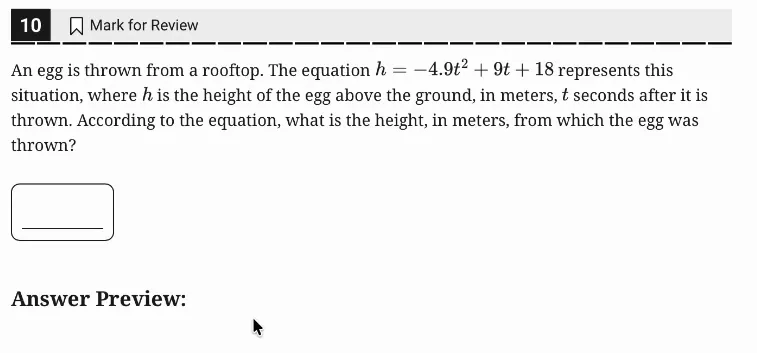
10
Practice Test 6, Module 1, Question 10Nonlinear functions
Answer 18
How it's solved: The starting height is the y-intercept, which in standard form is the constant term. Clicking the intercept in Desmos confirms it.
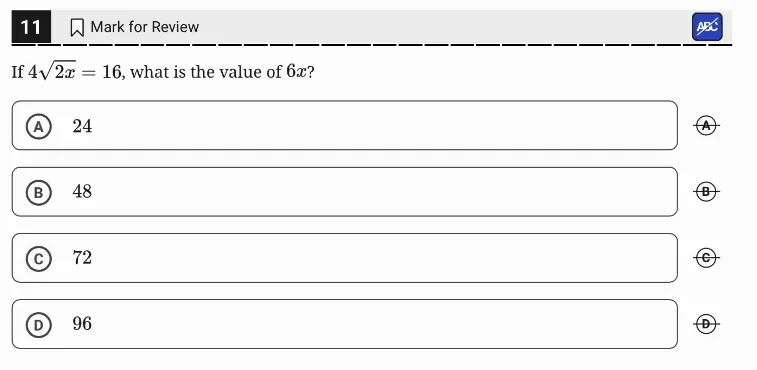
11
Practice Test 6, Module 1, Question 11Nonlinear equations in one variable and systems of equations in two variables
Answer B
How it's solved: Type the equation into Desmos to find x, then multiply by the coefficient the question asks for.
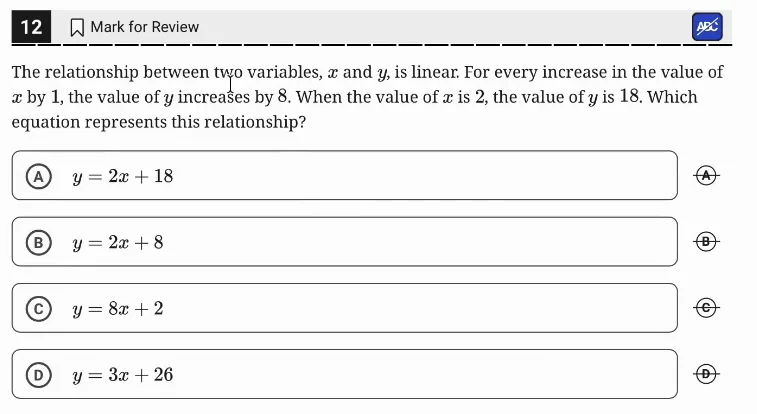
12
Practice Test 6, Module 1, Question 12Linear functions
Answer C
How it's solved: Plug the given point into each choice and keep the one that works. The slope described in the wording points to the same answer.
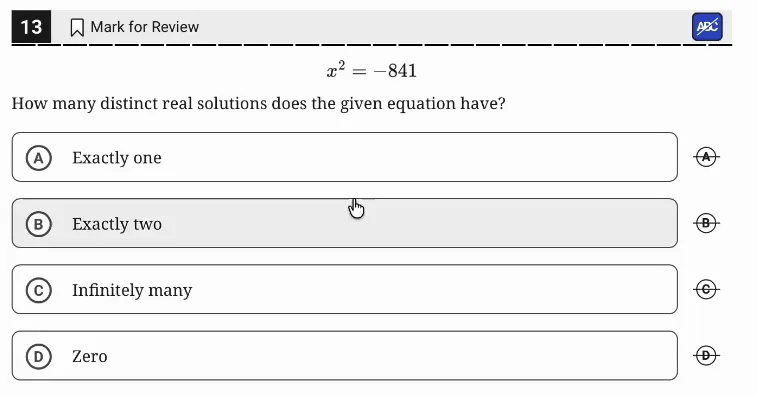
13
Practice Test 6, Module 1, Question 13Nonlinear equations in one variable and systems of equations in two variables
Answer D
How it's solved: Graph it in Desmos and notice nothing appears. Since the two sides are not identical, a blank graph means no solutions rather than infinitely many.
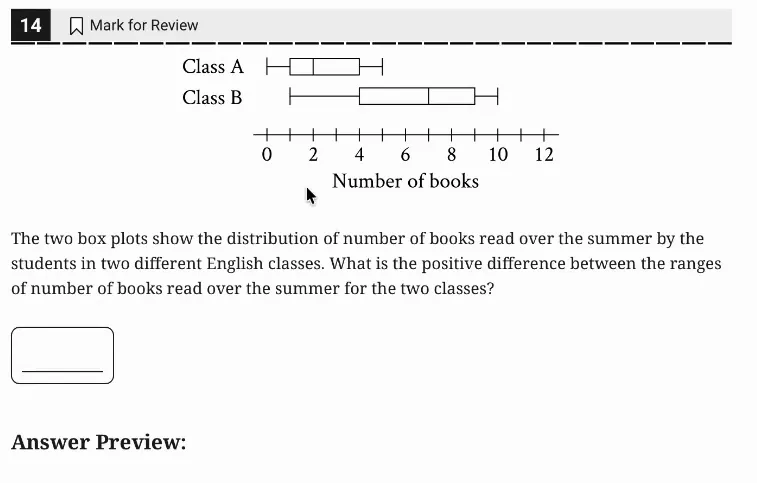
14
Practice Test 6, Module 1, Question 14One-variable data: distributions and measures of center and spread
Answer 4
How it's solved: Find each range as maximum minus minimum from the box plot whiskers, then subtract the two ranges.
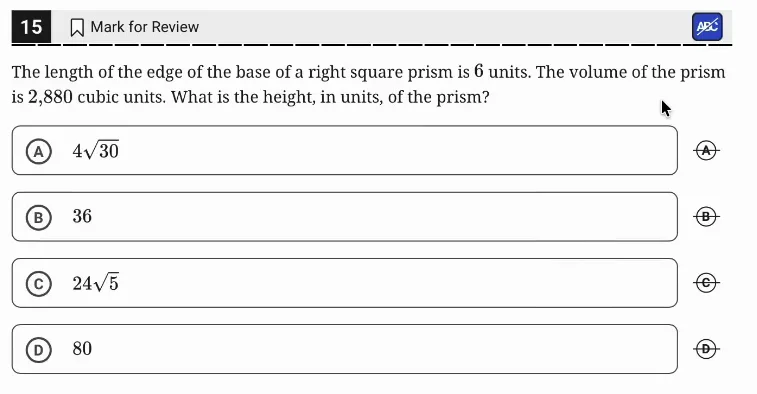
15
Practice Test 6, Module 1, Question 15Area and volume
Answer D
How it's solved: Use the square prism volume formula, base edge squared times height, and rename the height x so Desmos can solve for it.
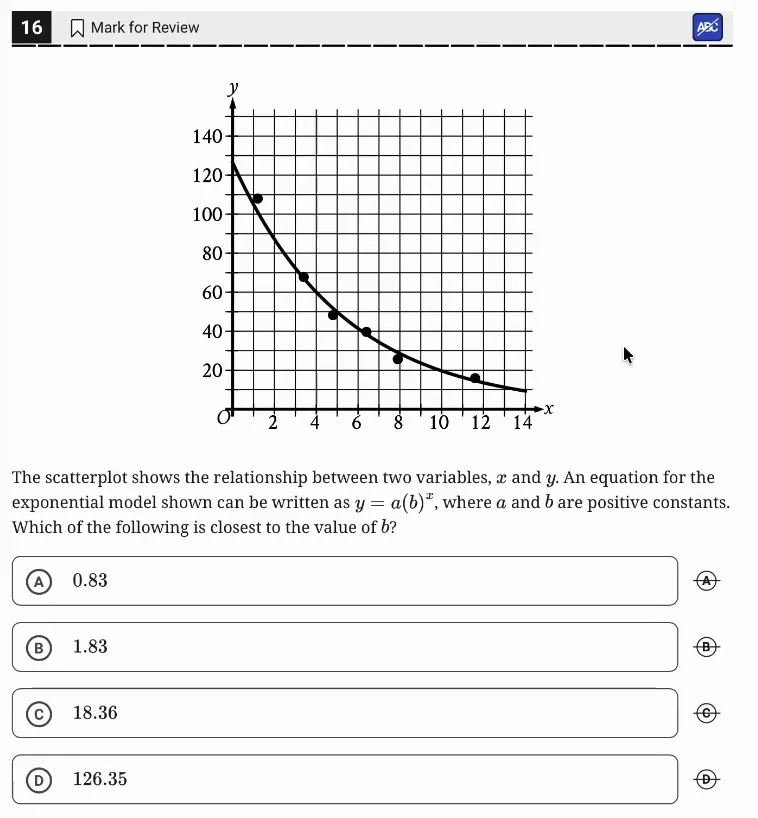
16
Practice Test 6, Module 1, Question 16Two-variable data: models and scatterplots
Answer A
How it's solved: Pick two points on the curve, enter them in a Desmos table and run an exponential regression to read the base, then choose the closest option.
17
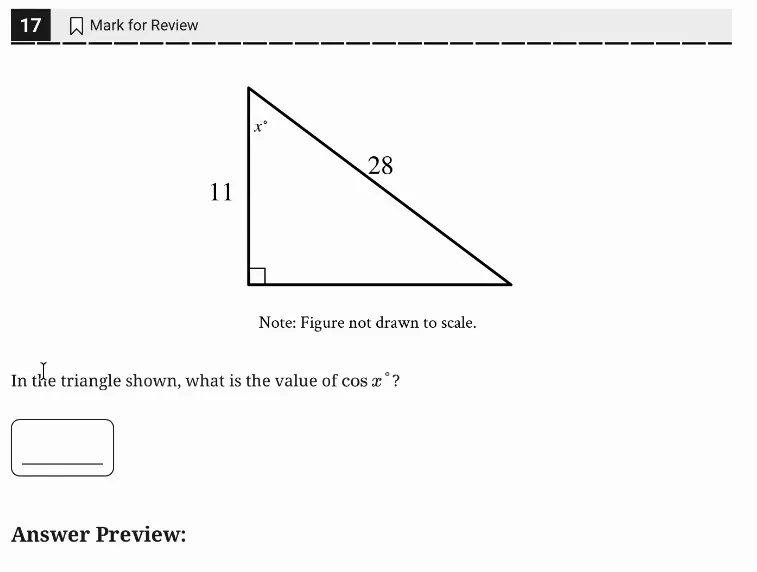
Practice Test 6, Module 1, Question 17Right triangles and trigonometry
Answer 0.3928 or 0.3929 or 11/28
How it's solved: Apply SOH CAH TOA: cosine is adjacent over hypotenuse, read directly from the triangle without finding the third side.
18
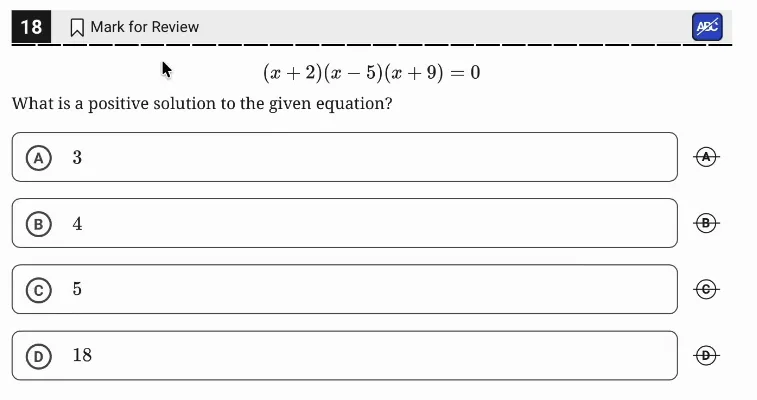
Practice Test 6, Module 1, Question 18Nonlinear equations in one variable and systems of equations in two variables
Answer C
How it's solved: Read the zeros from the factored form, or graph it in Desmos and zoom in on the positive x-intercept.
19
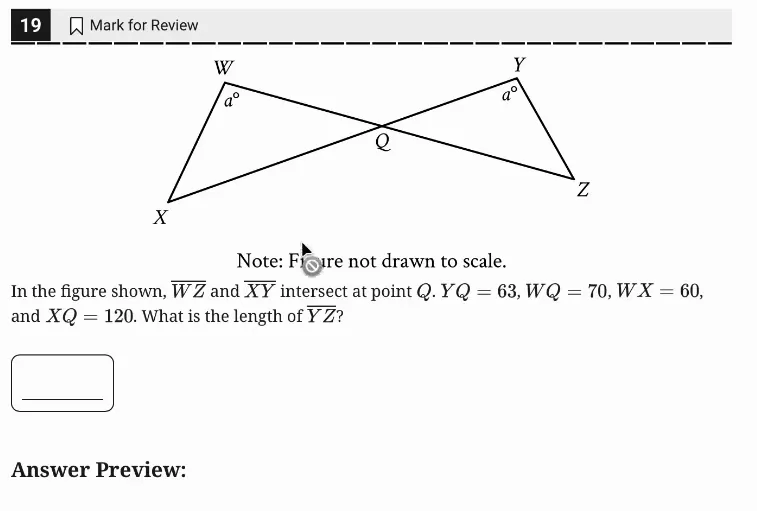
Practice Test 6, Module 1, Question 19Lines, angles, and triangles
Answer 54
How it's solved: Show the triangles are similar with the marked angles and vertical angles, then set up a proportion of corresponding sides and solve in Desmos.
20
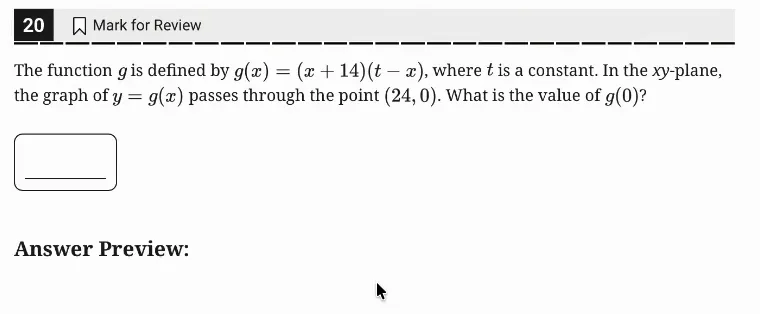
Practice Test 6, Module 1, Question 20Nonlinear functions
Answer 336
How it's solved: Substitute the given point into the function to solve for the constant in Desmos, then evaluate the function at zero.
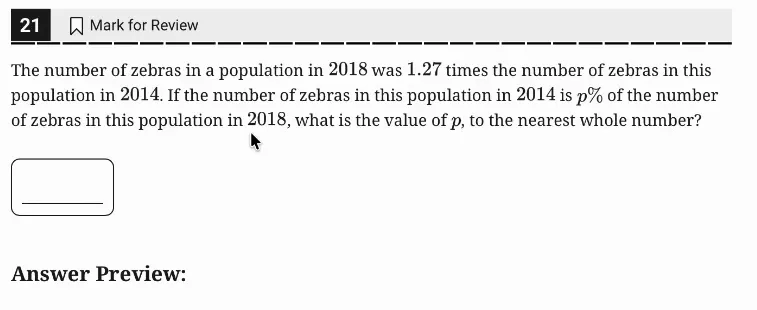
21
Practice Test 6, Module 1, Question 21Percentages
Answer 79
How it's solved: Translate both sentences into equations, then pick an easy value for the earlier population and compute the percent from the ratio.
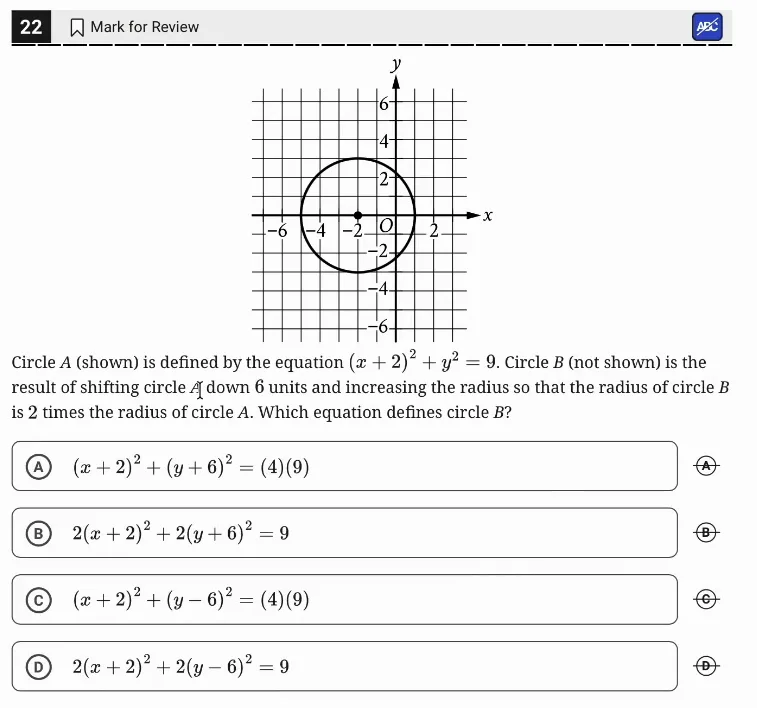
22
Practice Test 6, Module 1, Question 22Circles
Answer A
How it's solved: Graph the original circle in Desmos, then test each choice to see which one moves down and grows by the right amount.
Module 2
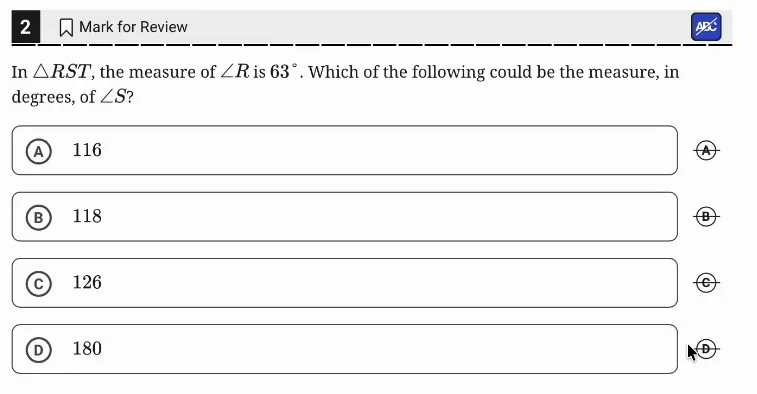
1
Practice Test 6, Module 2, Question 1Linear equations in one variable
Answer B
How it's solved: Write a linear model with a negative daily rate and the starting amount as the intercept, then find in Desmos when it reaches the target.
2
Practice Test 6, Module 2, Question 2Lines, angles, and triangles
Answer A
How it's solved: Use the triangle angle sum and rule out any choice that, added to the known angle, uses up or exceeds the total.
3
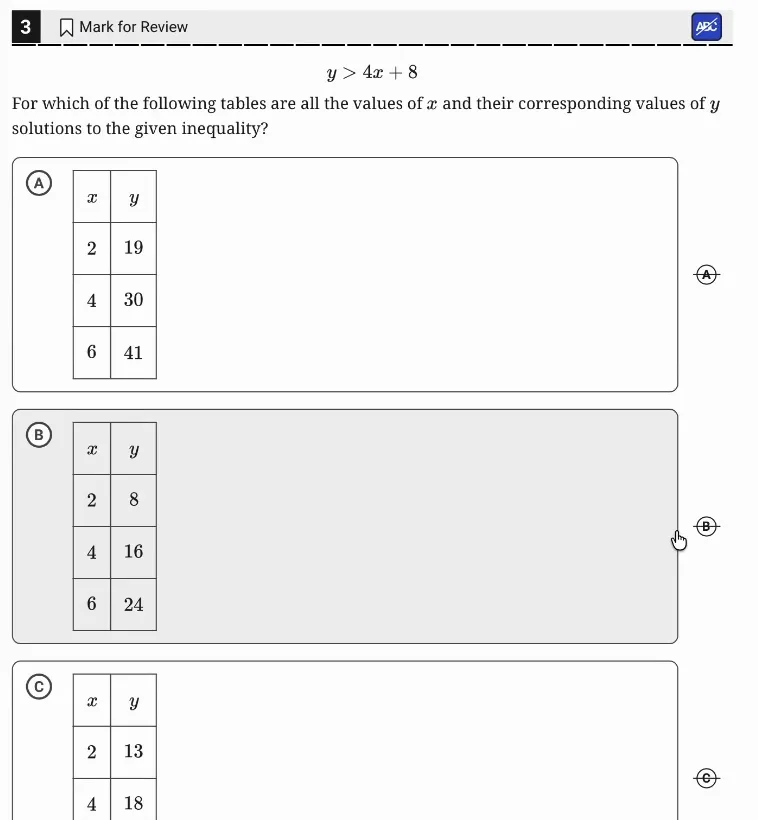
Practice Test 6, Module 2, Question 3Linear inequalities in one or two variables
Answer A
How it's solved: Graph the inequality in Desmos, plot each table's points, and choose the table where every point sits in the shaded region.
4
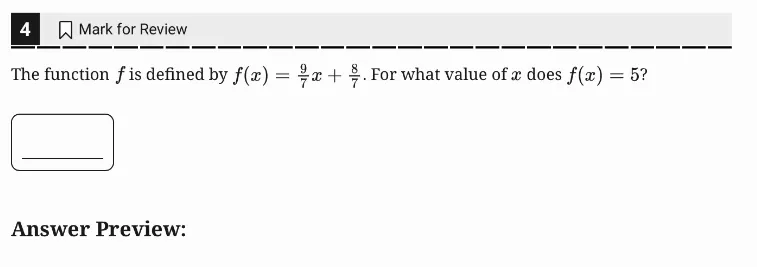
Practice Test 6, Module 2, Question 4Linear functions
Answer 3
How it's solved: Replace f(x) with the target output in Desmos and click the solution to read x.
5
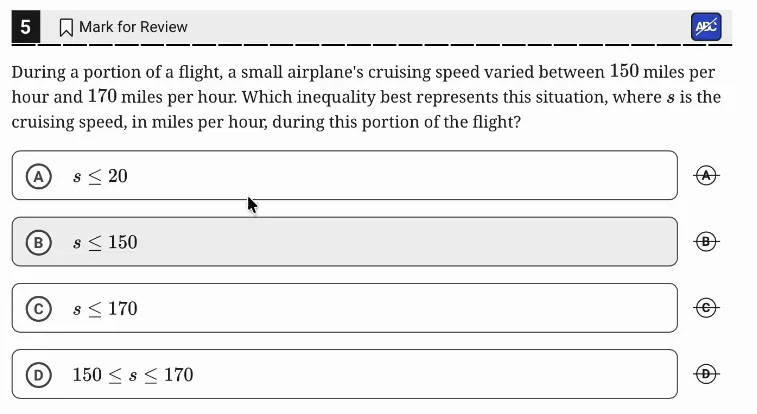
Practice Test 6, Module 2, Question 5Linear inequalities in one or two variables
Answer D
How it's solved: No calculation needed: translate the speed range into a compound inequality with s between the two bounds.
6
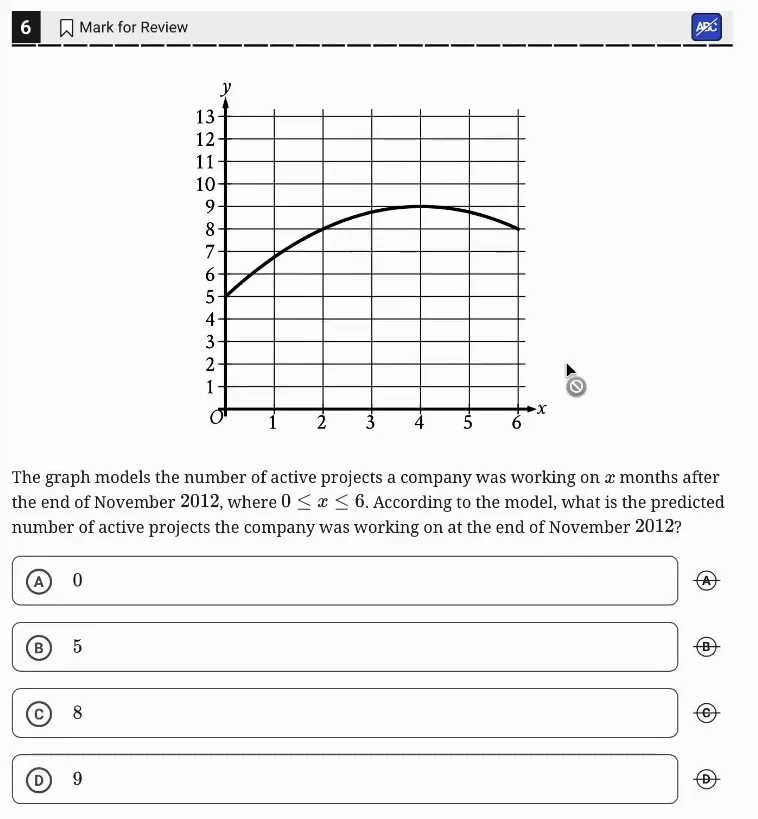
Practice Test 6, Module 2, Question 6Nonlinear functions
Answer B
How it's solved: Careful reading does the work here. The starting month corresponds to x equals zero, so read the y-value at that point.
7
Practice Test 6, Module 2, Question 7Linear functions
Answer D
How it's solved: Treat the function notation as two points, run a linear regression in a Desmos table, and match the decimal slope to a fraction.
8
Practice Test 6, Module 2, Question 8Linear functions
Answer A
How it's solved: Enter the table into Desmos and run a linear regression, swap in the problem's variables, then rearrange to match the choices' form.
9
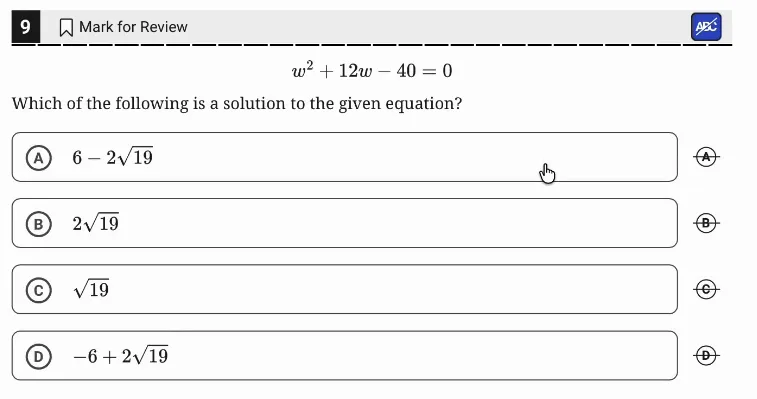
Practice Test 6, Module 2, Question 9Nonlinear equations in one variable and systems of equations in two variables
Answer D
How it's solved: Change the variable to x so Desmos shows the roots, then evaluate each choice and keep the one that matches a root.
10
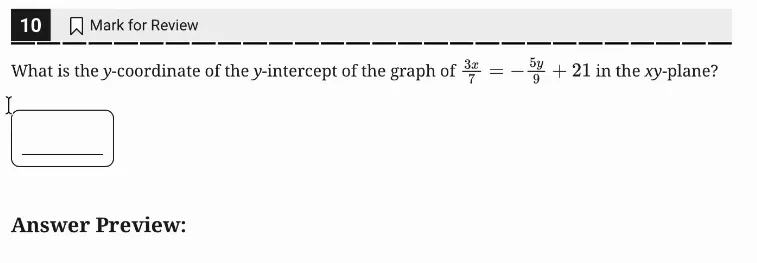
Practice Test 6, Module 2, Question 10Linear equations in two variables
Answer 189/5 or 37.8
How it's solved: Type the equation into Desmos exactly as written and click the y-intercept. No rearranging is needed.
11
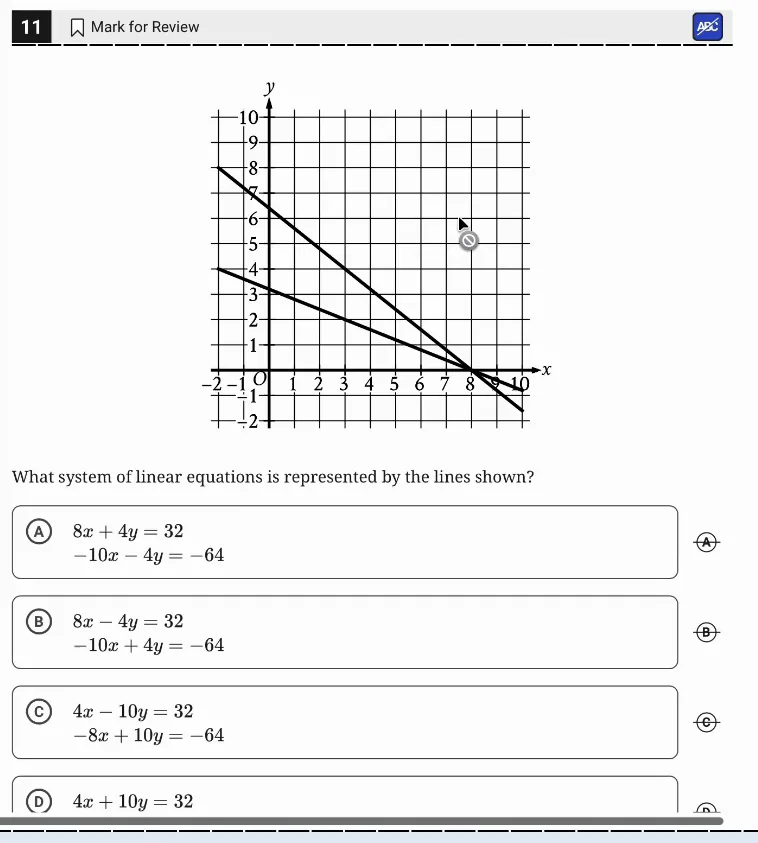
Practice Test 6, Module 2, Question 11Systems of two linear equations in two variables
Answer D
How it's solved: Trial and error in Desmos: graph each answer choice and pick the system whose lines match the picture, including where they cross.
12
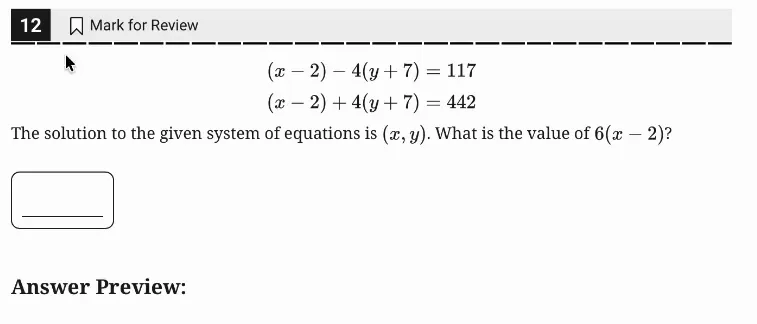
Practice Test 6, Module 2, Question 12Systems of two linear equations in two variables
Answer 1677
How it's solved: Graph both equations in Desmos, click the intersection for x, then evaluate the requested expression with that value.
13
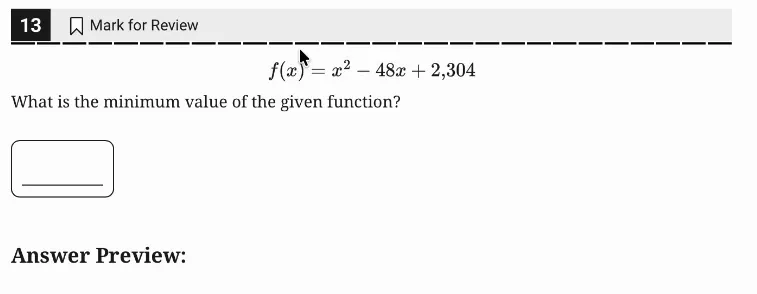
Practice Test 6, Module 2, Question 13Nonlinear functions
Answer 1728
How it's solved: Graph the quadratic in Desmos and click the vertex. Minimum value means the y-coordinate, not the x.
14
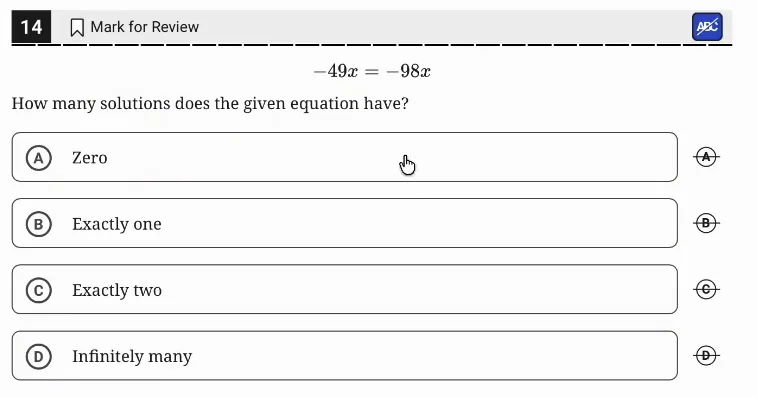
Practice Test 6, Module 2, Question 14Linear equations in one variable
Answer B
How it's solved: Graph both sides in Desmos and see a single crossing point, so the equation has exactly one solution.
15
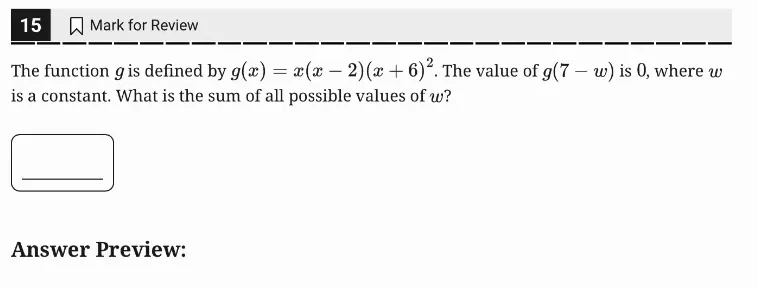
Practice Test 6, Module 2, Question 15Nonlinear functions
Answer 25
How it's solved: Enter the function in Desmos, rewrite the shifted input using x so it graphs, then click its zeros and add them.
16
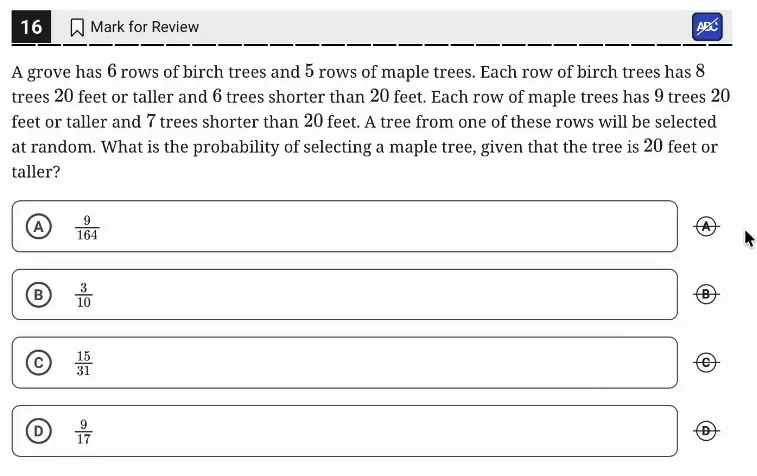
Practice Test 6, Module 2, Question 16Probability and conditional probability
Answer C
How it's solved: Build a two-way table by multiplying rows by trees per row, then divide the maple count by the total in the taller category.
17
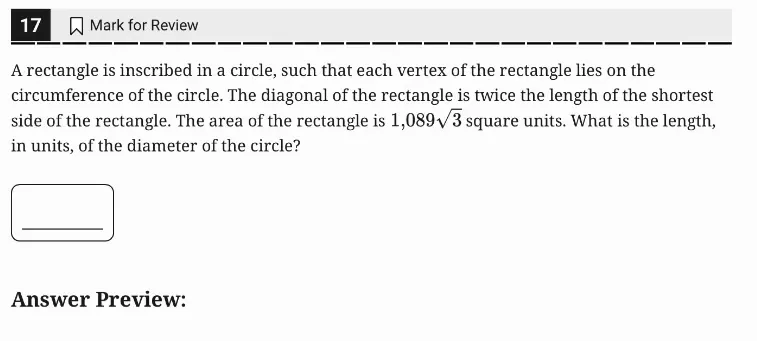
Practice Test 6, Module 2, Question 17Right triangles and trigonometry
Answer 66
How it's solved: Sketch the figure: the diagonal is the circle's diameter, and the side relationship signals a 30-60-90 triangle. Write area as length times width in Desmos.
18
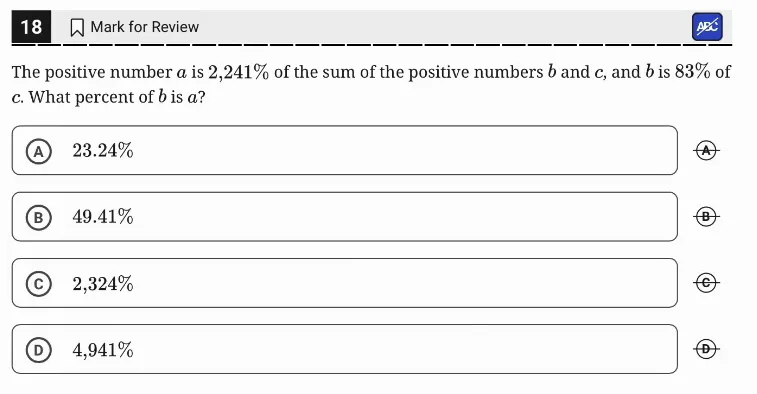
Practice Test 6, Module 2, Question 18Percentages
Answer D
How it's solved: Translate each sentence into an equation, give c any value in Desmos, and let it compute a over b as a percent.
19
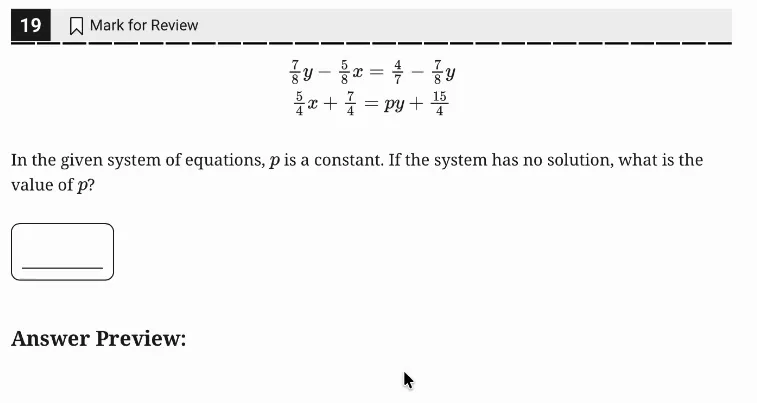
Practice Test 6, Module 2, Question 19Systems of two linear equations in two variables
Answer 3.5 or 7/2
How it's solved: Add a slider for p in Desmos and drag until the lines look parallel, zooming out to confirm. Algebraically, set the two slopes equal.
20
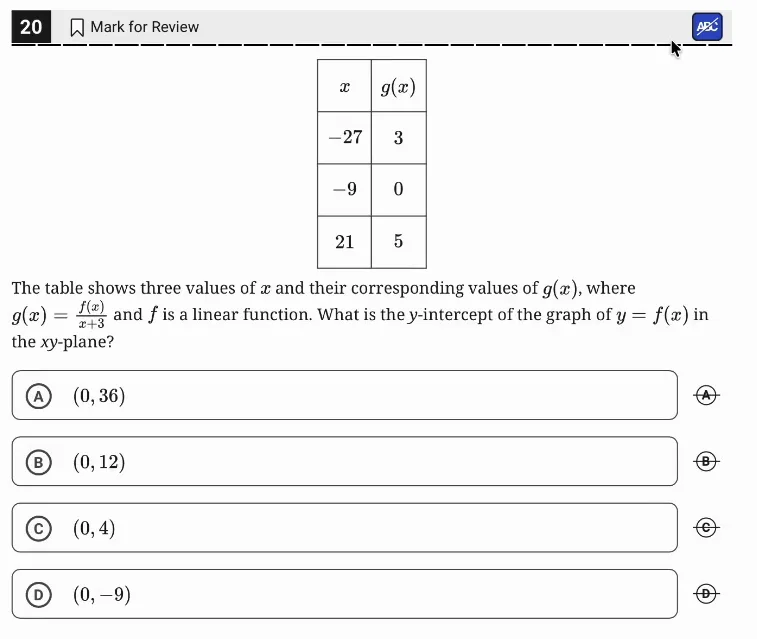
Practice Test 6, Module 2, Question 20Nonlinear functions
Answer A
How it's solved: Write f as mx plus b and run a custom regression on the table in Desmos to solve for m and b, then read the intercept.
21
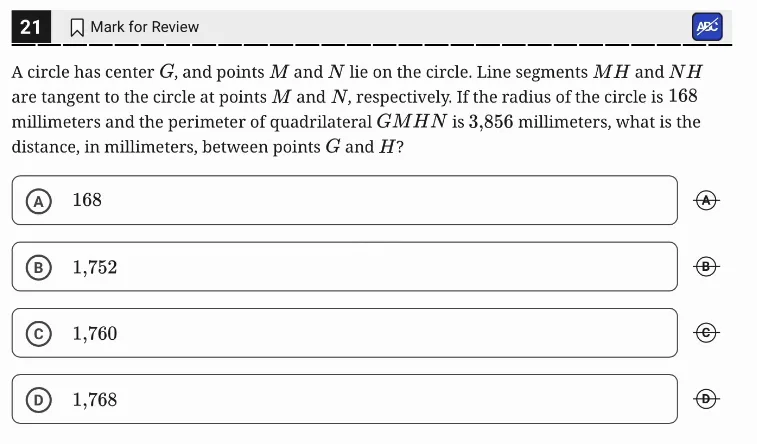
Practice Test 6, Module 2, Question 21Circles
Answer D
How it's solved: Sketch the tangents, use equal tangent lengths and right angles at the radii, solve the perimeter equation, then finish with the Pythagorean theorem.
22
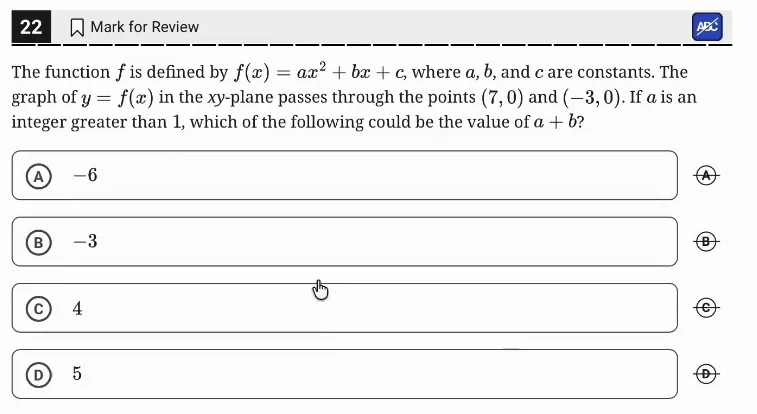
Practice Test 6, Module 2, Question 22Nonlinear functions
Answer A
How it's solved: Write the quadratic in factored form from its x-intercepts, expand with leading coefficient a, express a plus b in terms of a, and test each choice.
Practice Test 6 Answer Key and Scoring
The video shows how to get each answer. The official answer key comes from College Board:
In Bluebook and My Practice. Bluebook shows your score as soon as you submit. Your full results are in My Practice: every question, your answer, the correct answer and a written explanation.
On paper. College Board also posts a printable version of Practice Test 6 with an answer key, answer explanations and a scoring guide on its SAT Suite site.
Use My Practice to find which questions you missed, then come back here for the fastest way to solve them. To see what a given number of misses does to your score, use how many you can miss on SAT Math.
After Test 6
Sigma Prep has a mock version of Test 6, modeled question for question on the real one in three versions, so you can retest the same material with fresh problems. Every question has a video explanation. The Test 4 mock is free: try a full-length timed practice test. Start free today!
Common Questions
After you submit Practice Test 6 in Bluebook, your full results are in My Practice on the College Board site: every question, your answer, the correct answer and a written explanation. College Board also posts a printable version of Practice Test 6 with an answer key, answer explanations and a scoring guide. The video on this page adds the fastest way to solve each one.
On this page. Every one of the 44 math questions from Bluebook Practice Test 6 has its own section, from Module 1 Question 1 to Module 2 Question 22, with the correct answer, the skill it tests, how it is solved, and a video clip of just that question. The full walkthrough video above solves all 44 in order, often with Desmos rather than algebra.
Take the test timed in Bluebook first, score it, and pull out every question you missed or guessed on. Then jump to only those questions in the video and ask one thing for each: could I have recognized this setup, and did I know the move? Do not watch all 49 minutes like a movie.
Not as a measurement, because memory inflates the score. Sigma Prep Test 6 mirrors the official test question for question with fresh problems, in three versions, so you can check whether the skills are really there.
Want more SAT tips like this?
One article a week. No spam.
Ready to raise your SAT Math score?
Take the free Diagnostic Quiz and see where you stand. No payment required.