SAT Practice Test 10 Math Answers Explained: All 44 Questions on Video
Σ
Sigma Prep
SAT Math Instructor · 10+ Years Experience
August 13, 2026·Updated October 16, 2026·4 min read
Practice Test 10 is one of the newest official tests, and this is its complete math section solved live: every shortcut, every Desmos trick, no cuts and no script.
When you review Test 10, give every miss the same question: was this a type I did not recognize, or a point I gave away? The clips below give you the fastest route for the first kind.
Do not wave off the second kind. Misreading the question, dropping a sign or answering for x when it asked for 2x costs exactly as much as not knowing the math, and at higher scores two careless mistakes is the difference between a 750 and a 770. If giveaways keep showing up, slow down on the read and check what the question asked before you pick an answer. The full review method is in the Test 4 post.
All 44 Practice Test 10 Math Questions, One at a Time
Every math question from official Practice Test 10, in order, as it appears in the walkthrough. Each one has the correct answer, how it's solved, and a clip of just that question.
Module 1
1
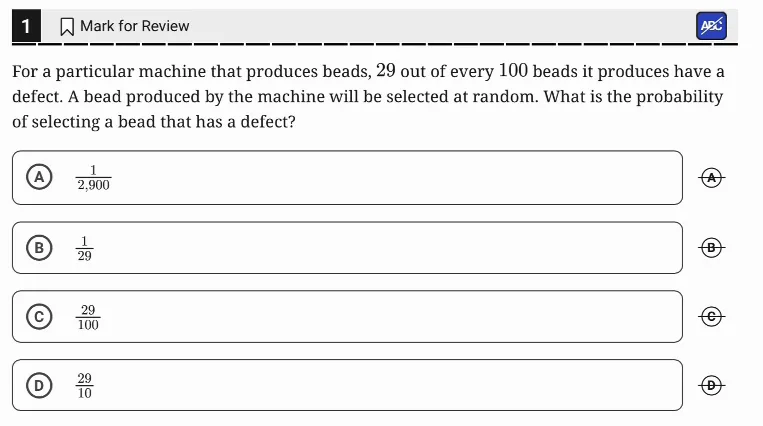
Practice Test 10, Module 1, Question 1Probability and conditional probability
Answer C
How it's solved: Mental math: write the favorable outcomes over the total outcomes as a fraction.
2
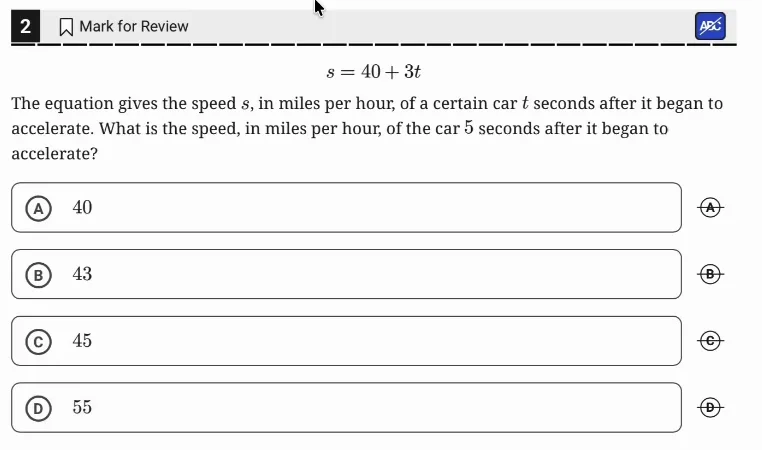
Practice Test 10, Module 1, Question 2Linear functions
Answer D
How it's solved: Substitute the given time into the linear equation and evaluate it mentally.
3
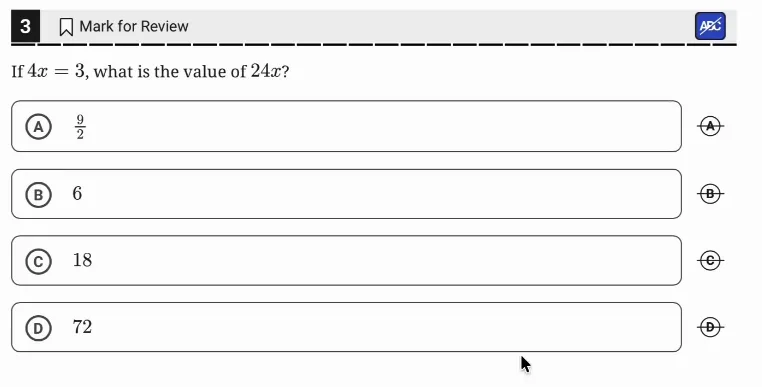
Practice Test 10, Module 1, Question 3Linear equations in one variable
Answer C
How it's solved: Spot the multiplier that turns the left side into the target expression and apply it to both sides. Solving for x in Desmos works too.
4
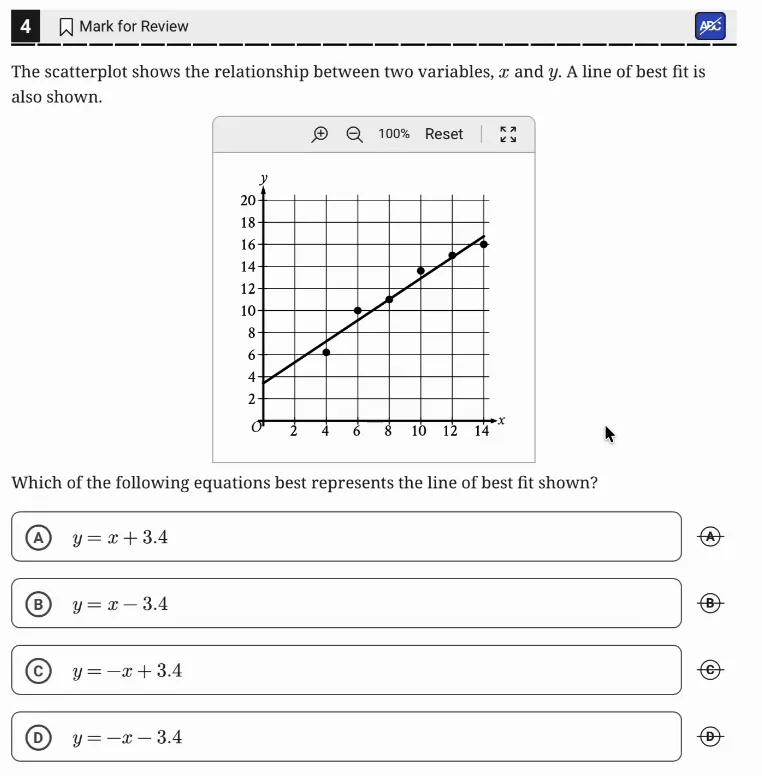
Practice Test 10, Module 1, Question 4Two-variable data: models and scatterplots
Answer A
How it's solved: Use the intercept sign and slope direction to eliminate choices, then confirm with a Desmos linear regression on two points read from the line.
5
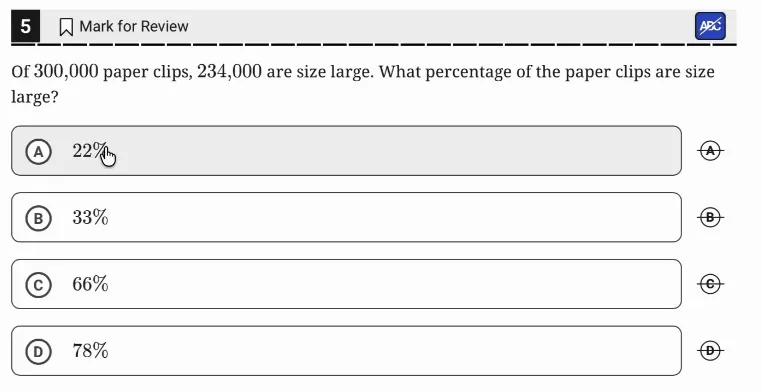
Practice Test 10, Module 1, Question 5Percentages
Answer D
How it's solved: Divide the part by the whole and convert the decimal to a percent.
6
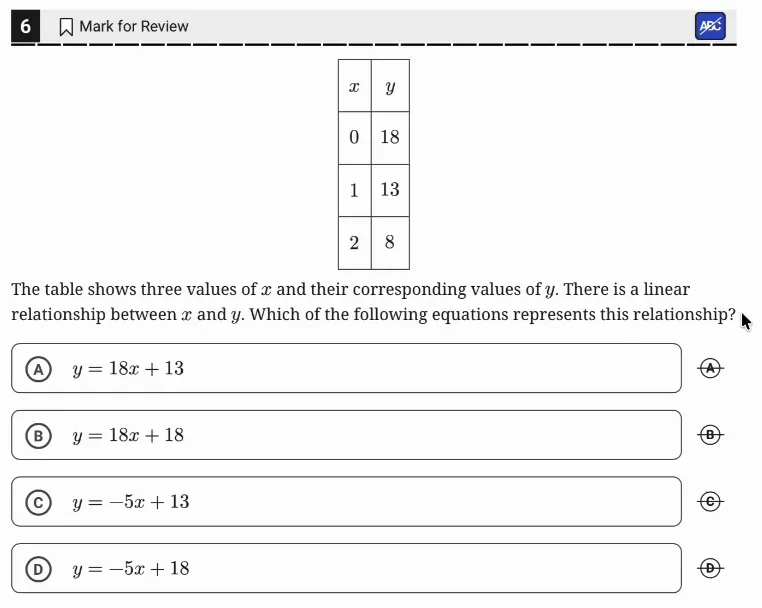
Practice Test 10, Module 1, Question 6Linear equations in two variables
Answer D
How it's solved: Enter two points from the table into Desmos and run a linear regression to get the equation.
7
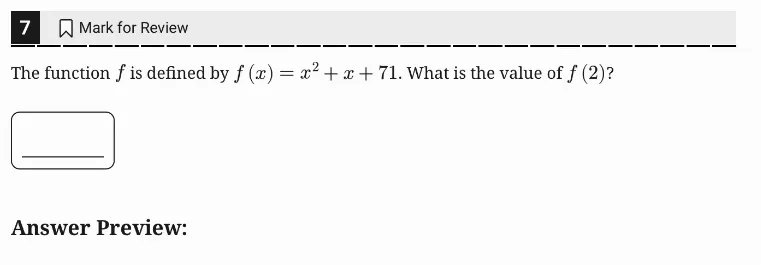
Practice Test 10, Module 1, Question 7Nonlinear functions
Answer 77
How it's solved: Define the function in Desmos, then evaluate it at the given input.
8
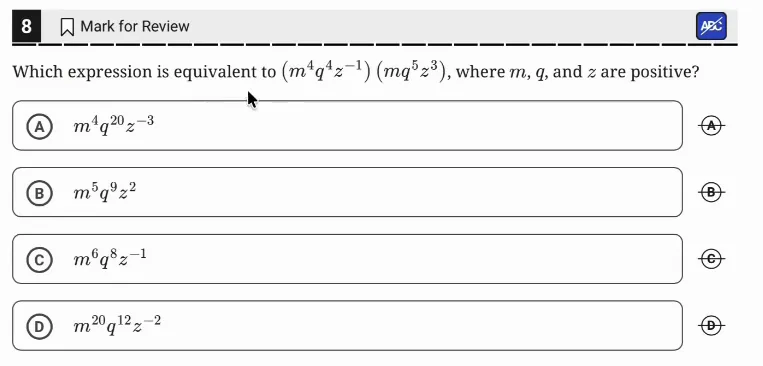
Practice Test 10, Module 1, Question 8Equivalent expressions
Answer B
How it's solved: Algebra with exponent rules: when multiplying like bases, add the exponents for each variable.
9
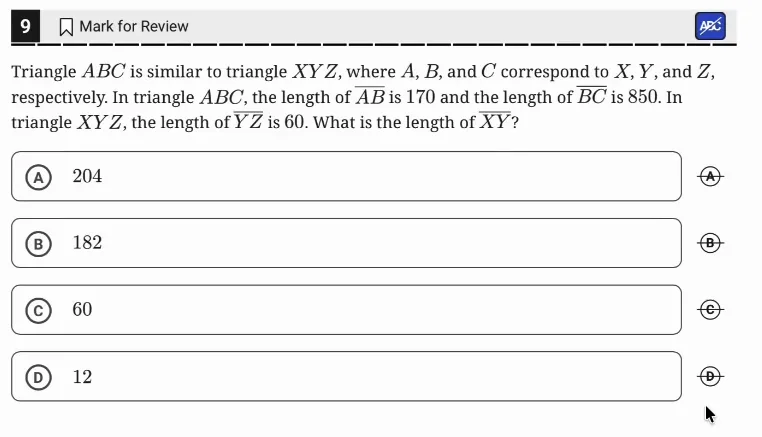
Practice Test 10, Module 1, Question 9Lines, angles, and triangles
Answer D
How it's solved: Find the scale factor from the known pair of corresponding sides, then divide the matching side of the other triangle by it.
10
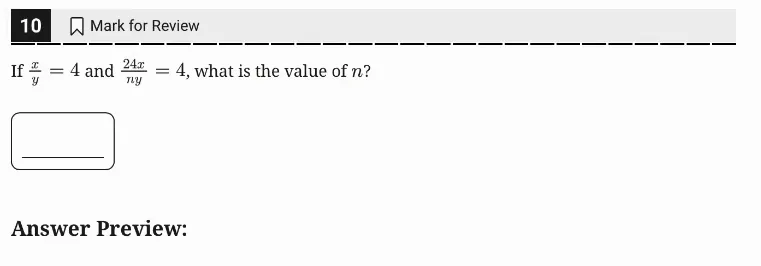
Practice Test 10, Module 1, Question 10Ratios, rates, proportional relationships, and units
Answer 24
How it's solved: Rewrite the fraction as a constant times the given ratio, substitute that ratio's value, and solve. Plugging in sample values and solving in Desmos also works.
11
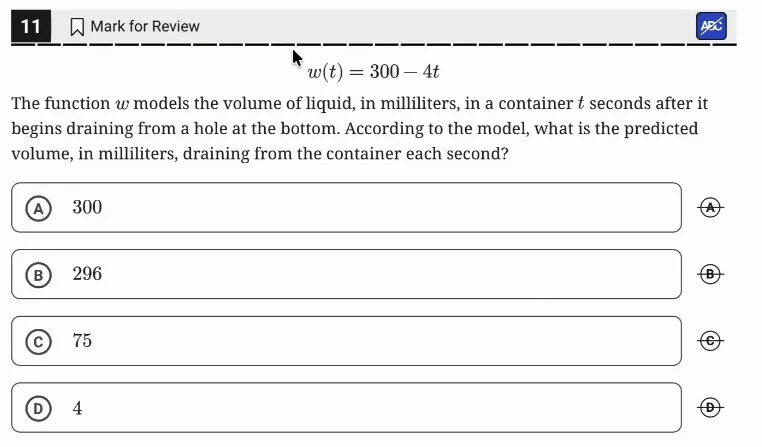
Practice Test 10, Module 1, Question 11Linear functions
Answer D
How it's solved: Recognize the question asks for the rate of change, so read the slope, the coefficient on the variable, from the linear model.
12
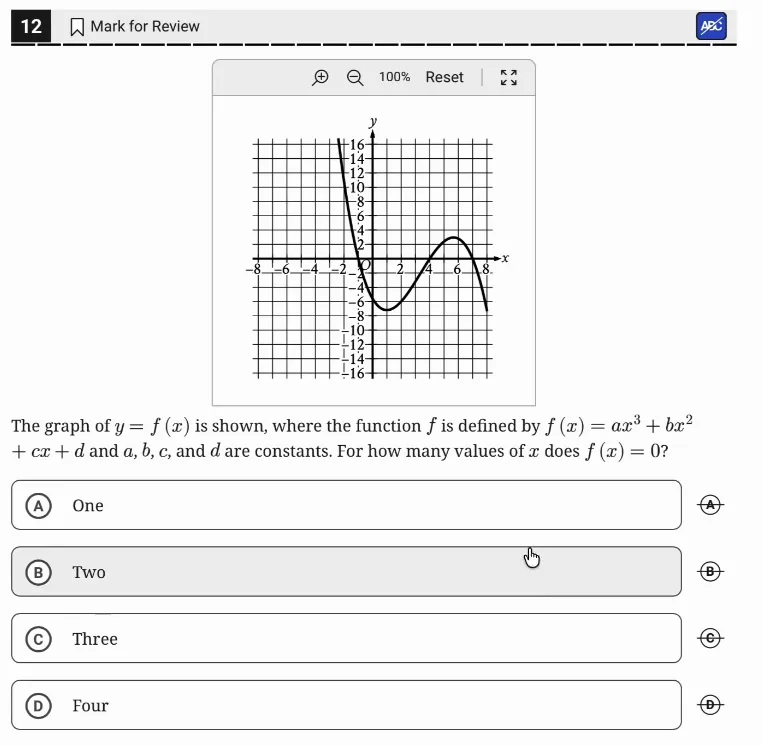
Practice Test 10, Module 1, Question 12Nonlinear functions
Answer C
How it's solved: Read a zero output as asking for x-intercepts, then count where the graph crosses the x-axis.
13
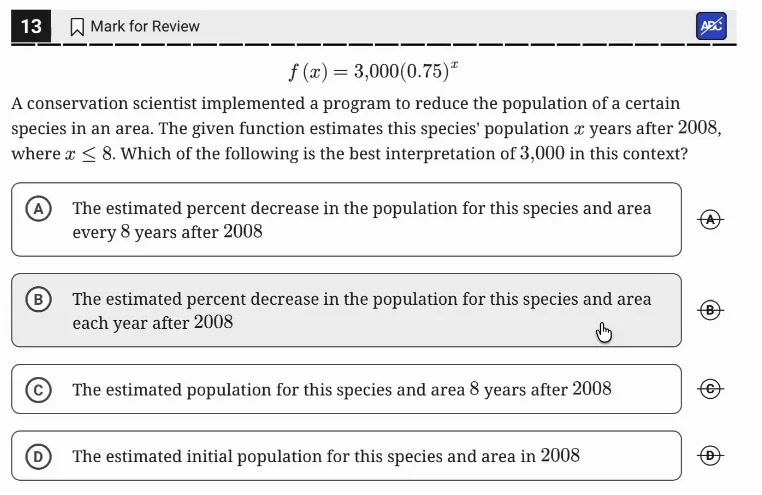
Practice Test 10, Module 1, Question 13Nonlinear functions
Answer D
How it's solved: Match the parts of the exponential form: the leading coefficient is the initial value, while the base describes the decay.
14
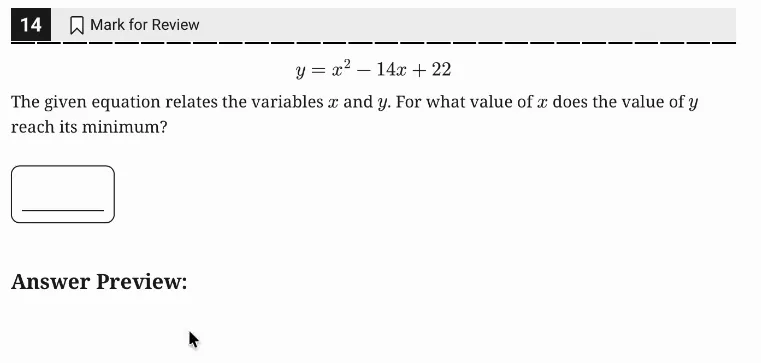
Practice Test 10, Module 1, Question 14Nonlinear functions
Answer 7
How it's solved: Graph the quadratic in Desmos and click the vertex, reporting its x-coordinate as asked.
15
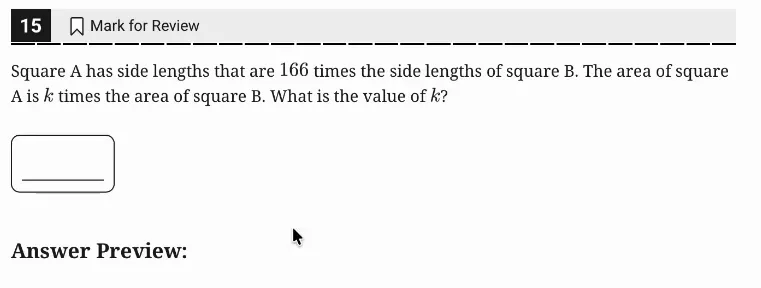
Practice Test 10, Module 1, Question 15Area and volume
Answer 27556
How it's solved: Proportionality: when side lengths scale by a factor, area scales by that factor squared.
16
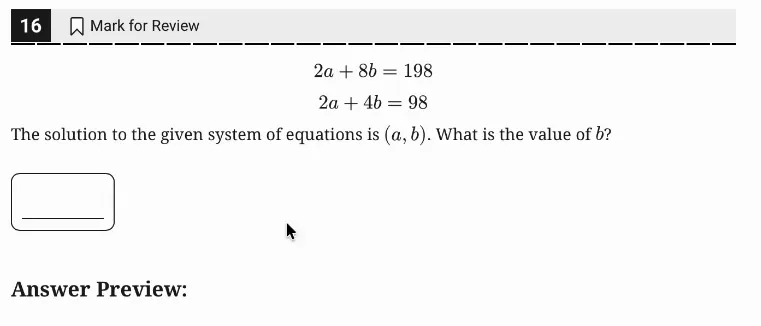
Practice Test 10, Module 1, Question 16Systems of two linear equations in two variables
Answer 25
How it's solved: Rename the variables to x and y, graph both lines in Desmos, and click the intersection to read the requested coordinate.
17
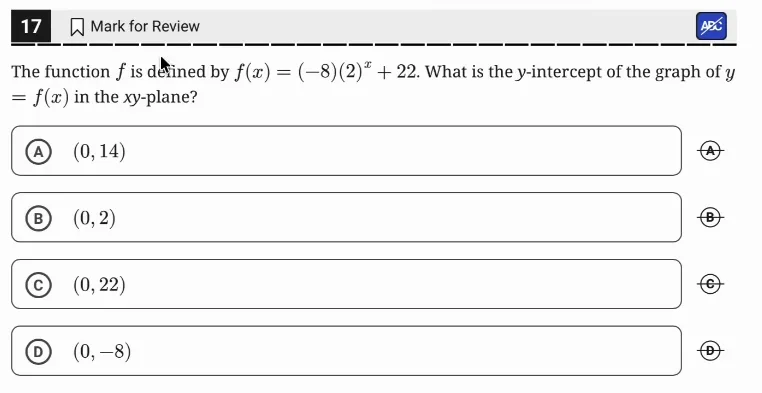
Practice Test 10, Module 1, Question 17Nonlinear functions
Answer A
How it's solved: Type the function into Desmos and click where the graph meets the y-axis.
18
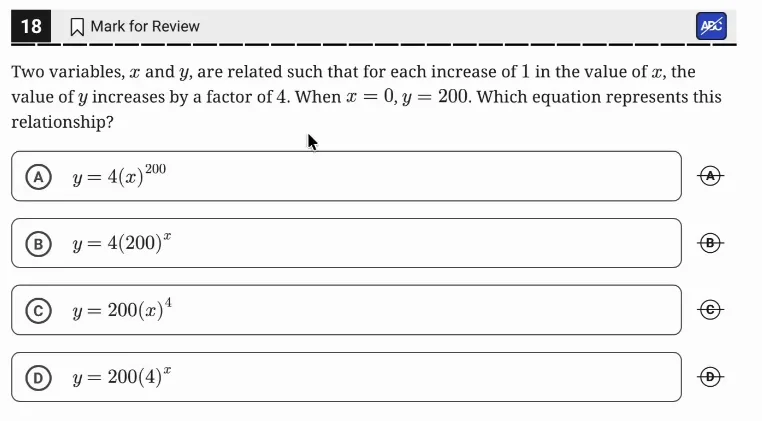
Practice Test 10, Module 1, Question 18Nonlinear functions
Answer D
How it's solved: Test each choice by substituting zero for x and keep the one that returns the stated starting value. The initial-value coefficient confirms it.
19
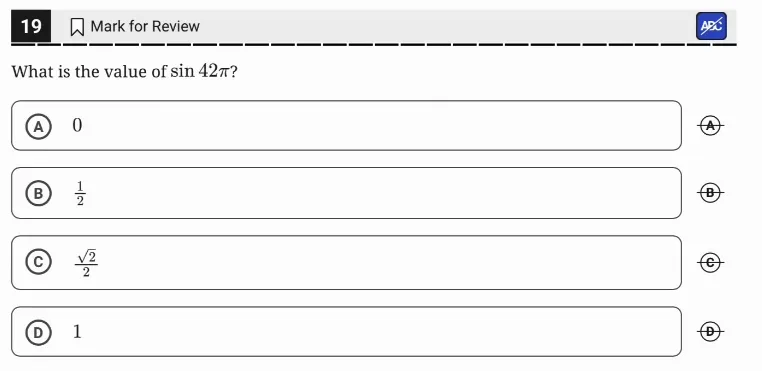
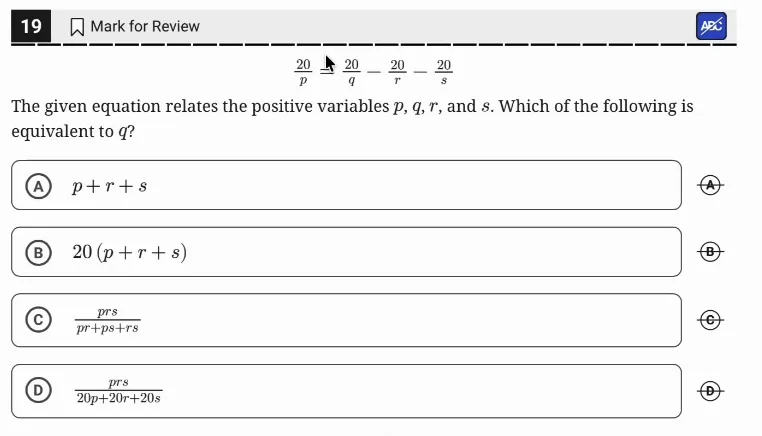
Practice Test 10, Module 1, Question 19Circles
Answer A
How it's solved: Evaluate the sine directly in Desmos, making sure the angle mode is set to radians.
20
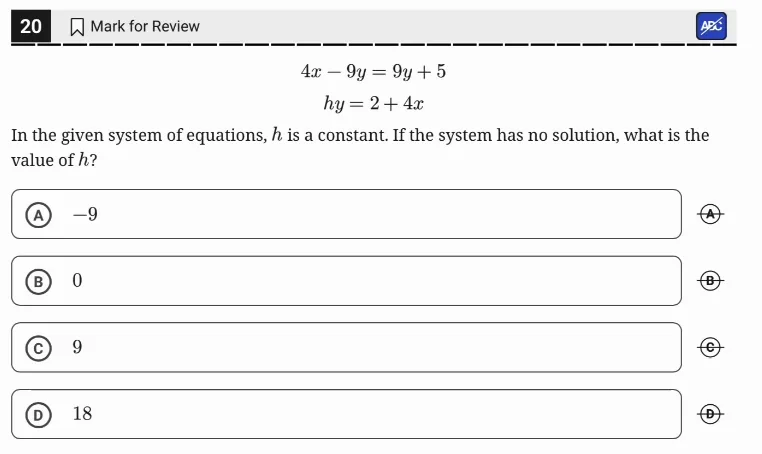
Practice Test 10, Module 1, Question 20Systems of two linear equations in two variables
Answer D
How it's solved: No solution means parallel lines. Graph both equations in Desmos and try each choice for the constant until the lines run parallel.
21
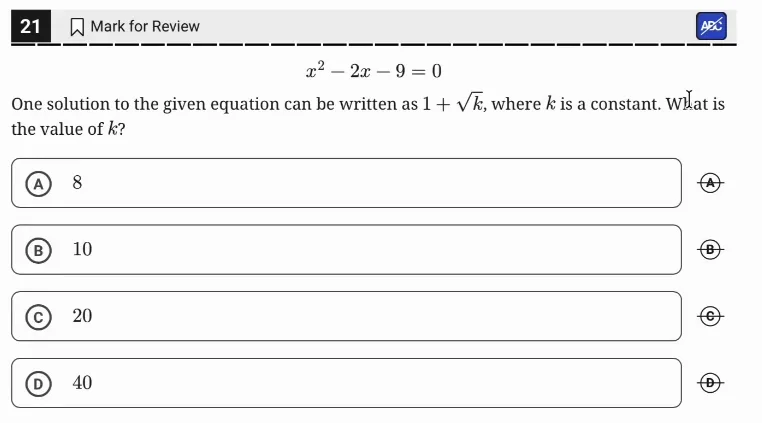
Practice Test 10, Module 1, Question 21Nonlinear equations in one variable and systems of equations in two variables
Answer B
How it's solved: Graph the quadratic in Desmos to find its roots, then evaluate each choice in the given radical form to see which matches a root.
22
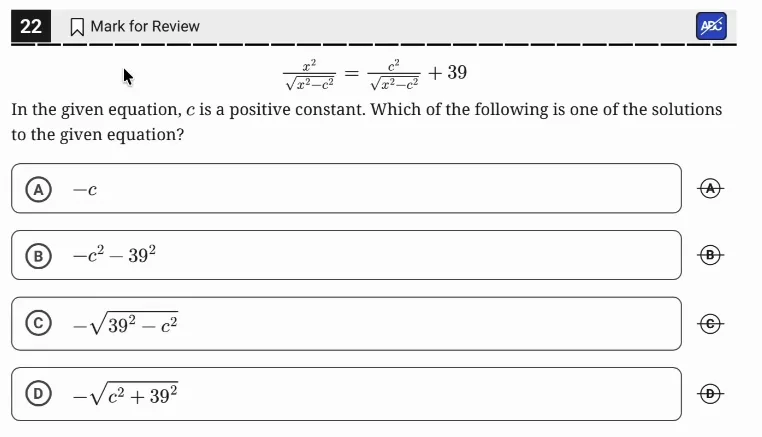
Practice Test 10, Module 1, Question 22Nonlinear equations in one variable and systems of equations in two variables
Answer D
How it's solved: Give the constant a positive sample value so Desmos can graph the equation, find a root, then test which choice reproduces it.
Module 2
1
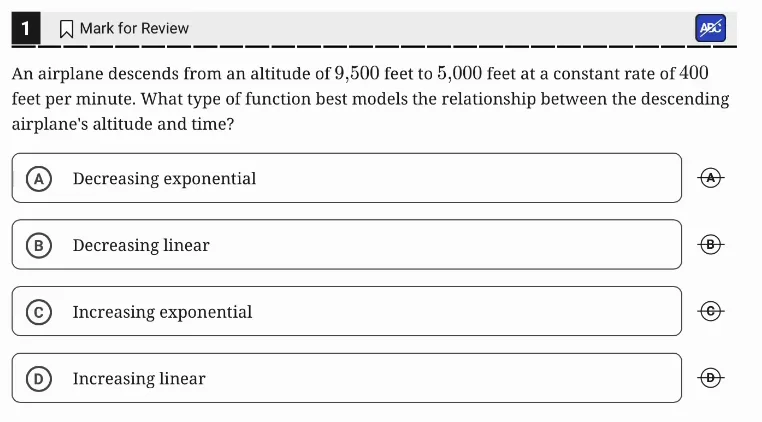
Practice Test 10, Module 2, Question 1Two-variable data: models and scatterplots
Answer B
How it's solved: A constant rate of change signals a linear model, and a falling quantity means it is decreasing.
2
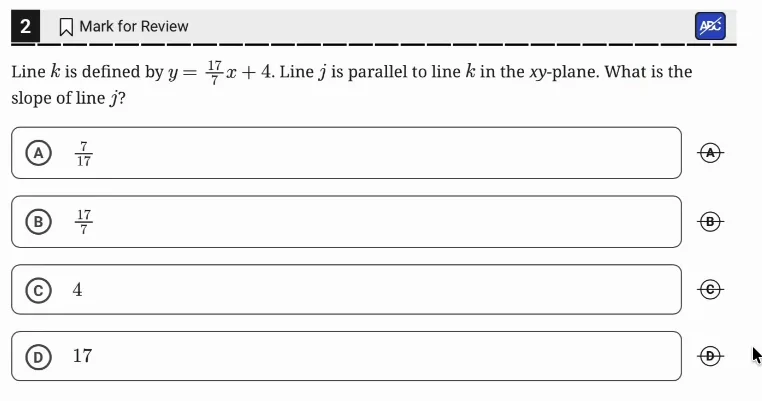
Practice Test 10, Module 2, Question 2Linear equations in two variables
Answer B
How it's solved: Parallel lines share a slope, so read the slope straight from the given equation.
3
Practice Test 10, Module 2, Question 3Linear functions
Answer C
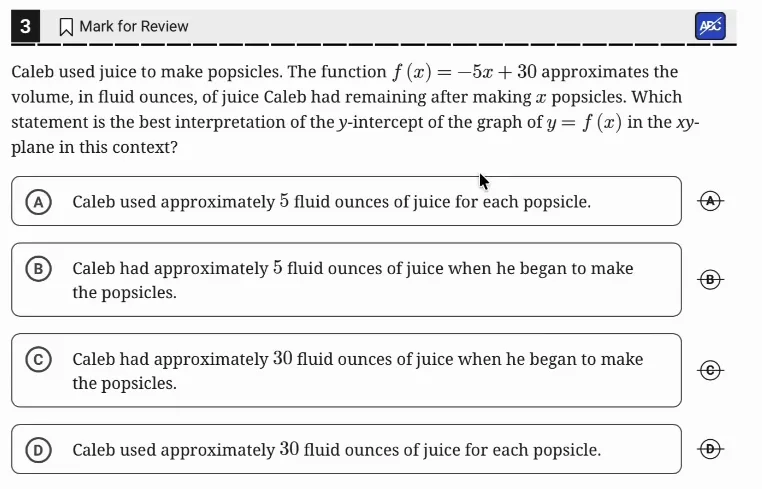
How it's solved: Identify the constant term as the starting value and pick the choice describing the initial amount, ruling out wording that signals slope.
4
Practice Test 10, Module 2, Question 4Nonlinear functions
Answer B
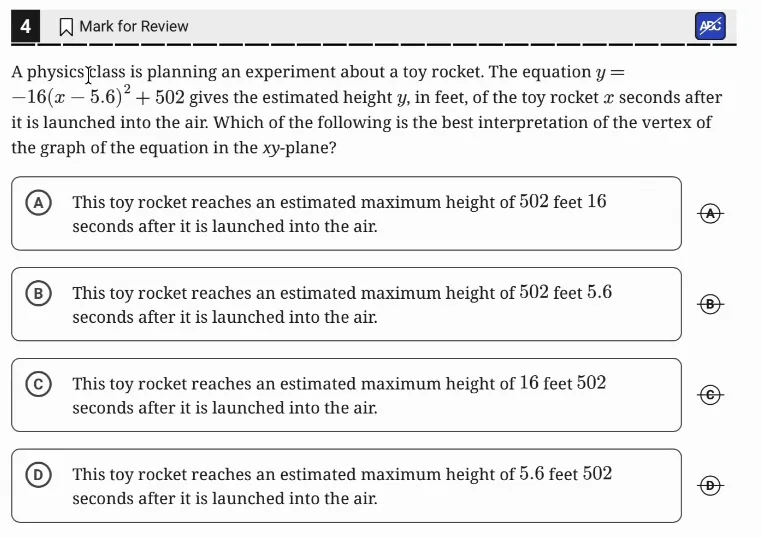
How it's solved: Graph in Desmos to confirm the vertex is a maximum, then match its x-coordinate to time and its y-coordinate to height.
5
Practice Test 10, Module 2, Question 5Linear functions
Answer 67
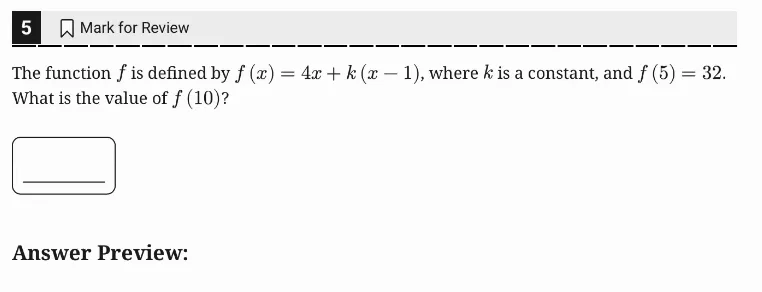
How it's solved: Use the given function value to write an equation for the constant, solve it in Desmos, then evaluate the function at the new input.
6
Practice Test 10, Module 2, Question 6Lines, angles, and triangles
Answer B
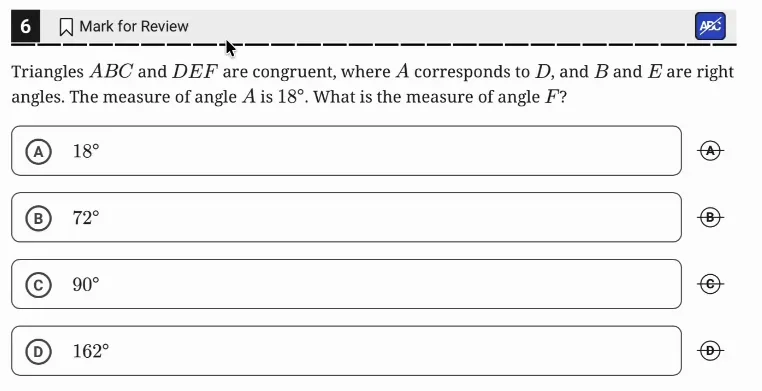
How it's solved: Congruent triangles have matching angles, so use the right angle to find the complement of the known angle.
7
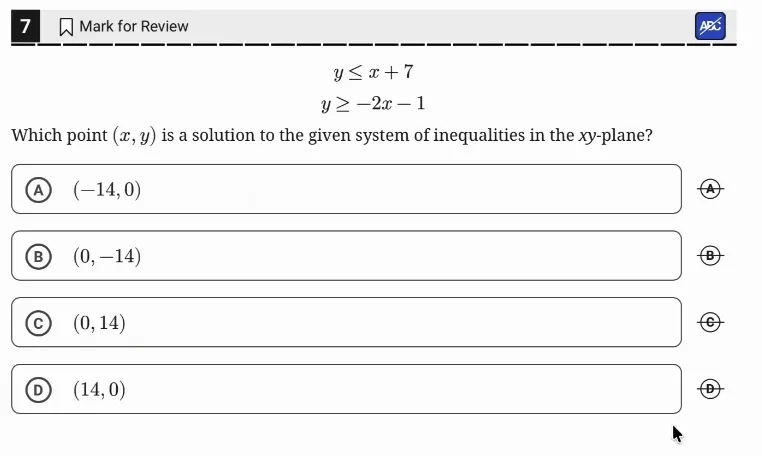
Practice Test 10, Module 2, Question 7Linear inequalities in one or two variables
Answer D
How it's solved: Graph both inequalities in Desmos, plot each answer point, and pick the one inside the overlapping shaded region.
8
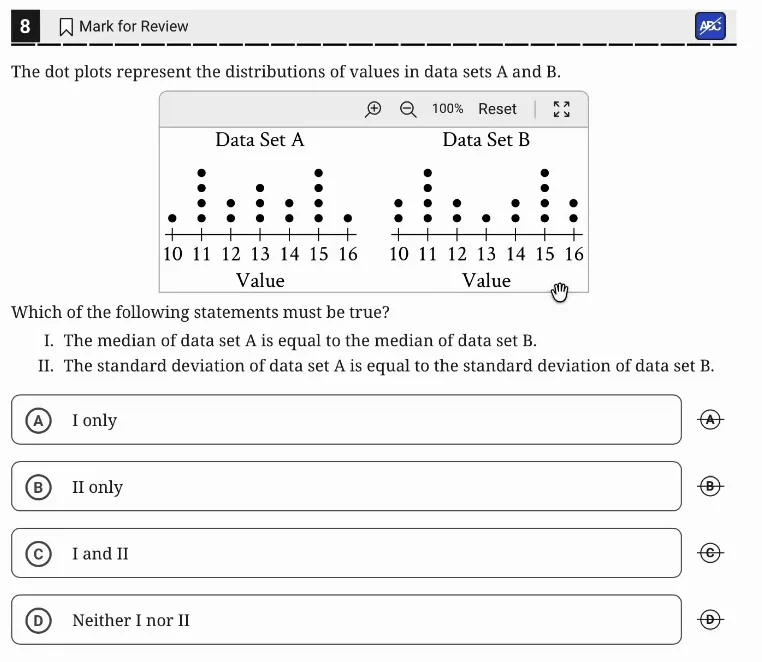
Practice Test 10, Module 2, Question 8One-variable data: distributions and measures of center and spread
Answer A
How it's solved: Both dot plots are symmetric, so their medians sit at the center. Desmos median and standard deviation commands confirm the comparison.
9
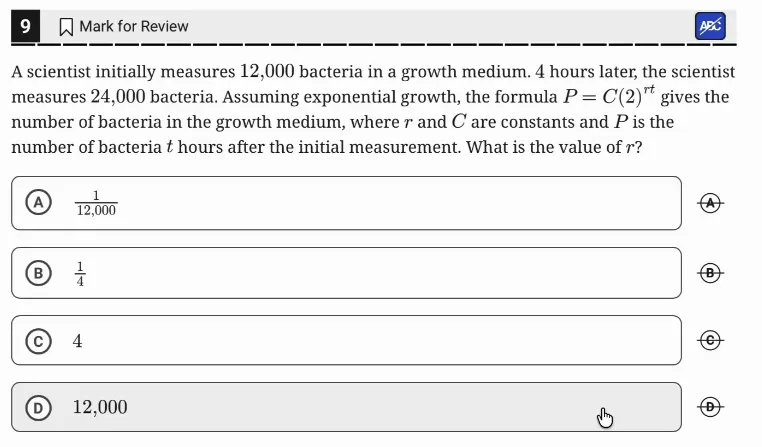
Practice Test 10, Module 2, Question 9Nonlinear functions
Answer B
How it's solved: Substitute the initial amount, later amount, and elapsed time into the exponential model, then test each choice in Desmos for the growth constant.
10
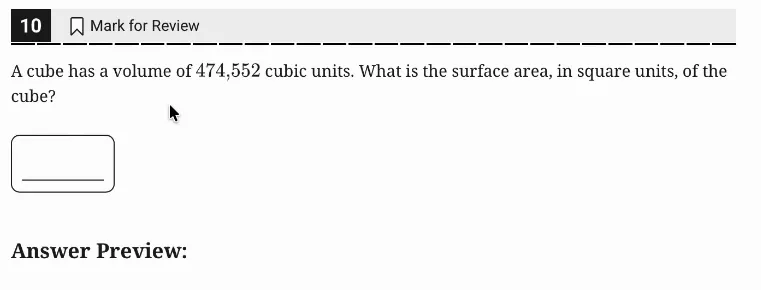
Practice Test 10, Module 2, Question 10Area and volume
Answer 36504
How it's solved: Set the volume equal to x cubed in Desmos to find the edge length, then compute surface area as six times the edge squared.
11
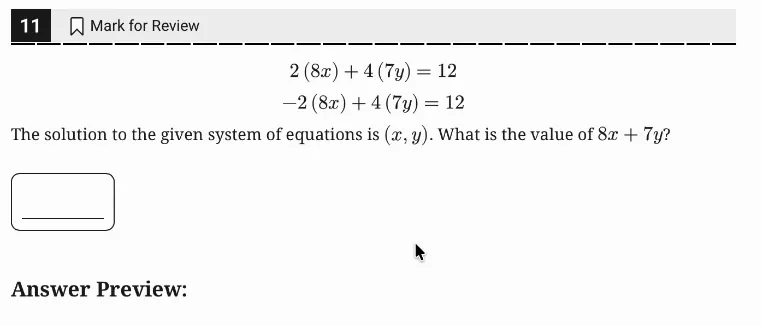
Practice Test 10, Module 2, Question 11Systems of two linear equations in two variables
Answer 3
How it's solved: Graph both equations in Desmos, click the intersection, and plug its coordinates into the requested expression.
12
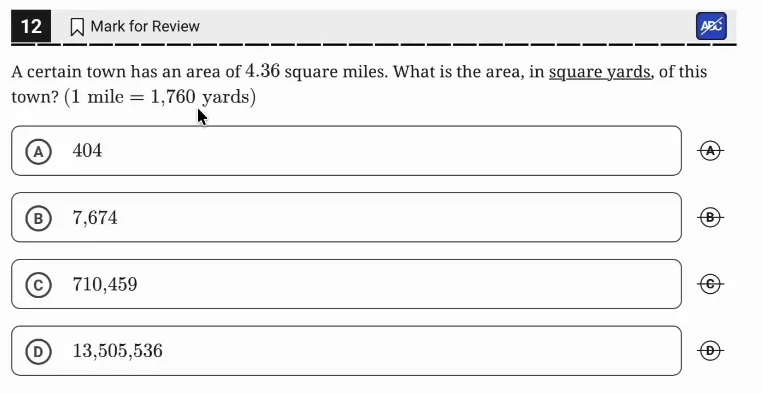
Practice Test 10, Module 2, Question 12Ratios, rates, proportional relationships, and units
Answer D
How it's solved: Dimensional analysis: because the units are squared, square the conversion factor before multiplying.
13
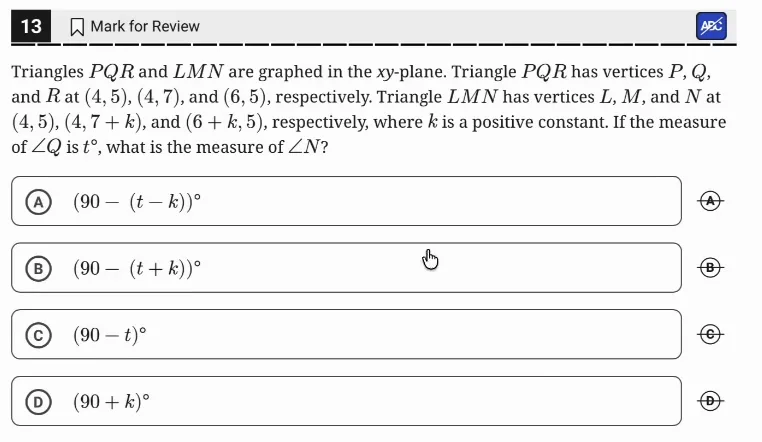
Practice Test 10, Module 2, Question 13Lines, angles, and triangles
Answer C
How it's solved: Plot the vertices in Desmos with a sample value for the unknown constant, then recognize nested similar triangles so corresponding angles match.
14
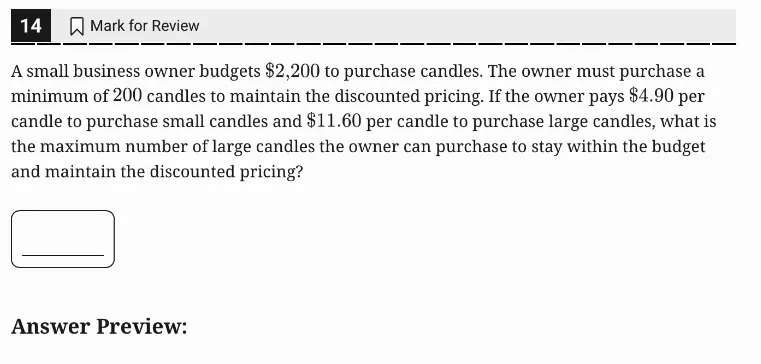
Practice Test 10, Module 2, Question 14Linear inequalities in one or two variables
Answer 182
How it's solved: Write a budget inequality and a minimum-count inequality, graph both in Desmos, and find the largest whole-number y in the overlap.
15
Practice Test 10, Module 2, Question 15Right triangles and trigonometry
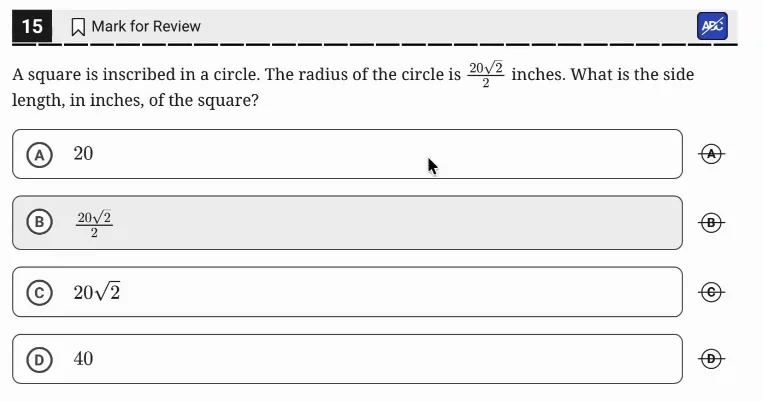
Answer A
How it's solved: Sketch the figure: the circle's diameter is the square's diagonal. Then use the Pythagorean theorem in Desmos or 45-45-90 ratios for the side.
16
Practice Test 10, Module 2, Question 16Circles
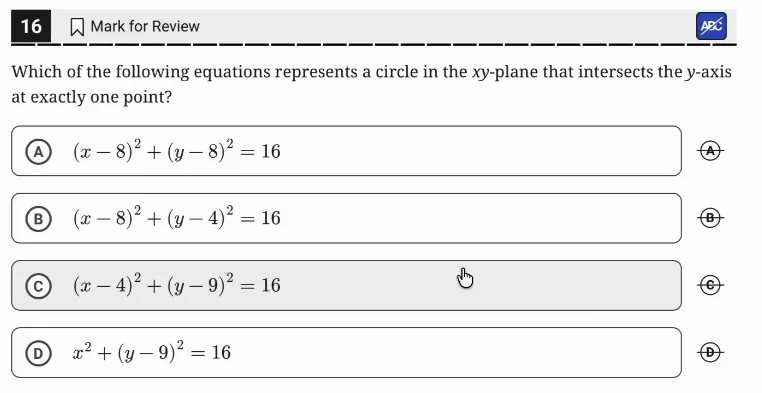
Answer C
How it's solved: Graph each circle in Desmos and keep the one that touches the y-axis at a single point.
17
Practice Test 10, Module 2, Question 17Systems of two linear equations in two variables
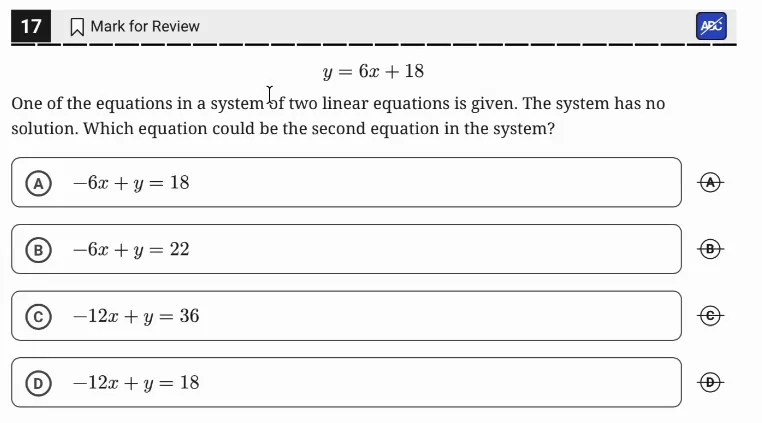
Answer B
How it's solved: No solution means parallel lines, so graph each choice in Desmos against the given line and find the parallel one.
18
Practice Test 10, Module 2, Question 18Equivalent expressions
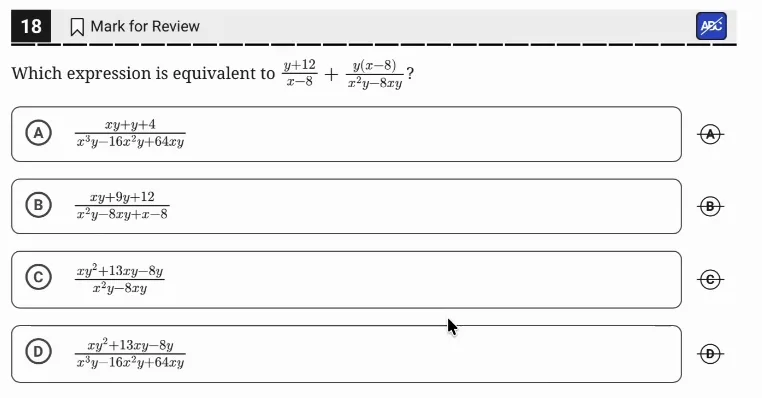
Answer C
How it's solved: Set the expression equal to a constant in Desmos, do the same for each choice, and find the graph that matches exactly.
19
Practice Test 10, Module 2, Question 19Nonlinear equations in one variable and systems of equations in two variables
Answer C
How it's solved: In Desmos, swap two variables for x and y and give the others numbers, then graph each choice to find the identical curve.
20
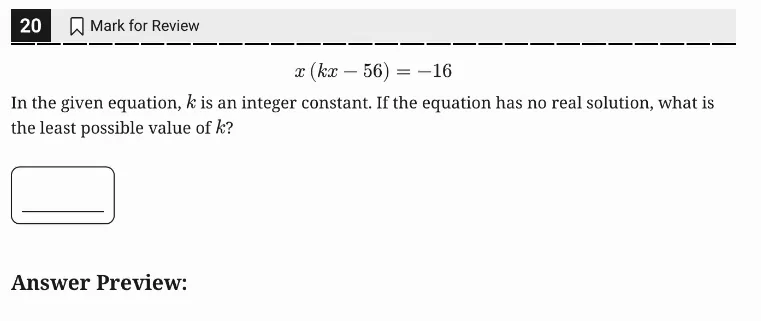
Practice Test 10, Module 2, Question 20Nonlinear equations in one variable and systems of equations in two variables
Answer 50
How it's solved: Expand into standard quadratic form, then graph the discriminant-below-zero inequality in Desmos with k as x and take the smallest integer in the region.
21
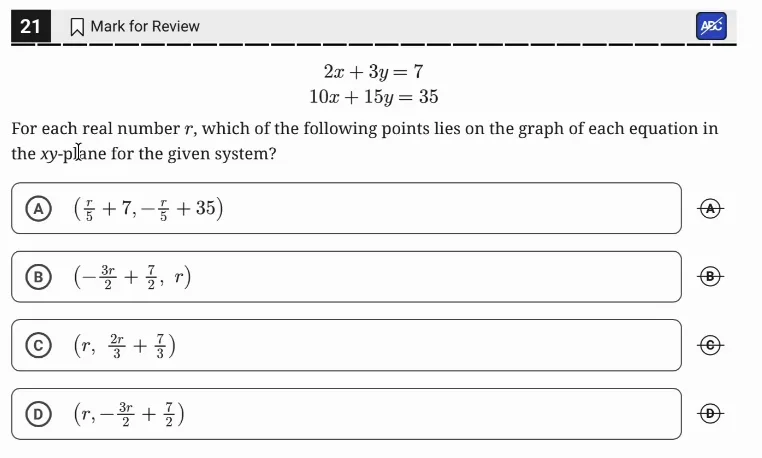
Practice Test 10, Module 2, Question 21Systems of two linear equations in two variables
Answer B
How it's solved: Both equations describe the same line. Pick a value for the parameter in Desmos and check which choice's point lands on it.
22
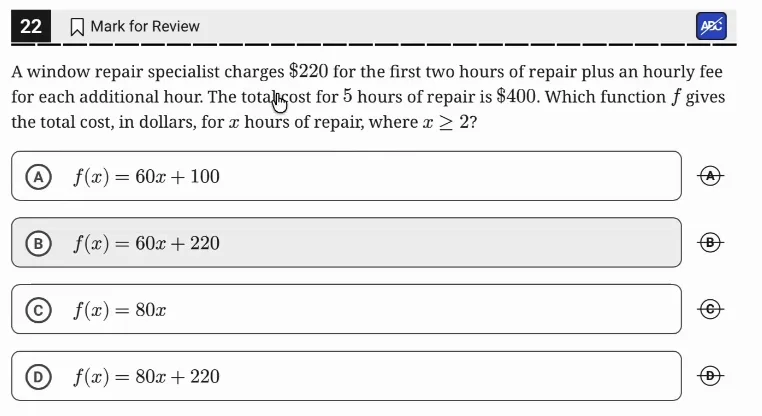
Practice Test 10, Module 2, Question 22Linear functions
Answer A
How it's solved: Turn the two cost facts into points, enter them in a Desmos table, and run a linear regression.
Practice Test 10 Answer Key and Scoring
The video shows how to get each answer. The official answer key comes from College Board:
In Bluebook and My Practice. Bluebook shows your score as soon as you submit. Your full results are in My Practice: every question, your answer, the correct answer and a written explanation.
On paper. College Board also posts a printable version of Practice Test 10 with an answer key, answer explanations and a scoring guide on its SAT Suite site.
Use My Practice to find which questions you missed, then come back here for the fastest way to solve them. To see what a given number of misses does to your score, use how many you can miss on SAT Math.
After Test 10
Sigma Prep's mock of Test 10 rebuilds it with new problems in three versions, video explanation on every question, so you can rehearse the same blueprint again without the answers riding along. The Test 4 mock is free: full-length timed practice tests. Start free today!
Common Questions
After you submit Practice Test 10 in Bluebook, your full results are in My Practice on the College Board site: every question, your answer, the correct answer and a written explanation. College Board also posts a printable version of Practice Test 10 with an answer key, answer explanations and a scoring guide. The video on this page adds the fastest way to solve each one.
On this page. Every one of the 44 math questions from Bluebook Practice Test 10 has its own section, from Module 1 Question 1 to Module 2 Question 22, with the correct answer, the skill it tests, how it is solved, and a video clip of just that question. The full walkthrough video above solves all 44 in order, often with Desmos rather than algebra.
Take the test timed in Bluebook first, score it, and pull out every question you missed or guessed on. Then jump to only those questions in the video and ask one thing for each: could I have recognized this setup, and did I know the move? Do not watch all 48 minutes like a movie.
Not as a measurement, because memory inflates the score. Sigma Prep Test 10 mirrors the official test question for question with fresh problems, in three versions, so you can check whether the skills are really there.
Want more SAT tips like this?
One article a week. No spam.
Ready to raise your SAT Math score?
Take the free Diagnostic Quiz and see where you stand. No payment required.