SAT Practice Test 4 Math Answers Explained: All 44 Questions on Video
Σ
Sigma Prep
SAT Math Instructor · 10+ Years Experience
May 8, 2026·Updated October 16, 2026·5 min read
If you just took official Practice Test 4 in Bluebook and you want to know how to solve the ones you missed, this is the video for you. Every one of the 44 math questions, solved start to finish in real time. No cuts, no edits, no script. Just the fastest route through each problem, which on this test very often means Desmos instead of algebra.
Already took Test 4? Skip the full video. Find the questions you missed or guessed on in the question list below and watch just those. Each one plays only that question. For every miss, ask yourself two things: could I have recognized this setup, and did I know the move?
Haven't taken it yet? Take it first, timed, in Bluebook, then come back and review your misses here. The test only measures you once, so it is worth saving for real conditions.
Want to use the video as practice instead? Pause before each question, solve it yourself, then watch how it is solved and compare. Did you get there the same way, or is there a faster route?
Any question type you could not recognize goes on your drill list: understand it, then repeat the type until you spot it on sight. That loop is the engine behind the full 800 plan.
Watch How Often Desmos Does the Work
As you go through the video, count how many questions get solved with no algebra at all. Type the equation in, read the answer off the graph. Systems, quadratics, medians, intersections. If you have been solving those by hand, that is minutes of test time you are giving away, and the Desmos advantage is the single fastest thing to steal from this walkthrough.
All 44 Practice Test 4 Math Questions, One at a Time
Every math question from official Practice Test 4, in order, as it appears in the walkthrough. Each one has the correct answer, how it's solved, and a clip of just that question.
Module 1
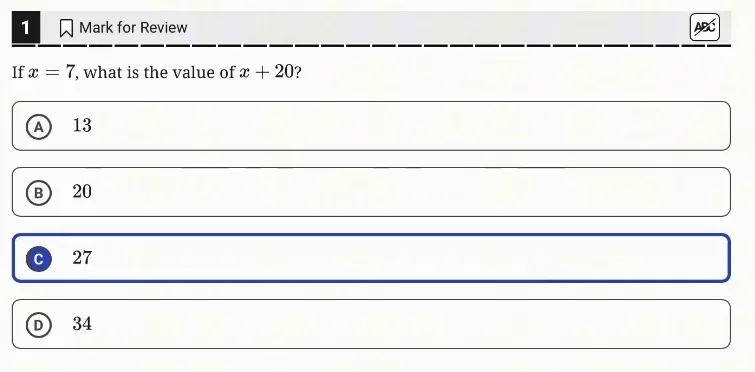
1
Practice Test 4, Module 1, Question 1Linear equations in one variable
Answer C
How it's solved: Mental math: substitute the given value into the expression and add.
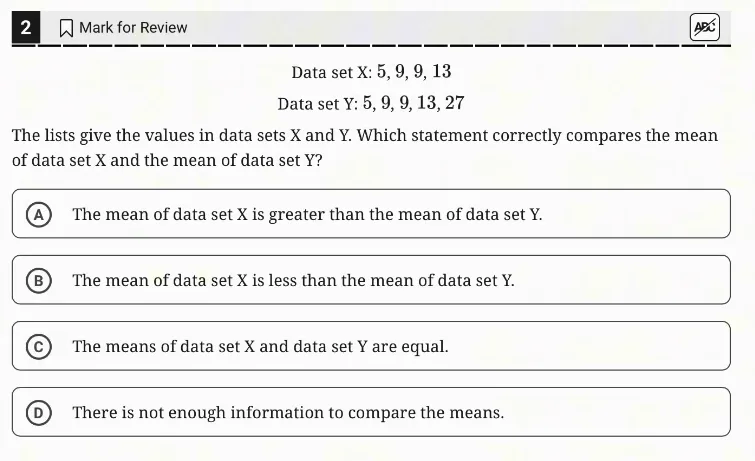
2
Practice Test 4, Module 1, Question 2One-variable data: distributions and measures of center and spread
Answer B
How it's solved: Type each list into Desmos with the mean function and compare the two results.
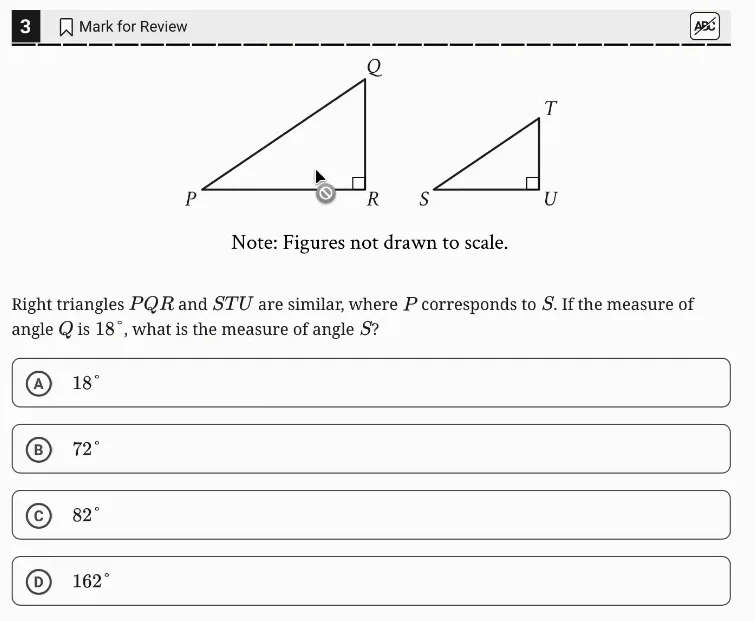
3
Practice Test 4, Module 1, Question 3Lines, angles, and triangles
Answer B
How it's solved: Corresponding angles of similar triangles match, so find the matching angle, then use the fact that the two acute angles of a right triangle are complementary.
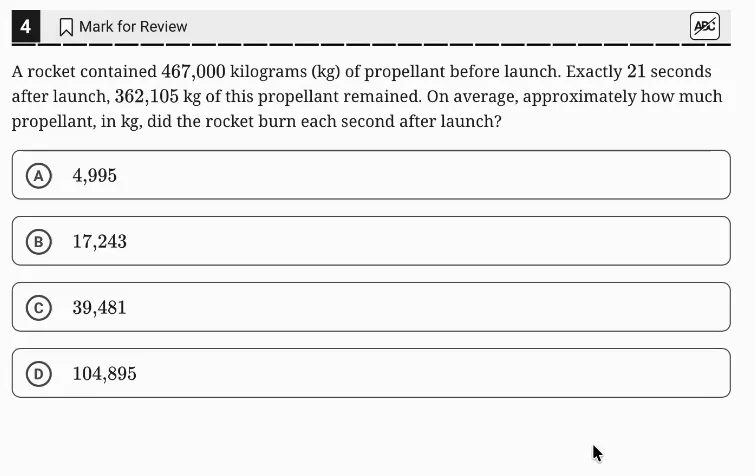
4
Practice Test 4, Module 1, Question 4Linear equations in one variable
Answer A
How it's solved: Treat it as a rate. Enter the before and after points in a Desmos table and run a linear regression to read the slope.
5
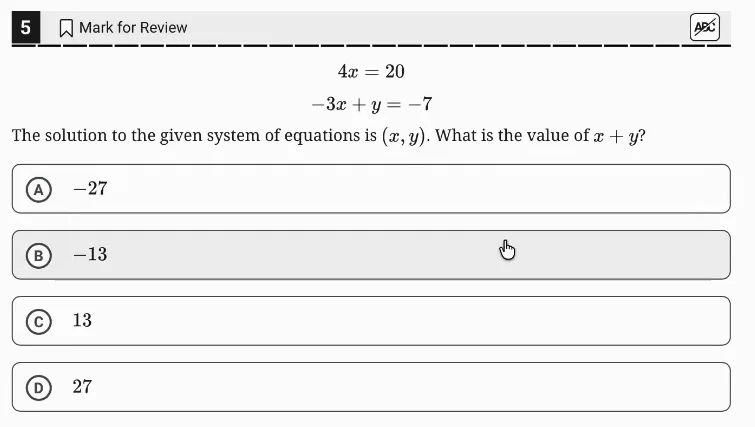
Practice Test 4, Module 1, Question 5Systems of two linear equations in two variables
Answer C
How it's solved: Graph both equations in Desmos, click the intersection, and add the coordinates.
6
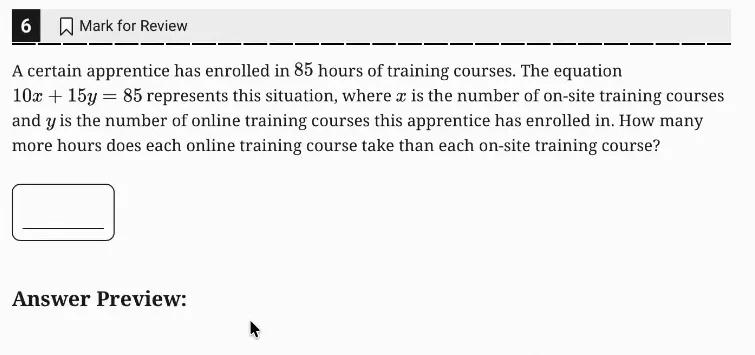
Practice Test 4, Module 1, Question 6Linear equations in two variables
Answer 5
How it's solved: No calculation needed. Read each coefficient as the time per item of that type and subtract the smaller from the larger.
7
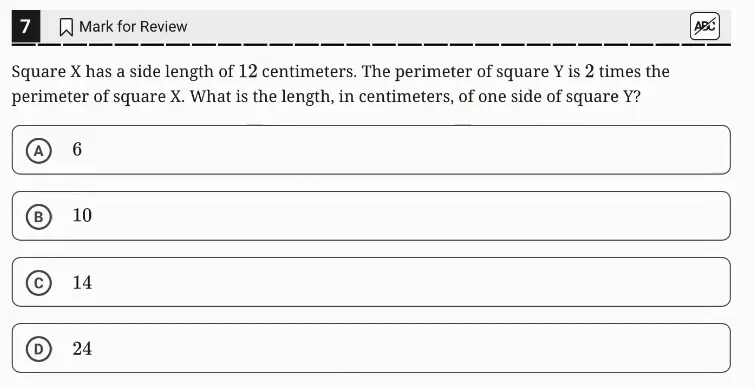
Practice Test 4, Module 1, Question 7Area and volume
Answer D
How it's solved: Perimeter scales the same way as side length, so apply the same scale factor directly to the side.
8
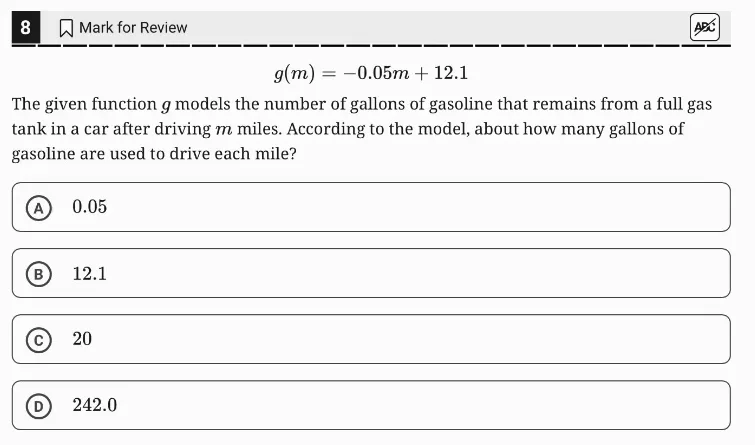
Practice Test 4, Module 1, Question 8Linear functions
Answer A
How it's solved: The keyword "each" signals slope, so read the rate from the coefficient on the variable.
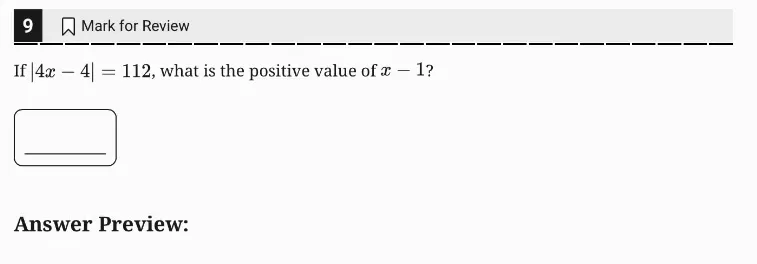
9
Practice Test 4, Module 1, Question 9Nonlinear equations in one variable and systems of equations in two variables
Answer 28
How it's solved: Enter the equation in Desmos to find x, or divide both sides first by hand, then adjust x to get the requested expression.
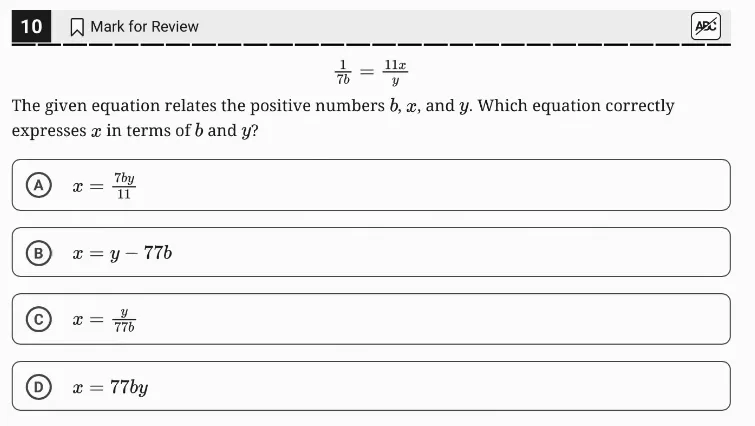
10
Practice Test 4, Module 1, Question 10Nonlinear equations in one variable and systems of equations in two variables
Answer C
How it's solved: Cross multiply the proportion, then divide both sides by the coefficient of x to isolate it.
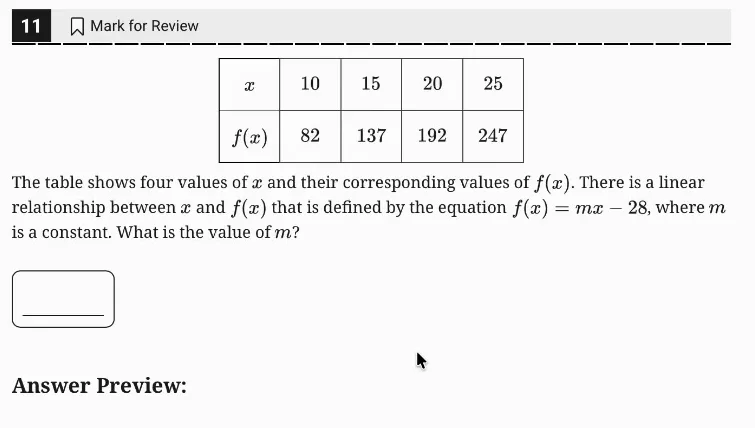
11
Practice Test 4, Module 1, Question 11Linear functions
Answer 11
How it's solved: Put two table points into a Desmos table and run a linear regression. The slope is the missing constant.
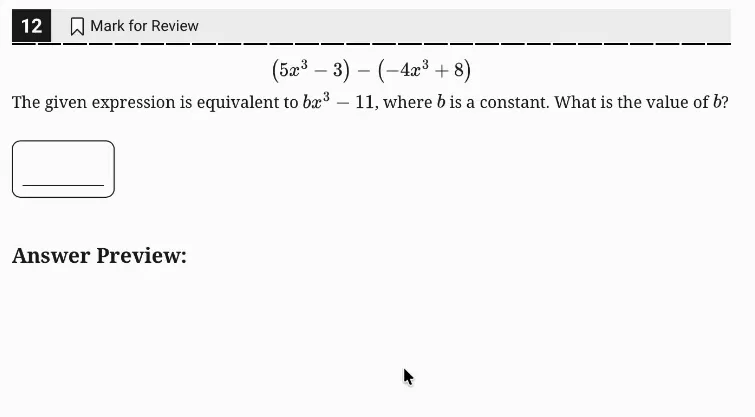
12
Practice Test 4, Module 1, Question 12Equivalent expressions
Answer 9
How it's solved: Done by hand: distribute the negative across the second group, then combine the cubic terms.
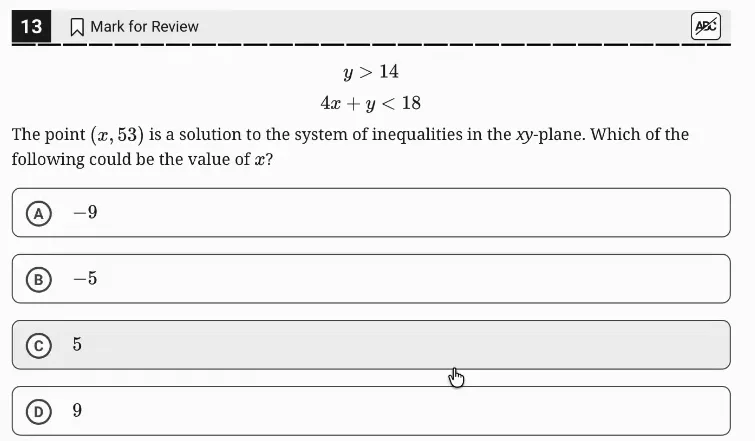
13
Practice Test 4, Module 1, Question 13Linear inequalities in one or two variables
Answer A
How it's solved: Graph both inequalities in Desmos, then plot each answer choice as a point and keep the one inside the overlapping region.
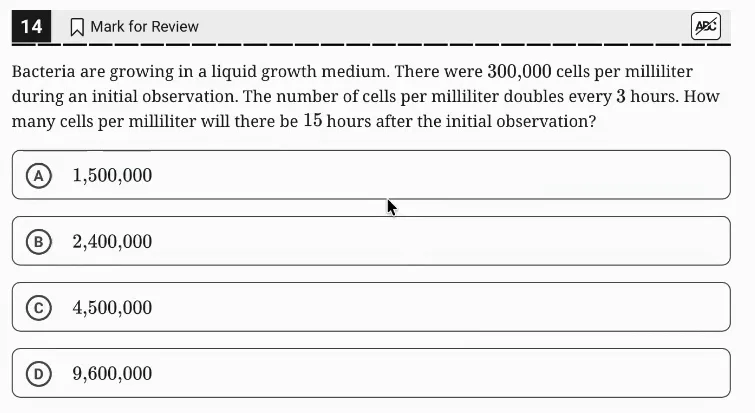
14
Practice Test 4, Module 1, Question 14Nonlinear functions
Answer D
How it's solved: Count how many doubling periods fit in the time span and multiply by that power of two, or list each doubling in order.
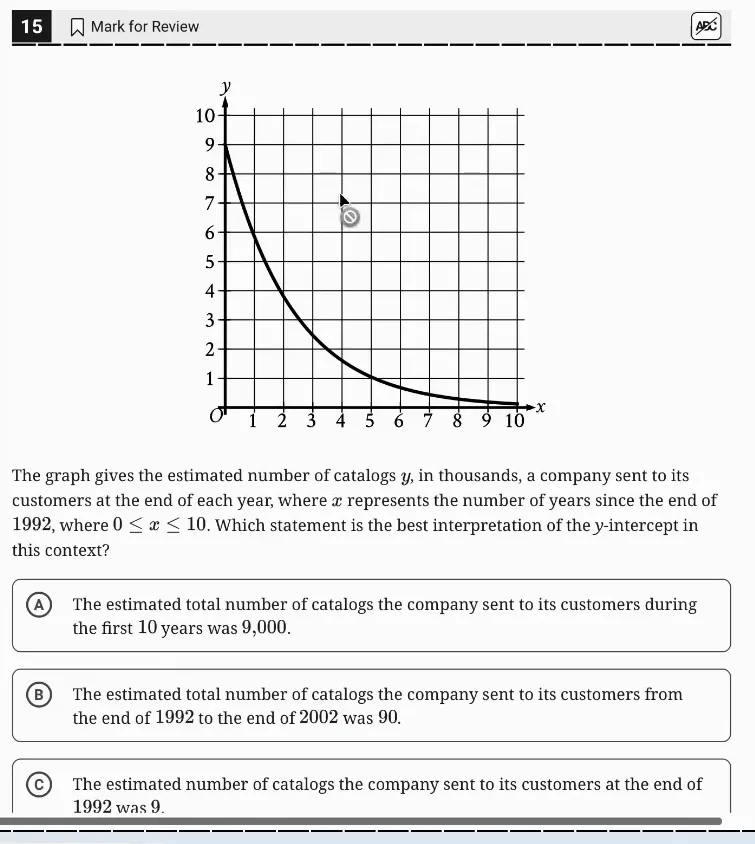
15
Practice Test 4, Module 1, Question 15Nonlinear functions
Answer D
How it's solved: Recognize the exponential graph, convert the y-intercept using the stated units, and remember a y-intercept means the input is zero, which points to the starting time.
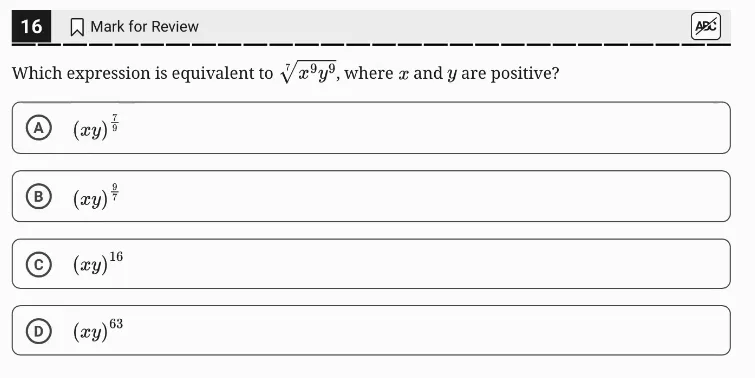
16
Practice Test 4, Module 1, Question 16Equivalent expressions
Answer B
How it's solved: Convert the radical to a fractional exponent: the power inside goes on top and the root index goes on the bottom.
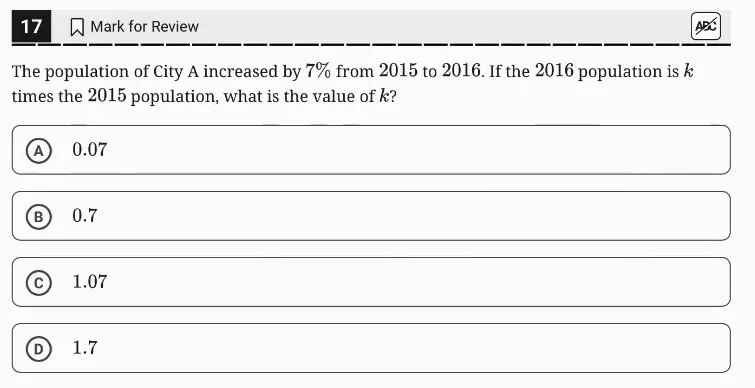
17
Practice Test 4, Module 1, Question 17Percentages
Answer C
How it's solved: A percent increase becomes a multiplier of one plus the rate written as a decimal.
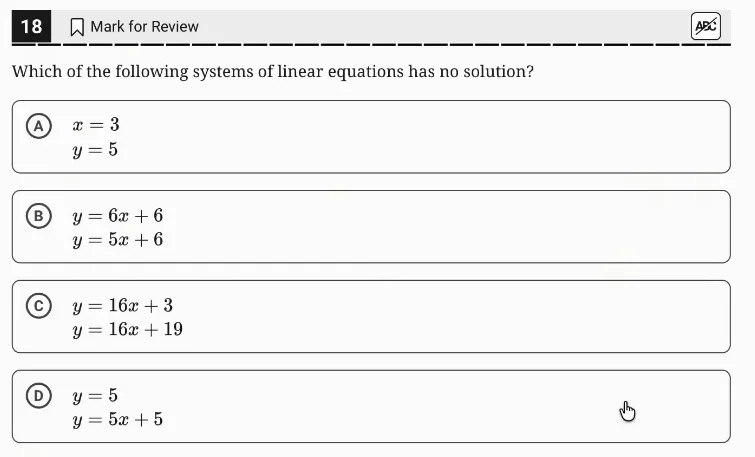
18
Practice Test 4, Module 1, Question 18Systems of two linear equations in two variables
Answer C
How it's solved: Graph each pair in Desmos and look for the lines that never meet, meaning same slope with different intercepts.
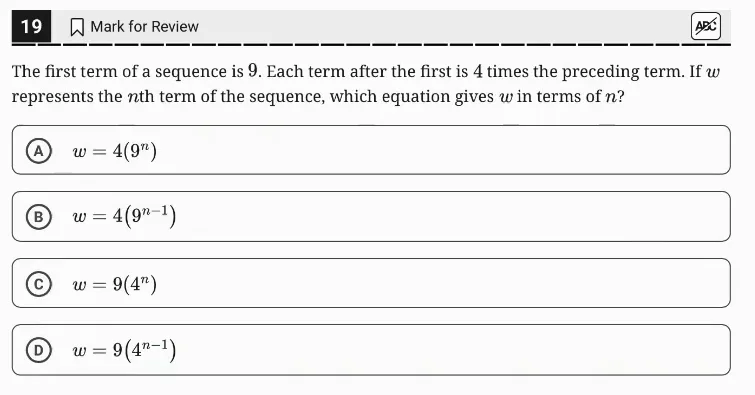
19
Practice Test 4, Module 1, Question 19Nonlinear functions
Answer D
How it's solved: The starting value goes in front, which narrows it to two choices. Then plug in the first term's position to see which formula returns the first term.
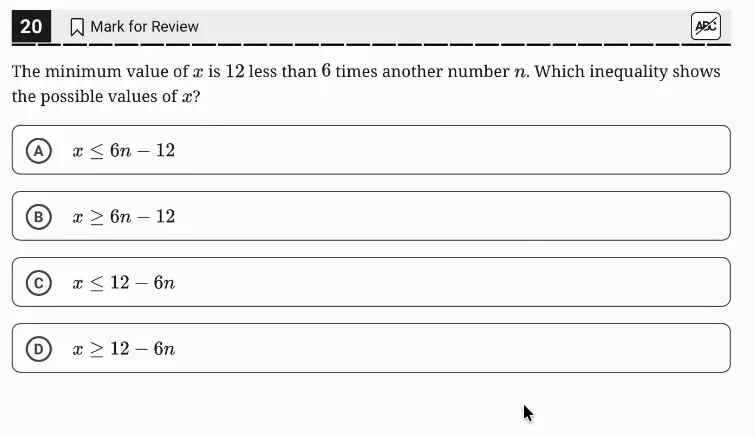
20
Practice Test 4, Module 1, Question 20Linear inequalities in one or two variables
Answer B
How it's solved: Translate the phrase in reading order, watching the reversal that "less than" causes, then use the word minimum to choose greater than or equal to.
21
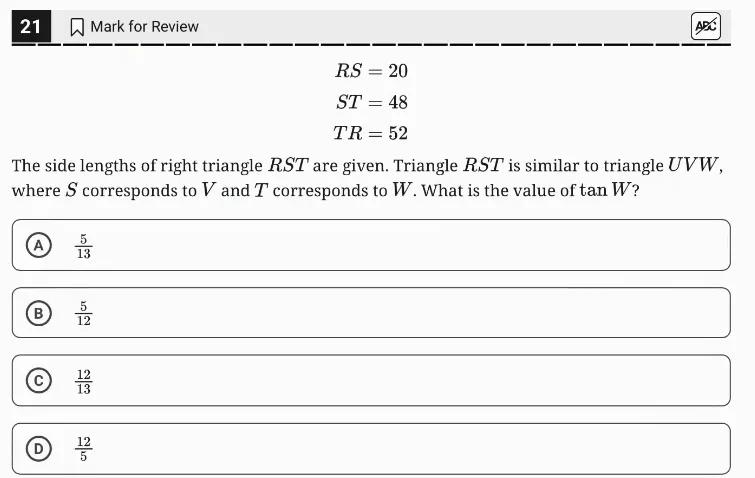
Practice Test 4, Module 1, Question 21Right triangles and trigonometry
Answer B
How it's solved: Similar triangles share trig ratios, so sketch the original triangle and find tangent of the matching angle as opposite over adjacent.
22
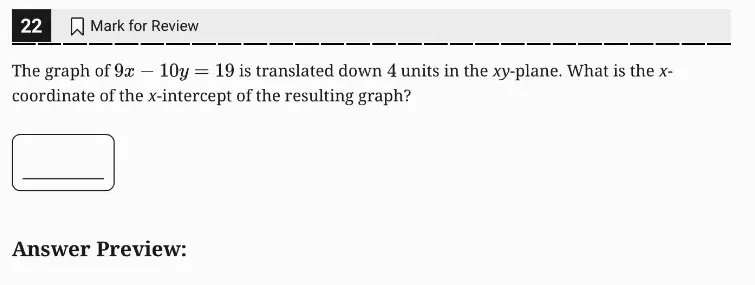
Practice Test 4, Module 1, Question 22Linear equations in two variables
Answer 59/9 or 6.555 or 6.556
How it's solved: Solve for y, subtract the shift to move the line down, graph it in Desmos, and click the x-intercept.
Module 2
1
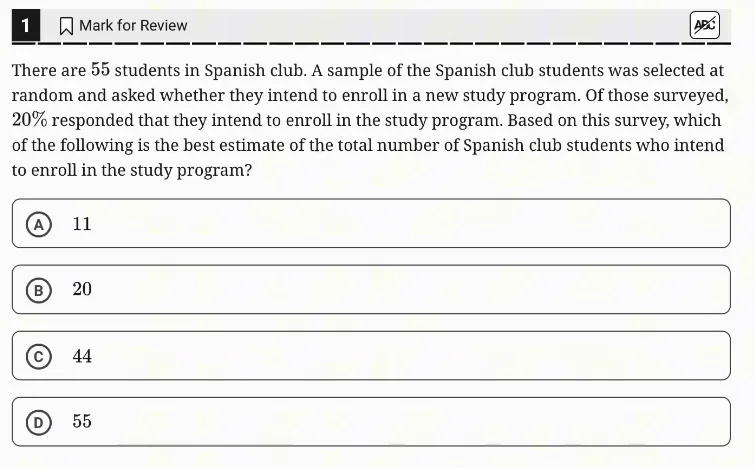
Practice Test 4, Module 2, Question 1Inference from sample statistics and margin of error
Answer A
How it's solved: Multiply the sample percentage, as a decimal, by the whole group. Mental math works here.
2
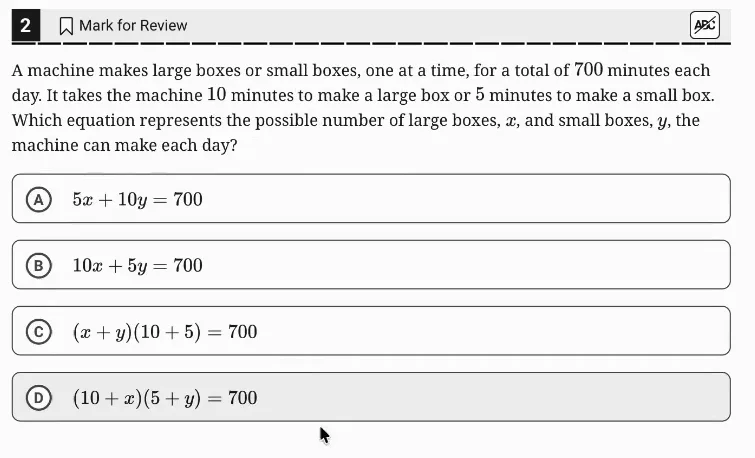
Practice Test 4, Module 2, Question 2Linear equations in two variables
Answer B
How it's solved: Pair each per-item time with its variable and set the sum equal to the total time.
3
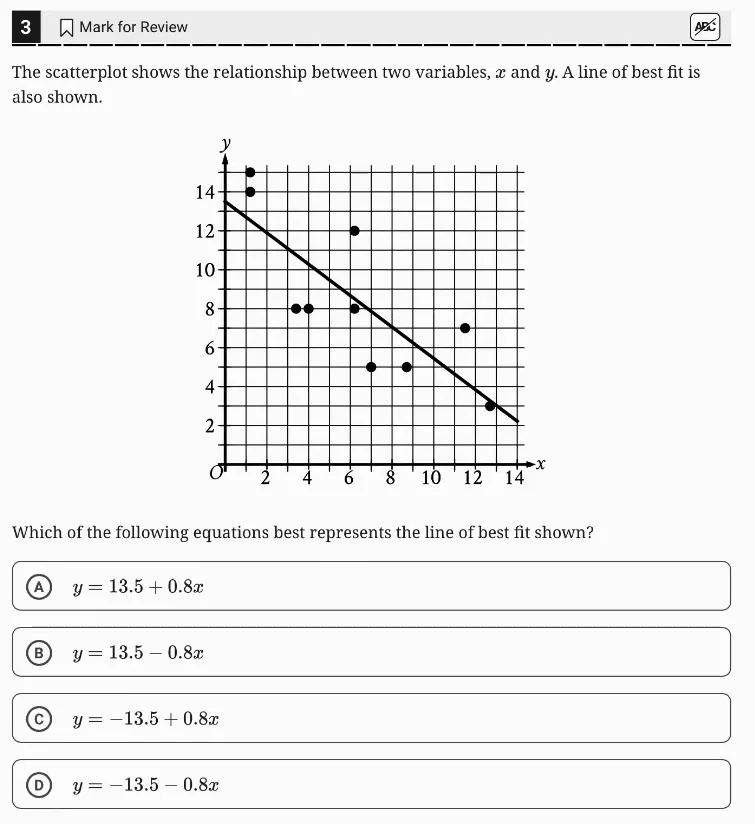
Practice Test 4, Module 2, Question 3Two-variable data: models and scatterplots
Answer B
How it's solved: Read the y-intercept off the graph and note the line falls, so pick the positive intercept with a negative slope.
4
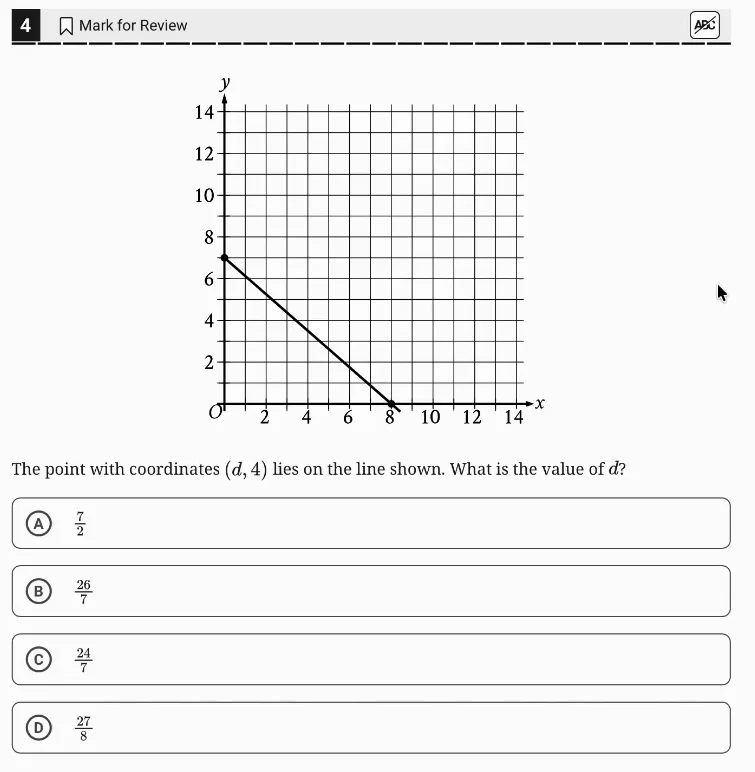
Practice Test 4, Module 2, Question 4Linear equations in two variables
Answer C
How it's solved: Put the two labeled points in a Desmos table, regress for the line, then substitute the known y and compare the resulting x to the choices.
5
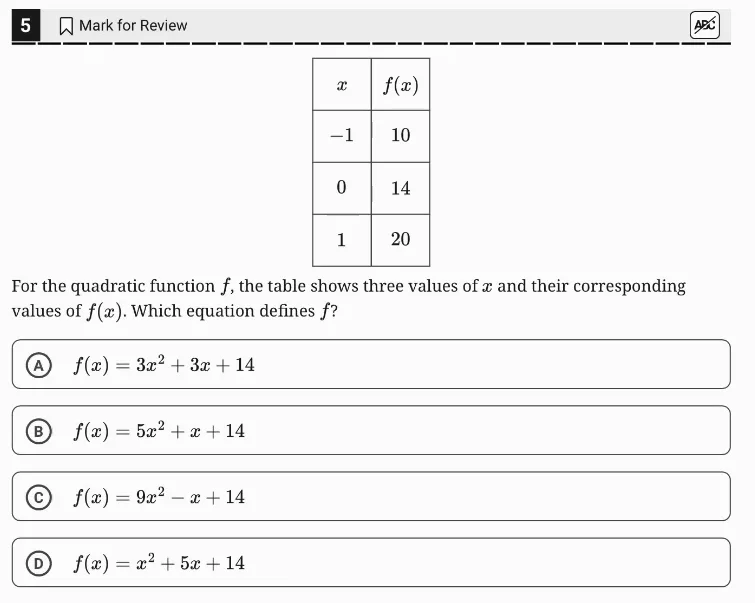
Practice Test 4, Module 2, Question 5Nonlinear functions
Answer D
How it's solved: Enter the three table points in Desmos and run a quadratic regression to get the equation.
6
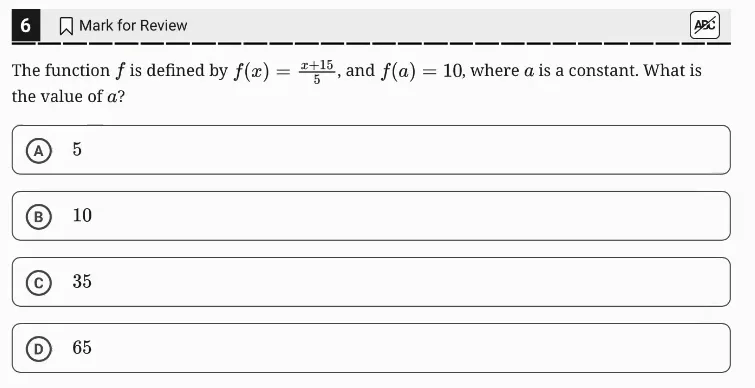
Practice Test 4, Module 2, Question 6Linear functions
Answer C
How it's solved: Define the function in Desmos and test each answer choice as the input until the output matches, or graph both sides and click the intersection.
7
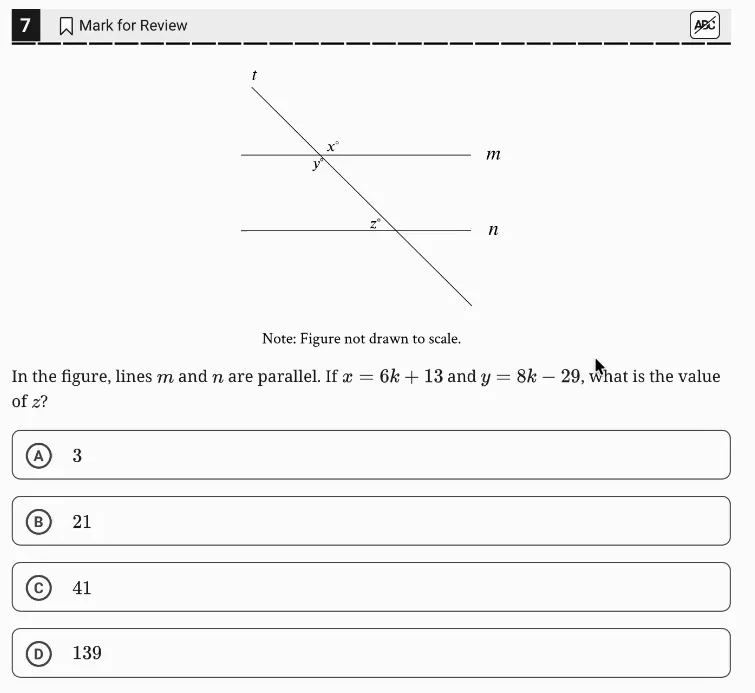
Practice Test 4, Module 2, Question 7Lines, angles, and triangles
Answer C
How it's solved: Set the vertical angles equal and solve in Desmos, then use same-side interior angles forming a straight-angle sum to find the last angle.
8
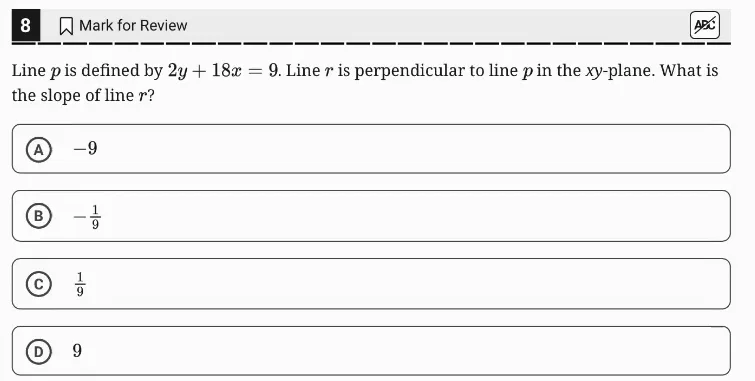
Practice Test 4, Module 2, Question 8Linear equations in two variables
Answer C
How it's solved: Rewrite in slope-intercept form to read the slope, then take the opposite reciprocal for the perpendicular line.
9
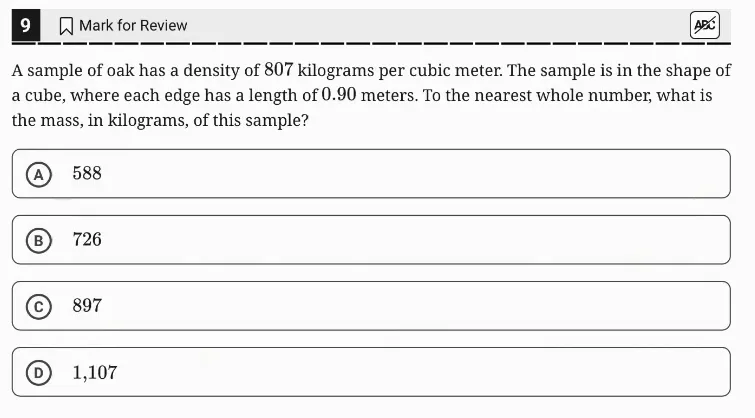
Practice Test 4, Module 2, Question 9Ratios, rates, proportional relationships, and units
Answer A
How it's solved: Set up a proportion from the density, cube the edge length to get the volume, and let Desmos solve for the mass.
10
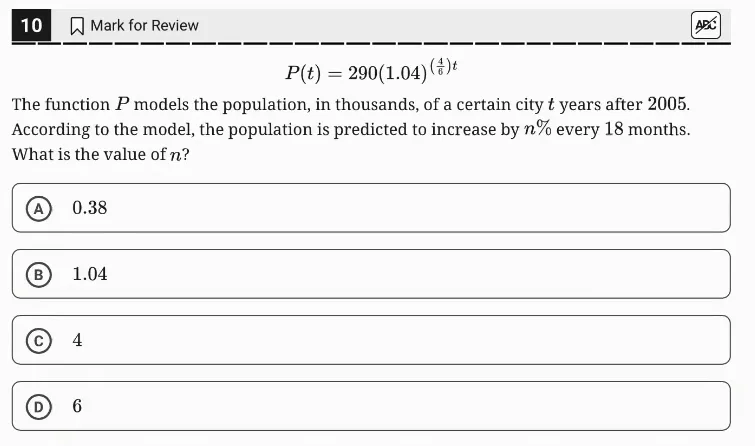
Practice Test 4, Module 2, Question 10Nonlinear functions
Answer C
How it's solved: Read the growth factor in the exponential model. It equals one plus the rate, so convert the decimal part to a percent.
11
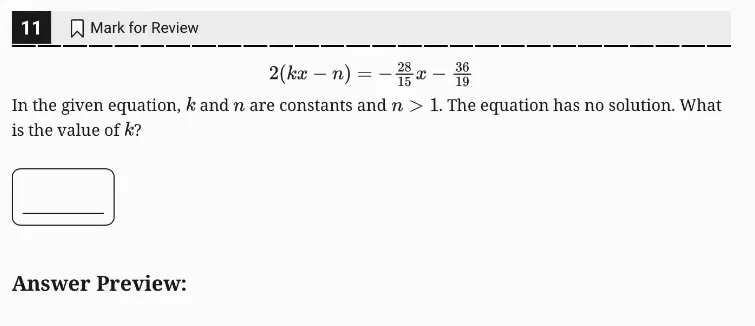
Practice Test 4, Module 2, Question 11Linear equations in one variable
Answer -0.9333 or -14/15
How it's solved: No solution means equal slopes with different intercepts, so distribute, set the x-coefficients equal, and solve for the constant.
12
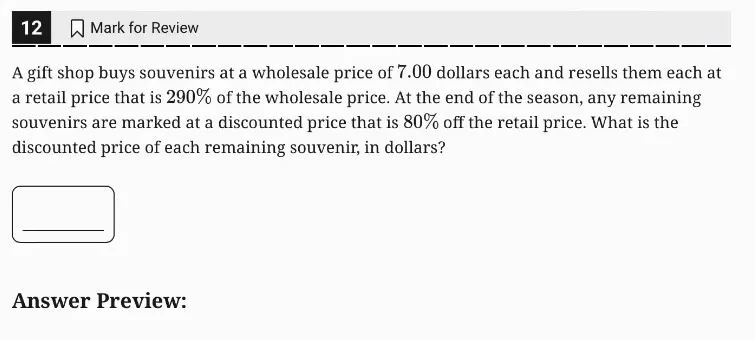
Practice Test 4, Module 2, Question 12Percentages
Answer 203/50 or 4.06
How it's solved: Translate each sentence into an equation: "percent of" means multiply, and "percent off" means multiply by one minus the rate.
13
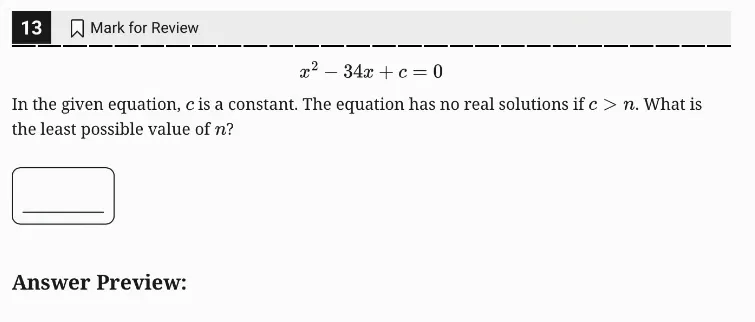
Practice Test 4, Module 2, Question 13Nonlinear equations in one variable and systems of equations in two variables
Answer 289
How it's solved: A discriminant problem. Set b squared minus 4ac below zero, enter it in Desmos with the unknown renamed to x, and read the boundary.
14
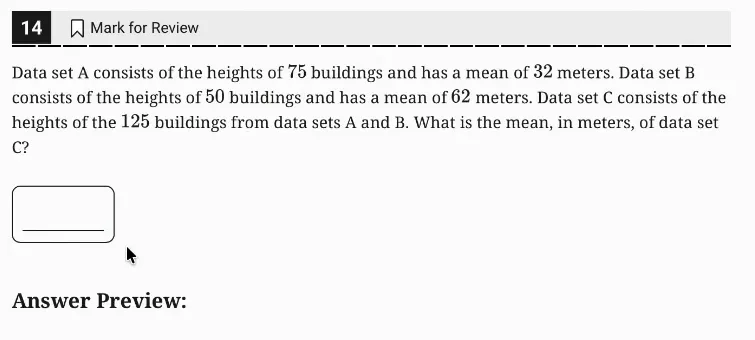
Practice Test 4, Module 2, Question 14One-variable data: distributions and measures of center and spread
Answer 44
How it's solved: Use a weighted average: multiply each group's mean by its share of the total count and add.
15
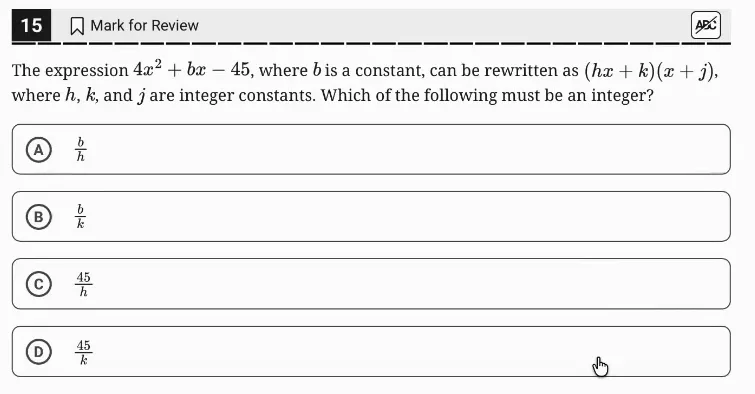
Practice Test 4, Module 2, Question 15Equivalent expressions
Answer D
How it's solved: Compare factored and expanded forms. First terms fix the leading factor, last terms give possible factor pairs, then check which choice must be an integer.
16
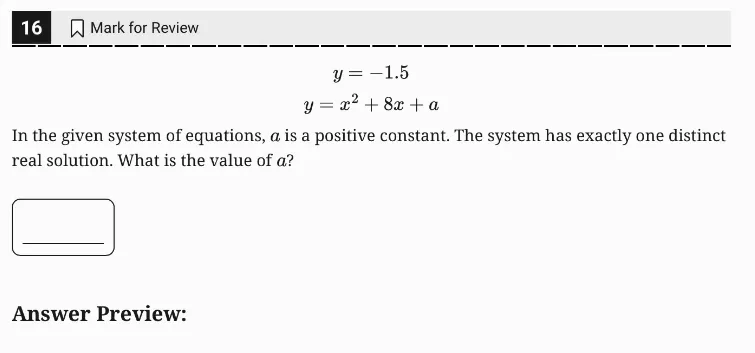
Practice Test 4, Module 2, Question 16Nonlinear equations in one variable and systems of equations in two variables
Answer 14.5 or 29/2
How it's solved: Set the two equations equal, move everything to one side, and set the discriminant to zero. Solve in Desmos after renaming the unknown to x.
17
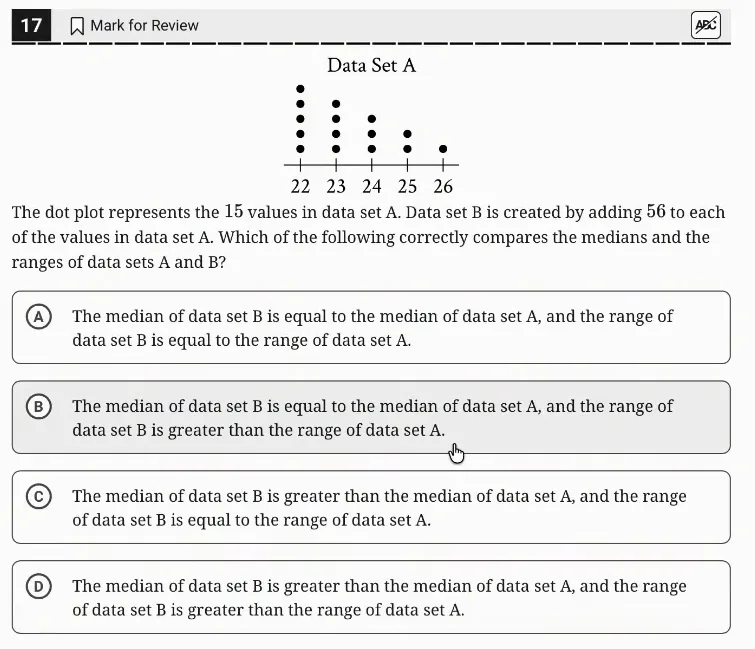
Practice Test 4, Module 2, Question 17One-variable data: distributions and measures of center and spread
Answer C
How it's solved: Write the dot plot out as lists, shift each value, use the Desmos median function, and compute range as high minus low.
18
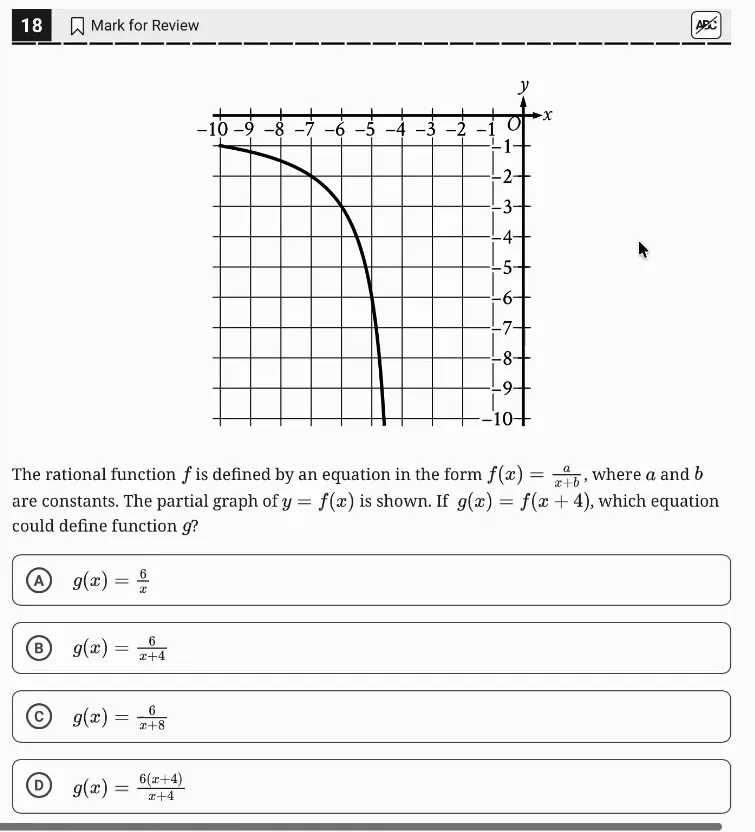
Practice Test 4, Module 2, Question 18Nonlinear functions
Answer C
How it's solved: Run a custom regression in Desmos with a tilde on two graph points to find the constants, then substitute the shifted input into the function.
19
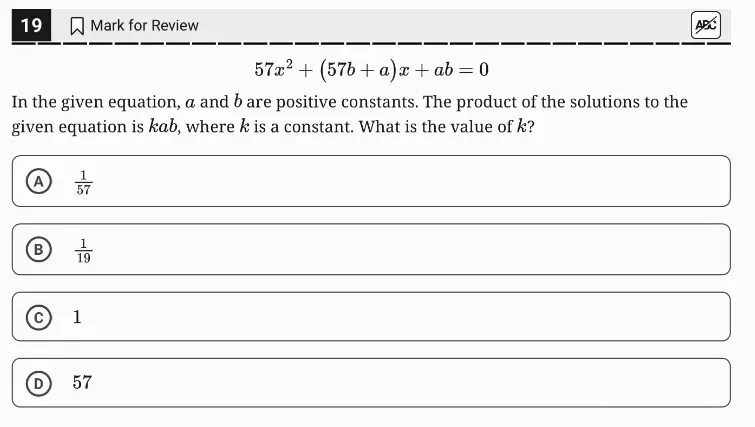
Practice Test 4, Module 2, Question 19Nonlinear equations in one variable and systems of equations in two variables
Answer A
How it's solved: Plug sample values for the constants into Desmos, find the roots, multiply them, and compare that product with the given form to get the missing constant.
20
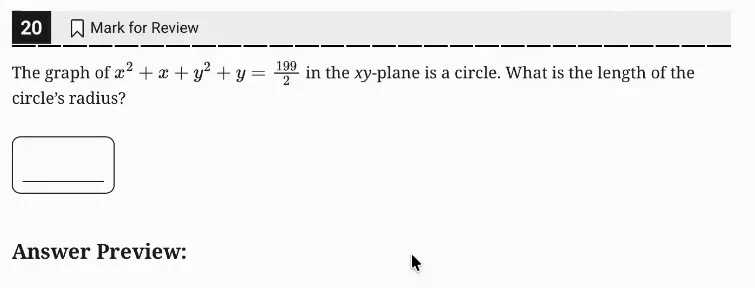
Practice Test 4, Module 2, Question 20Circles
Answer 10
How it's solved: Graph the circle in Desmos, click its top and bottom points to get the diameter, and halve it.
21
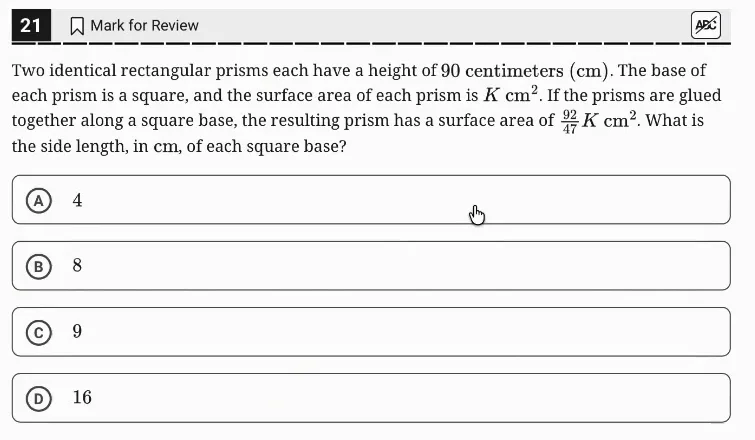
Practice Test 4, Module 2, Question 21Area and volume
Answer B
How it's solved: Write the surface area formula for one square-based prism, then for the combined prism, and set up the given relationship to solve for the base side.
22
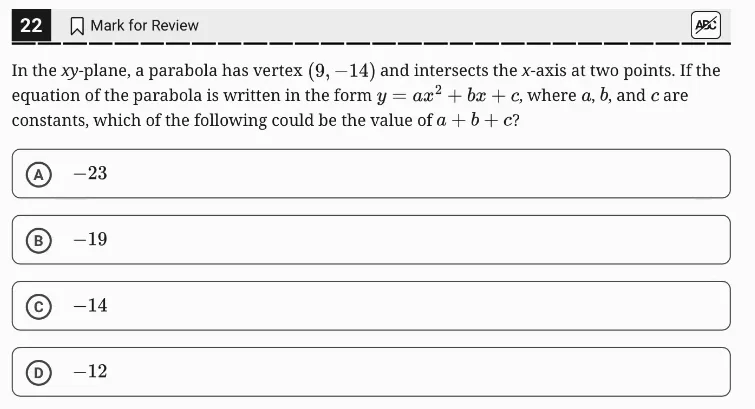
Practice Test 4, Module 2, Question 22Nonlinear functions
Answer D
How it's solved: Start in vertex form, expand to standard form, and write the coefficient sum in terms of a. Then keep the choice that makes the parabola open the right way.
Practice Test 4 Answer Key and Scoring
The video shows how to get each answer. The official answer key comes from College Board:
In Bluebook and My Practice. Bluebook shows your score as soon as you submit. Your full results are in My Practice: every question, your answer, the correct answer and a written explanation.
On paper. College Board also posts a printable version of Practice Test 4 with an answer key, answer explanations and a scoring guide on its SAT Suite site.
Use My Practice to find which questions you missed, then come back here for the fastest way to solve them. To see what a given number of misses does to your score, use how many you can miss on SAT Math.
What to Do After Test 4
Here is the problem with official practice tests: there are only eight, and retaking one you already did does not measure much, because you half-remember the answers. Whether you know it or just recognize question 12 is impossible to tell.
That is exactly why we built our practice tests the way we did. Sigma Prep has a mock version of Test 4 modeled question for question on the real one, same format, same topic distribution, same difficulty curve, but with brand new problems. It comes in three versions, so you can measure yourself on Test 4 material three separate times and every sitting is a real measurement.
Every question on the mock comes with a video explanation too, so reviewing your misses works the same way this walkthrough does, except it jumps you straight to your exact problem. Start free today!
Common Questions
After you submit Practice Test 4 in Bluebook, your full results are in My Practice on the College Board site: every question, your answer, the correct answer and a written explanation. College Board also posts a printable version of Practice Test 4 with an answer key, answer explanations and a scoring guide. The video on this page adds the fastest way to solve each one.
On this page. Every one of the 44 math questions from Bluebook Practice Test 4 has its own section, from Module 1 Question 1 to Module 2 Question 22, with the correct answer, the skill it tests, how it is solved, and a video clip of just that question. The full walkthrough video above solves all 44 in order, often with Desmos rather than algebra.
Take the test timed in Bluebook first, score it, and pull out every question you missed or guessed on. Then jump to only those questions in the video and ask one thing for each: could I have recognized this setup, and did I know the move? Do not watch all 43 minutes like a movie.
Not as a measurement, because memory inflates the score. Sigma Prep Test 4 mirrors the official test question for question with fresh problems, in three versions, so you can check whether the skills are really there.
Want more SAT tips like this?
One article a week. No spam.
Ready to raise your SAT Math score?
Take the free Diagnostic Quiz and see where you stand. No payment required.