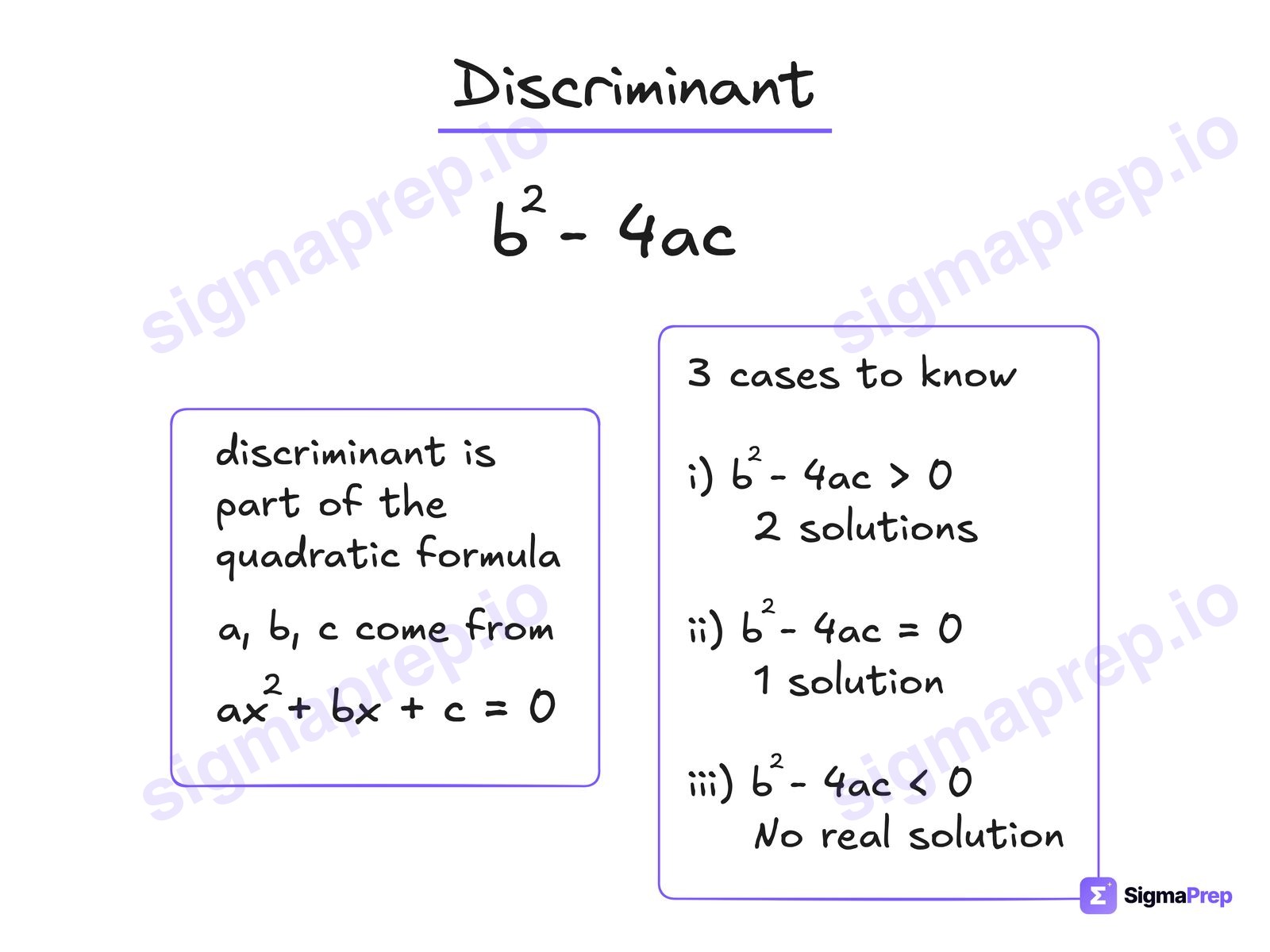
10. DiscriminantTwo things to spot: you need a quadratic, and a sentence telling you how many solutions. That is a discriminant problem. Know the 3 cases: greater than 0 for 2 solutions, equal to 0 for 1 solution, and less than 0 for no solution. Then let Desmos solve it.Worked example in the app →
This is the Advanced Math skill where the calculator changes the game the most. Any equation in one variable, quadratic, absolute value, radical, gets solved by typing it into Desmos and reading where the graph crosses. A system is two graphs and their intersections. College Board knows that, so the hard questions are the ones where you have to know what to type: a constant that has to be swapped for x, or a sentence about how many solutions there are.
The one habit
Desmos only solves for x. If the unknown is c or k, retype the equation with x in its place. Half the free-response questions on this topic are lost by students who typed the equation exactly as written and got nothing back.
The five ways the SAT asks it
1. Rearrange the formula
Nonlinear equations and systems · Easyanswer B
The given equation relates the variables a, b, and c. Which equation correctly expresses b in terms of a and c?
Get b alone: subtract c, divide everything by 3. The wrong choices divide only part of the expression or multiply instead. Do the two steps in order and do them to the whole side. This shows up with real formulas too, temperature, density, humidity, and it is the same two steps.
2. How many solutions
Nonlinear equations and systems · Mediumanswer D
How many distinct real solutions does the given equation have?
Type it into Desmos: the parabola touches the x-axis once, at 5, so exactly one solution. By hand, x² − 10x + 25 is (x − 5)², a perfect square. A parabola that never reaches the axis has zero real solutions, one that crosses has two. The graph answers all three cases without a formula.
3. Absolute value
Nonlinear equations and systems · Mediumanswer 13
What is the positive value of x−1 that satisfies the given equation?
Absolute value equations have two solutions, one for each sign: 6x − 6 = 78 gives x = 14, and 6x − 6 = −78 gives x = −12. They asked for the positive value of x − 1, which is 13. Read what they want, then pick the branch. Desmos shows both crossings if you type the whole equation in.
4. A line meets a parabola
Nonlinear equations and systems · Mediumanswer C
If (x,y) is a solution to the given system of equations, which of the following could be the value of x?
Type both, click the two intersections: x = 2 and x = −2. Only −2 is a choice. By hand, set them equal, x + 4 = x² + x, so x² = 4. The trap is stopping at 2 when the answer is the negative root.
5. Exactly one solution: the discriminant
Nonlinear equations and systems · Hardanswer B
In the given equation, c is a constant. The equation has exactly one solution. What is the value of c?
Two things to spot: a quadratic, and a sentence about how many solutions. That is a discriminant question. Exactly one solution means b² − 4ac = 0, so 24² − 4(−3)(c) = 0 and c = −48. Type b² − 4ac = 0 into Desmos with c written as x and read it off. Two solutions means greater than 0, no solution means less than 0. This is usually free response, which is why you cannot just test the choices.
Try one
This is a real question from our Nonlinear Equations · Medium set. Solve it the fast way, then watch how I do it.
try one · Nonlinear equations · Medium
What is the solution to the given equation?
(x+3)(x+4)=(x−3)(x−4)+14
Where the points actually go
Typing a constant into Desmos and expecting it to solve, taking the wrong branch of an absolute value, and not recognizing a discriminant question from its second sentence. The app has 448 questions on this skill, 112 easy, 126 medium and 210 hard, every one with a video explanation. The free diagnostic shows whether this is where your points are going.
Common Questions
Type the equation in exactly as written and click where the graph crosses the x-axis; each crossing is a solution. If the unknown is a letter other than x, rewrite it with x first, because Desmos only solves for x.
For ax² + bx + c = 0, the discriminant is b² − 4ac. Positive means two real solutions, zero means exactly one, negative means none. You need it when a quadratic has an unknown constant and the question tells you how many solutions there are.
Usually two, one for each sign of what is inside. |6x − 6| = 78 means 6x − 6 = 78 or 6x − 6 = −78. The question then tells you which one it wants, often "the positive solution." Or just put it into Desmos.
Graph both in Desmos and click the intersections, or set the two expressions for y equal and solve the resulting quadratic. There can be two, one, or zero solutions depending on whether the line crosses, touches, or misses the parabola.
Want more SAT tips like this?
One article a week. No spam.
Ready to raise your SAT Math score?
Take the free Diagnostic Quiz and see where you stand. No payment required.