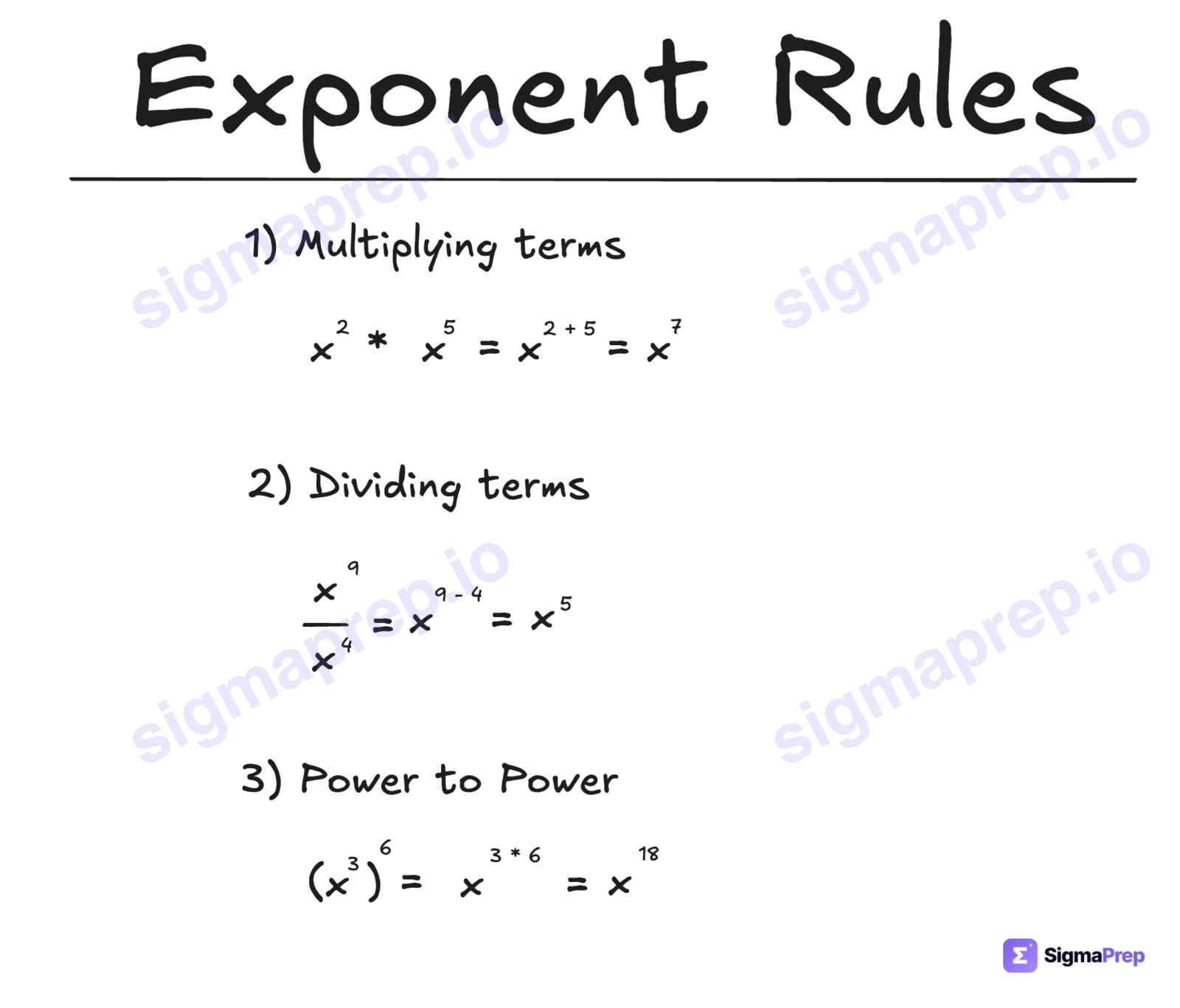
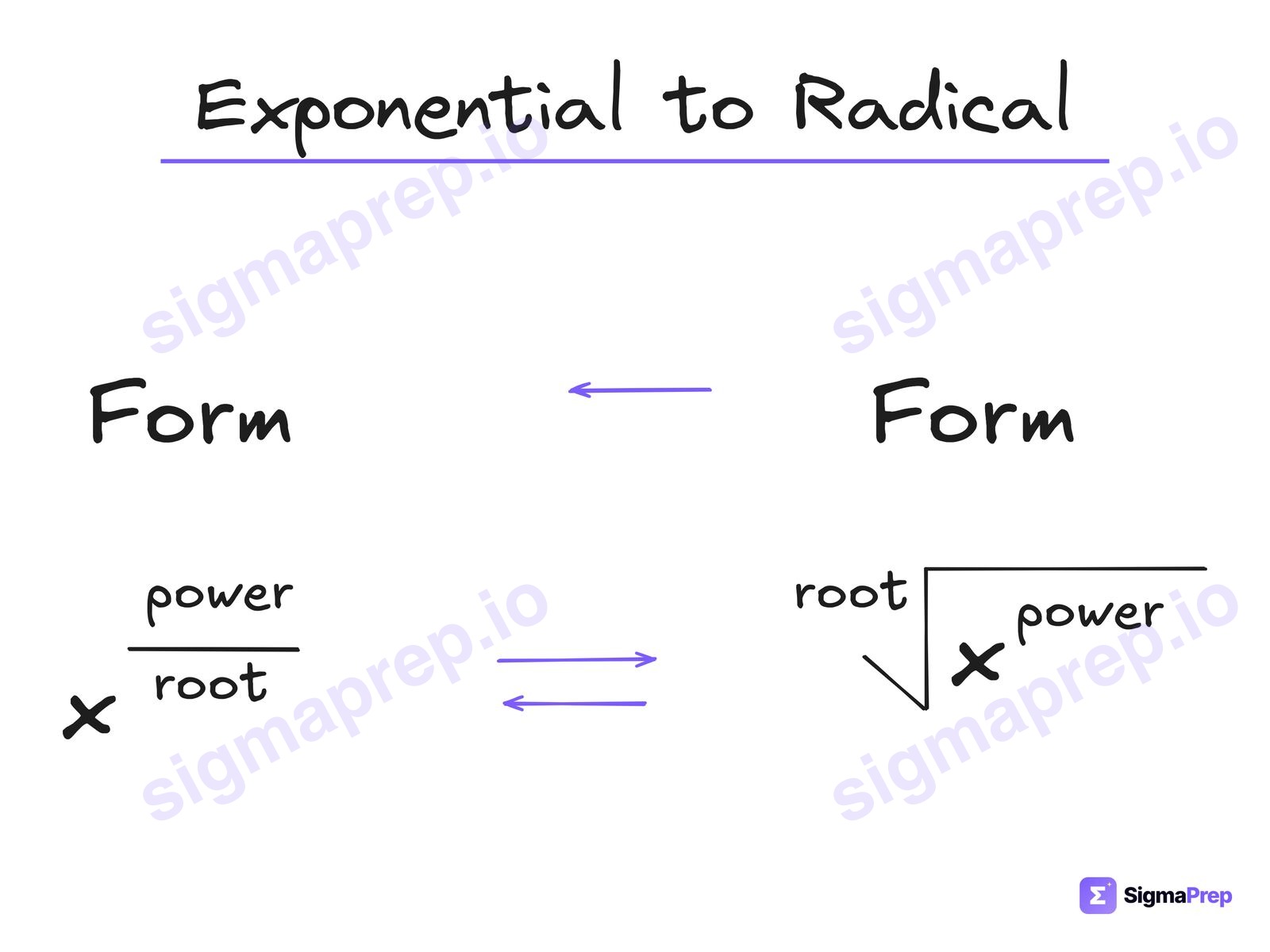
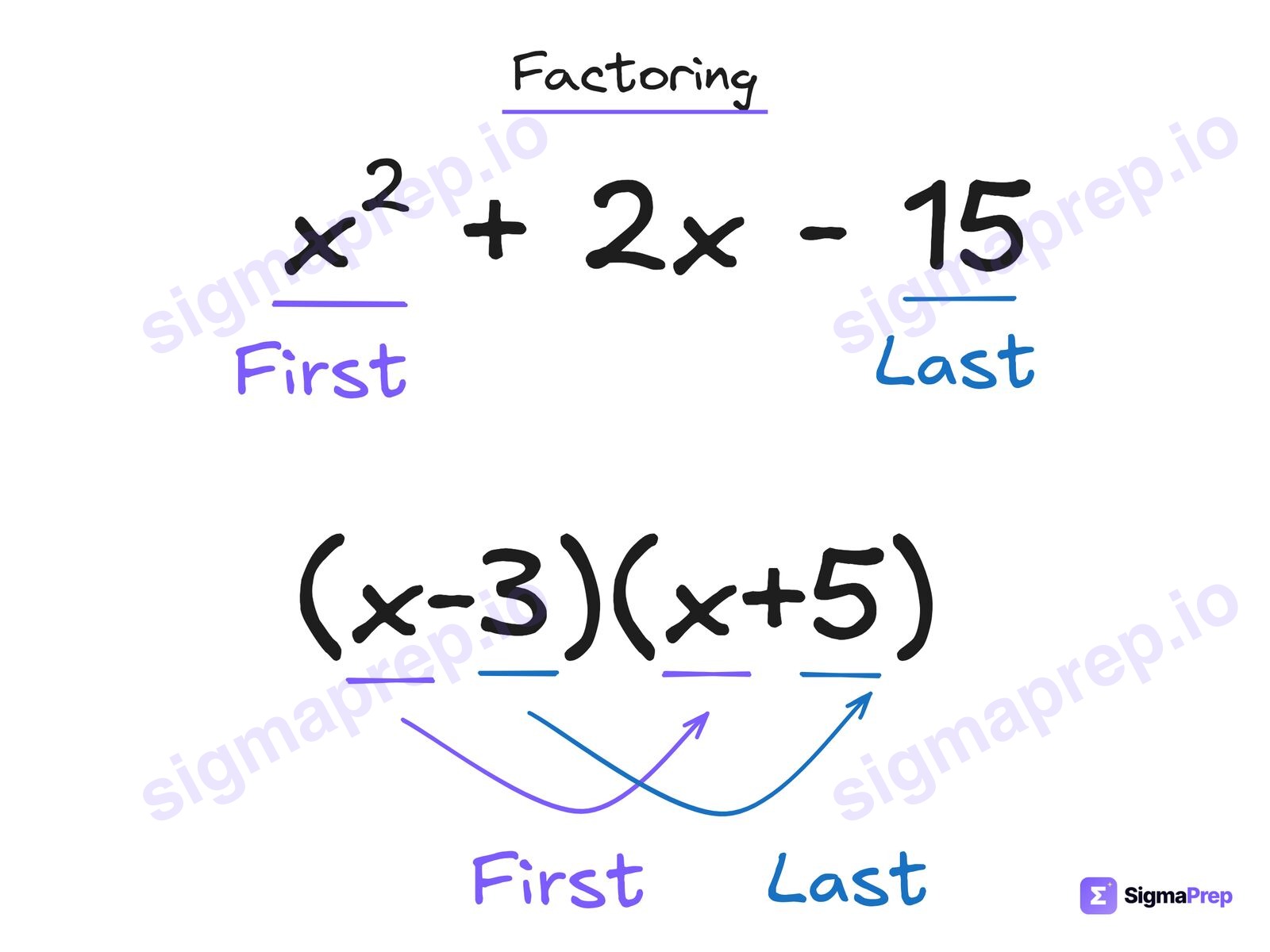
5. Exponent RulesThree rules, in order. Multiplying means add the exponents, dividing means subtract the exponents, and an exponent raised to another exponent means you multiply the exponents.Worked example in the app →6. Exponential to RadicalNever leave a radical as a radical. Root on the outside, power on the inside, and as an exponent you write power divided by root. Also remember that a square root has a root of 2 even though nobody writes a 2 on the outside.Worked example in the app →7. FactoringWhen comparing factored form to expanded form, notice that in FOIL first times first gives the first term in expanded form, and last times last gives the last term.Worked example in the app →
"Which expression is equivalent to..." shows up several times on every test, inside Advanced Math. These are the questions students either love or skip. The good news is that "equivalent" is a hack: two expressions are equivalent if their graphs are identical, so Desmos can check any answer choice in seconds. The bad news is that three rules and one trap still have to be in your head, because the free-response versions have no choices to test.
The three exponent rules
Multiplying means add the exponents. Dividing means subtract them. A power raised to a power means multiply them. And a radical is never left as a radical: the root goes on the bottom of the exponent and the power on top, with a square root having a root of 2 even though nobody writes it.
The five ways the SAT asks it
1. Combine and distribute
Equivalent expressions · Easyanswer A
Which expression is equivalent to (3x2−5)−(−4x2+3x−8)?
Subtracting a whole parenthesis flips every sign inside it: −(−4x²) is +4x², −(3x) is −3x, −(−8) is +8. Then combine: 7x² − 3x + 3. The wrong choices flip one sign and not the others. Type the original and each choice into Desmos; the one whose graph sits exactly on top of the original is the answer.
2. Exponent rules
Equivalent expressions · Mediumanswer A
Which expression is equivalent to h4q17h12q5, where h>0 and q>0?
Dividing, so subtract: 12 − 4 leaves h⁸ on top because there were more h's on top, and 17 − 5 leaves q¹² on the bottom because there were more q's on the bottom. That is the whole rule. The choice with h⁸q¹² forgot which side the q's live on.
3. Radicals into exponents
Equivalent expressions · Hardanswer 11/6
If 3x5x7=xba for all positive values of x, where ba is in lowest terms, what is the value of ba?
Rewrite both radicals: the square root of x⁷ is x to the 7/2, the cube root of x⁵ is x to the 5/3. Dividing means subtract, 7/2 − 5/3 = 11/6, and Desmos will do the fraction and hand you 11/6 with one click. Every radical question on the test starts with this rewrite.
4. Match the factored form
Equivalent expressions · Mediumanswer 3
If the expression 3x2+7x−6 is rewritten in the form (3x−2)(x+k), where k is a constant, what is the value of k?
From FOIL, last times last is the last term. The constants are −2 and k, and their product has to be −6, so k = 3. No need to expand the whole thing. First times first checks the leading term the same way. This shape appears constantly, and it is a ten-second question once you see it.
5. Rational expressions
Equivalent expressions · Mediumanswer C
The expression 6x+3618 is equivalent to x+b3, where b is a constant and x>0. What is the value of b?
Factor the 6 out of the bottom: 6x + 36 is 6(x + 6), and 18 over 6 is 3, so the expression is 3 over (x + 6) and b = 6. The trap is 36, for people who did not factor. When the question is "for what value of b," Desmos can still help: graph the original and the form with a slider for b, and slide until the graphs match.
Try one
This is a real question from our Equivalent Expressions · Medium set. Solve it the fast way, then watch how I do it.
try one · Equivalent expressions · Medium
Which expression is equivalent to 2x−106x2−34x+20, where x>5?
Where the points actually go
A flipped sign in a subtraction, exponents added when they should have been subtracted, and a radical left as a radical. Every one of them is caught by graphing the original and the answer together, and the ones that are not multiple choice are caught by the three rules.
The app has 399 equivalent expression questions, 105 easy, 161 medium and 133 hard, every one with a video explanation. The free diagnostic shows whether this is where your points are going.
Common Questions
Type the original expression as y = and each answer choice as y = . Equivalent expressions have identical graphs, so the correct choice sits exactly on top of the original. It works for polynomials, fractions and exponents alike.
Multiplying the same base means add the exponents, dividing means subtract them, and a power raised to a power means multiply them. A radical becomes a fraction exponent with the power on top and the root on the bottom, and a square root has a root of 2.
Compare one term instead of expanding. From FOIL, first times first gives the leading term and last times last gives the constant term. If 3x² + 7x − 6 equals (3x − 2)(x + k), then −2 times k must be −6, so k = 3.
Equivalent expressions are one of the three skills in Advanced Math, which is about 35% of SAT Math. Expect a few per test, mostly in the first half of each module, with the radical and rational versions in the harder module.
Want more SAT tips like this?
One article a week. No spam.
Ready to raise your SAT Math score?
Take the free Diagnostic Quiz and see where you stand. No payment required.