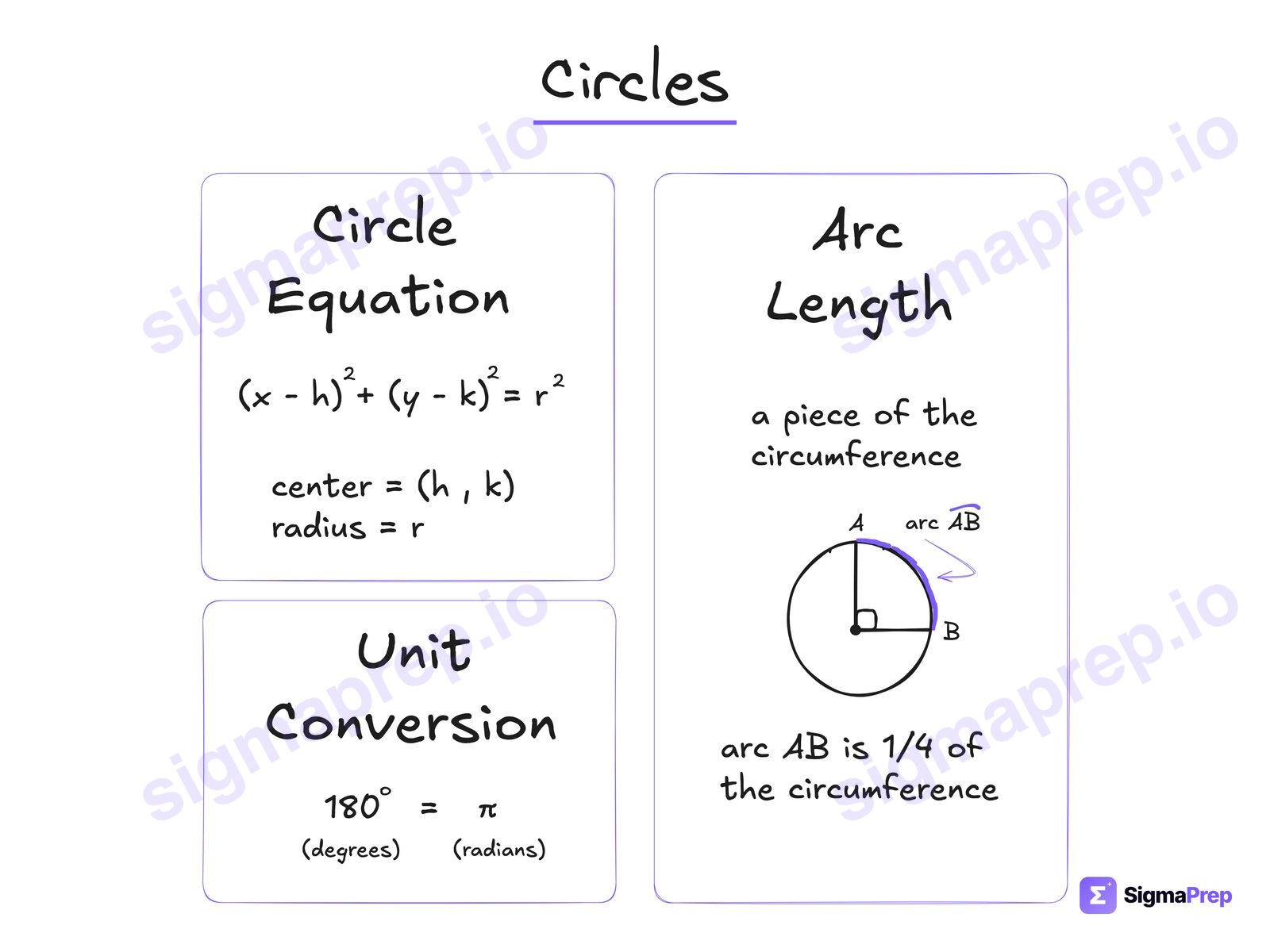
24. CirclesThe right side of (x - h)^2 + (y - k)^2 = r^2 is the radius SQUARED. A radius of 3m makes the right side 9m^2, not 3m^2, and a right side of 49k^2 means the radius is 7k. The center goes in with the signs flipped: center (5, 12) is (x - 5) and (y - 12). Two traps in one question, and both wrong answers are sitting in the choices.Worked example in the app →
Circles are a small slice of SAT Math: usually one or two questions out of 44, inside the Geometry and Trigonometry domain. They are also some of the most predictable questions on the test. College Board asks the same five things every time, and four of the five come down to one equation.
The one formula
(x − h)² + (y − k)² = r²
The center is (h, k) with the signs flipped, and the number on the right is r squared, not r. Both of those are traps College Board sets on purpose. If the equation says (x + 3)², the x-coordinate of the center is −3. If the right side says 49, the radius is 7. That is most of the topic.
It is figure 24 on the formula sheet, with a worked example.
The five ways the SAT asks it
1. Read the center and radius off the equation
Circles · Easyanswer D
The graph of the given equation in the xy-plane is a circle. What is the length of the radius of this circle?
The easy version. The equation is already in the form above and the question wants the center, the radius, or the diameter. Flip the signs, square-root the right side: 49 is r², so the radius is 7. The only way to miss it is to rush and pick 49.
2. The equation is not in that form yet
Circles · Hardanswer D
The given equation defines a circle in the xy-plane. What are the coordinates of the center of the circle?
This is the medium and hard version, and the one to practice. The textbook way is completing the square twice. The fast way on the digital SAT: type the equation into Desmos exactly as written. It draws the circle, and if the question is multiple choice you drop the answer choices in as points and see which one sits in the middle. That is the whole question.
If it is a free-response question, or you want the no-calculator version: the center is minus half of each linear coefficient. Half of 12 is 6, so h = −6. Half of −18 is −9, so k = 9. Center (−6, 9), nothing squared. You only complete the square when the question wants the radius, and even then it is one line: r² is the right side plus h² plus k², so 109 here.
3. A point on the circle gives you the equation
Circles · Mediumanswer B
A circle in the xy-plane has its center at (2,−3), and the point (5,1) lies on the circle. Which of the following is the equation of the circle?
Every answer choice is a circle, so type them into Desmos and look: the right one has its center at (2, −3) and runs through (5, 1). The others miss one or both. Without a calculator, the radius is the distance from the center to the point, and College Board almost always picks numbers that make a 3-4-5 or a 5-12-13 triangle. Here the legs are 3 and 4, so r = 5 and the equation ends in 25.
4. Degrees to radians and back
Circles · Mediumanswer 210
An angle has a measure of 67π radians. What is the measure, in degrees, of the angle?
Radians live inside the Circles skill. The conversion is one multiplication: degrees times π/180 gives radians, radians times 180/π gives degrees. The fast check is that π radians is 180°, so 7π/6 has to be a bit more than 180°, and 210 is the only number that fits. Run the check before the arithmetic and you will never be off by a factor of two.
5. Arcs, sectors, and central angles
Circles · Easyanswer C
A circle with center O has a circumference of 48. Points A and C lie on the circle such that central angle AOC measures 60∘. What is the length of minor arc AC?
These are proportion questions wearing a circle. A central angle of 60° is one sixth of 360°, so the arc it cuts off is one sixth of the circumference: 48 divided by 6 is 8. A sector would be one sixth of the area the same way. Set up the fraction first and the rest is arithmetic. The hard version hands you the arc length and asks for the angle, which is the same fraction read backwards.
What the hard ones add
The hard set has three more moves on top of the five, and every one of them is the same equation again.
Tangent lines. A tangent is perpendicular to the radius at the point where it touches. So the slope of the tangent at (4, 3) on a circle centered at the origin is the negative reciprocal of 3/4, which is −4/3. That is the entire question.
Shifting a circle. Moving the circle changes only h and k. Shift it right 5 and h goes up by 5. The radius never moves.
"Touches the y-axis at exactly one point." That means the distance from the center to the y-axis equals the radius, so |h| = r. The equation whose h and r match is the answer.
Try one
This is a real question from our Circles · Medium set, the kind that lands in the harder second module. Solve it the fast way, then watch how I do it.
try one · Circles · Medium
What is the center of the circle in the xy-plane with the given equation?
x2+24x+y2=0
Where the points actually go
Almost nobody misses a circle question because they do not know the formula. They miss on the two traps built into it, the sign flip and r versus r², and on the radians question when they skip the π-is-180° check. The fix is not more theory. It is doing the questions easy to hard until the traps are boring.
The app has 315 circle questions, 21 easy, 84 medium and 210 hard, every one with a video explanation. If you want to know whether circles are even your problem, the free diagnostic tells you which topics are actually costing you points.
Common Questions
Usually one or two per test out of 44 Math questions. Circles sit inside Geometry and Trigonometry, which is about 15% of the section, and the harder ones land in the second module.
(x − h)² + (y − k)² = r², where (h, k) is the center and r is the radius. The signs inside the parentheses are the opposite of the center’s coordinates, and the right side is r squared, not r.
Only when a circle equation comes in expanded form and the question asks for the radius. For the center, take minus half of each linear coefficient. On the digital SAT you can also graph the equation in Desmos and read the center off the graph.
Yes. The built-in Desmos calculator graphs any circle equation as typed, labels the center when you click it, and shows where it crosses the axes. It will not convert radians to degrees for you, so know that π radians is 180°.
Want more SAT tips like this?
One article a week. No spam.
Ready to raise your SAT Math score?
Take the free Diagnostic Quiz and see where you stand. No payment required.