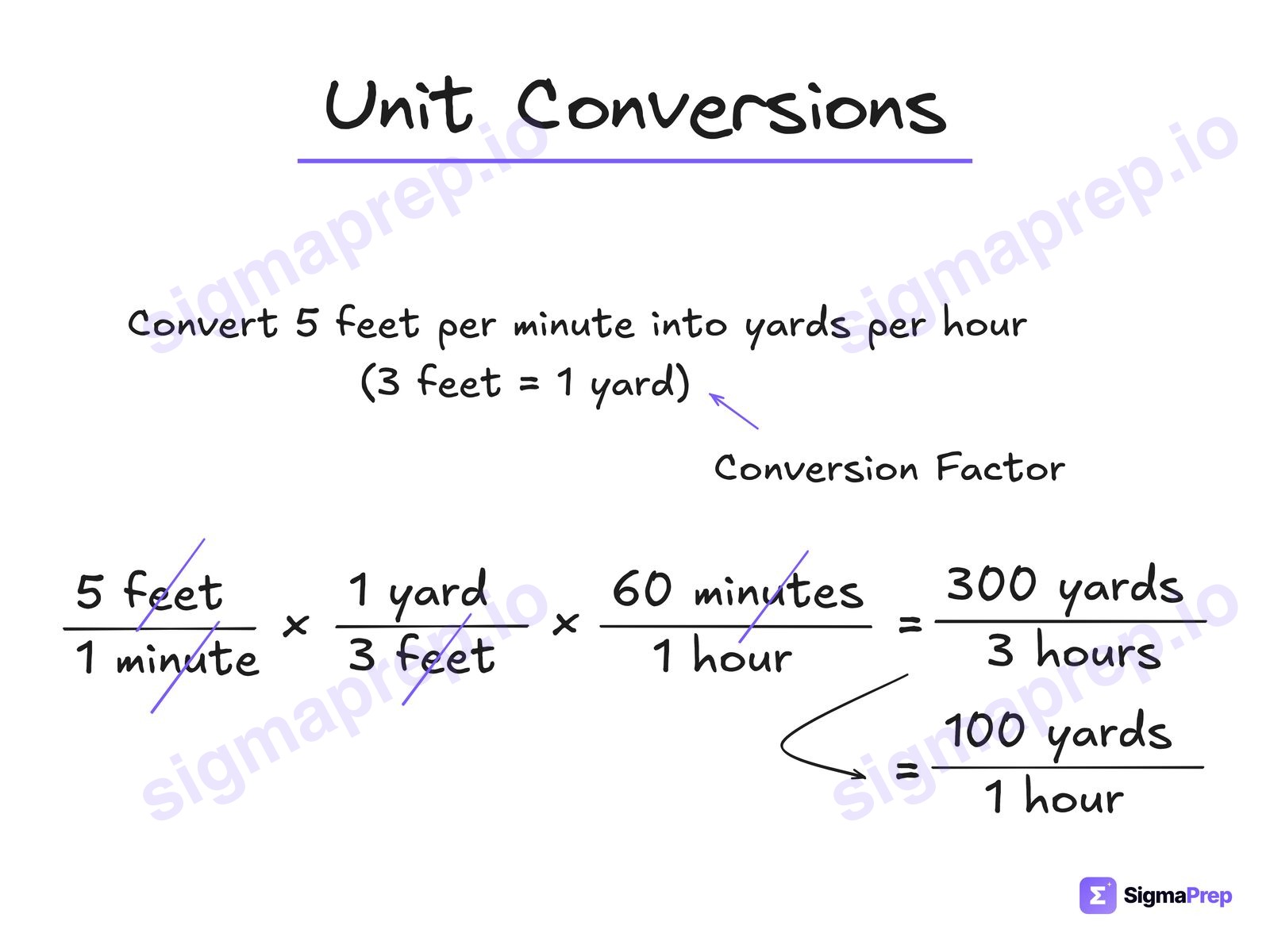
13. Unit ConversionsPer makes the fraction. Line the units up so each one cancels: whatever is on the bottom of one fraction goes on top of the next. If a unit is squared, square the whole conversion factor, or the units will not cancel.Worked example in the app →
Problem-Solving and Data Analysis is about 15% of SAT Math, 5 to 7 questions, and this skill is the first half of it. Nobody fails these because of the math. They fail because a unit got dropped or a fraction got flipped. Every question on this page is a fraction with units on it, and the units tell you which way the fraction goes.
Per makes the fraction
"35 widgets per minute" is 35 widgets over 1 minute. To convert, multiply by a fraction whose units cancel what you have: minutes on the bottom of one fraction means minutes go on top of the next. Line the units up so each one cancels and the arithmetic takes care of itself. The test gives you almost every conversion factor you need in parentheses. It does not give you the setup.
The five ways the SAT asks it
1. A rate times a time
Ratios, rates and units · Easyanswer 2100
A machine produces an average of 35 widgets per minute. At this rate, how many widgets will the machine produce in 1 hour?
35 per minute times 60 minutes in an hour is 2,100. The only trap is the hour: they say "per minute" and ask about an hour, and the 60 is not written anywhere in the question. Read the units on both ends before you multiply.
2. A ratio with one part known
Ratios, rates and units · Easyanswer B
A bag contains blue and green marbles in a ratio of 6 to 1. If the bag contains 48 blue marbles, how many green marbles does it contain?
6 blue for every 1 green, and 48 blue, so 48 divided by 6 is 8 green. The choice 288 is for people who multiplied. Set it up as a proportion, 6 over 1 equals 48 over g, and cross-multiply if the numbers are not this friendly.
3. A chain of conversions
Ratios, rates and units · Mediumanswer 2688
How many fluid ounces are equivalent to 84 quarts? (8 fluid ounces =1 cup and 4 cups =1 quart)
Two steps, both given: 84 quarts times 4 cups per quart times 8 fluid ounces per cup. Quarts cancel, cups cancel, ounces remain: 2,688. Write every factor as a fraction with the unit you are killing on the bottom, and it is impossible to multiply when you should have divided.
4. Density
Ratios, rates and units · Mediumanswer B
An object has a mass of 216 grams and a volume of 27 cubic centimeters. What is the density, in grams per cubic centimeter, of the object?
Density is mass over volume, grams per cubic centimeter, and "per" tells you which goes on top: 216 over 27 is 8. The wrong choices multiply or divide the other way. The hard version gives you the density and a cube's volume and asks for the mass, which is the same fraction solved for a different piece.
5. Squared units
Ratios, rates and units · Hardanswer B
The speed of a sled is increasing at a rate of 8.6 meters per second squared. What is this rate, in miles per minute squared, rounded to the nearest tenth? (Use 1 mile =1,609 meters.)
The most-missed question on this topic, and it only ever appears at the end of the second module. Meters to miles is one factor. Seconds squared to minutes squared means the seconds factor gets squared too: 60 seconds per minute becomes 3,600 seconds squared per minute squared. Miss that and you are off by a factor of 60, which is exactly what the wrong choices are.
Try one
This is a real question from our Ratios and Rates · Medium set. Solve it the fast way, then watch how I do it.
try one · Ratios and rates · Medium
Which of the following speeds is equivalent to 72 kilometers per hour? (1 kilometer =1,000 meters)
Where the points actually go
Flipping a fraction, skipping a conversion the question did not spell out, and forgetting to square a factor when the unit is squared. Write the units on every number and all three disappear.
The app has 315 ratio and rate questions, 112 easy, 105 medium and 98 hard, every one with a video explanation. The free diagnostic shows whether this is where your points are going.
Common Questions
Write what you have as a fraction with units, then multiply by conversion fractions arranged so each unit cancels: whatever is on the bottom of one fraction goes on top of the next. The test gives the conversion factors; you supply the arrangement.
Square the whole conversion factor for the squared unit. Seconds squared to minutes squared uses (60 seconds per minute)², which is 3,600. Forgetting the square is the most common error on the hardest ratio question.
Mass divided by volume, in units like grams per cubic centimeter. "Per" tells you mass goes on top. The harder versions give density and the dimensions of a cube and ask for the mass, so you find the volume first and multiply.
Ratios, rates, proportional relationships and units are one of the skills in Problem-Solving and Data Analysis, which is about 15% of SAT Math, 5 to 7 questions. Expect one or two per test, and the squared-units version only in the harder module.
Want more SAT tips like this?
One article a week. No spam.
Ready to raise your SAT Math score?
Take the free Diagnostic Quiz and see where you stand. No payment required.