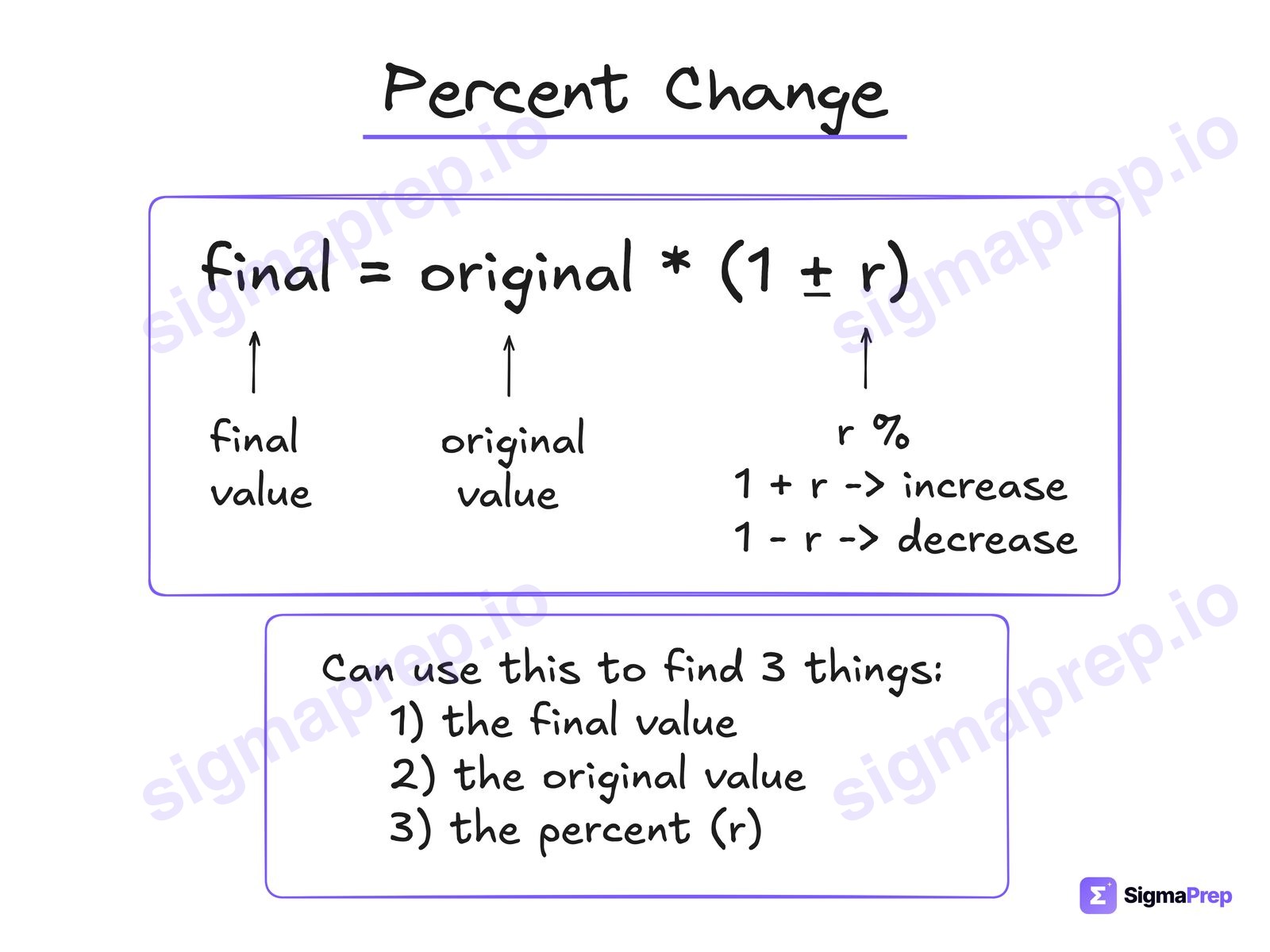
14. Percent ChangeUse this equation in 3 different ways: to find the final amount, the original amount, or the percent. Make whatever the question asks for the unknown, x, plug in numbers for the other two, and let Desmos solve it for you. Very useful and versatile.Worked example in the app →
Percentages sit inside Problem-Solving and Data Analysis, about 15% of SAT Math. The easy ones are arithmetic. The hard ones are the same arithmetic with the unknown moved to a different spot in the sentence, and that is where students who "know percents" lose points. One equation handles all of it.
The one equation
Final = original × (1 ± rate). Increase by 5% is × 1.05, decrease by 30% is × 0.70. Use it three ways: to find the final amount, the original amount, or the percent. Make whatever the question asks for x, plug in the other two, and let Desmos solve it. The word "of" means multiply, and "what percent" means the unknown is the rate.
The five ways the SAT asks it
1. What percent
Percentages · Easyanswer D
A company that ships orders to customers has 450,000 batteries in stock. Of those, 324,000 are rechargeable. What percentage of the batteries are rechargeable?
Part over whole: 324,000 over 450,000 is 0.72, so 72%. The choice 28% is the other part, the batteries that are not rechargeable, and it is there for people who read the question halfway.
2. Apply an increase
Percentages · Mediumanswer 65
Last year, Priya had 50 vines in the vineyard. This year, the number of vines in Priya's vineyard is 30% greater than the number of vines in the vineyard last year. How many vines does Priya have in the vineyard this year?
30% greater than 50 is 50 × 1.30 = 65. Not 50 + 30, and not 30% of 50. "Greater than" means the original plus the percent of the original, which is why the factor is 1.30 and not 0.30.
3. Find the original
Percentages · Mediumanswer A
A number n is increased by 5%. If the result is 378, what is the value of n?
The result is known and the start is not: 378 = x × 1.05, so x = 360. The trap is subtracting 5% of 378, which gives 359 and is one of the choices. You cannot undo a percent increase by subtracting the same percent. Divide by the factor instead, or type 378 = x(1.05) into Desmos.
4. Find the percent change
Percentages · Mediumanswer C
A customer's monthly heating bill was $55.20. Due to a rate increase, the monthly bill is now $58.64. To the nearest tenth of a percent, by what percent did the amount of the customer's heating bill increase?
Change over original: (58.64 − 55.20) over 55.20 is 0.0623, so 6.2%. Over the original, never over the new amount. The choice 5.9% is what you get dividing by 58.64. The equation still works: 58.64 = 55.20(1 + x).
5. Chained percents
Percentages · Hardanswer A
The number a is 250% greater than the number b. The number b is 70% less than 30. What is the value of a?
Work backwards through the sentence. b is 70% less than 30, so b = 30 × 0.30 = 9. a is 250% greater than b, so a = 9 × 3.50 = 31.50. "250% greater" means × 3.5, not × 2.5, and that one factor is what makes this a hard question. Every chained-percent question is two applications of the same equation in a row.
Try one
This is a real question from our Percentages · Medium set. Solve it the fast way, then watch how I do it.
try one · Percentages · Medium
The number k is 42% greater than 80. If k is the product of 80 and r, what is the value of r?
Where the points actually go
Subtracting a percent to undo an increase, dividing by the new amount instead of the original, and reading "250% greater" as × 2.5. All three are the same equation used with the wrong number in the wrong slot.
The app has 378 percentage questions, 105 easy, 119 medium and 154 hard, every one with a video explanation. The free diagnostic shows whether this is where your points are going.
Common Questions
Final = original × (1 + rate). A 5% increase multiplies by 1.05; a 30% decrease multiplies by 0.70. To find the original from the final, divide by the factor instead of subtracting the percent.
The change divided by the original amount, times 100. Always the original, not the new amount. From $55.20 to $58.64 is 3.44 over 55.20, about 6.2%.
Multiply by 1 + 2.50 = 3.5. "Percent greater than" adds the percent to the whole, so 100% greater is double and 250% greater is 3.5 times. "250% of" would be × 2.5, which is the trap.
Percentages are one of the skills in Problem-Solving and Data Analysis, about 15% of SAT Math. Expect one or two per test, with the reverse and chained versions in the harder second module.
Want more SAT tips like this?
One article a week. No spam.
Ready to raise your SAT Math score?
Take the free Diagnostic Quiz and see where you stand. No payment required.