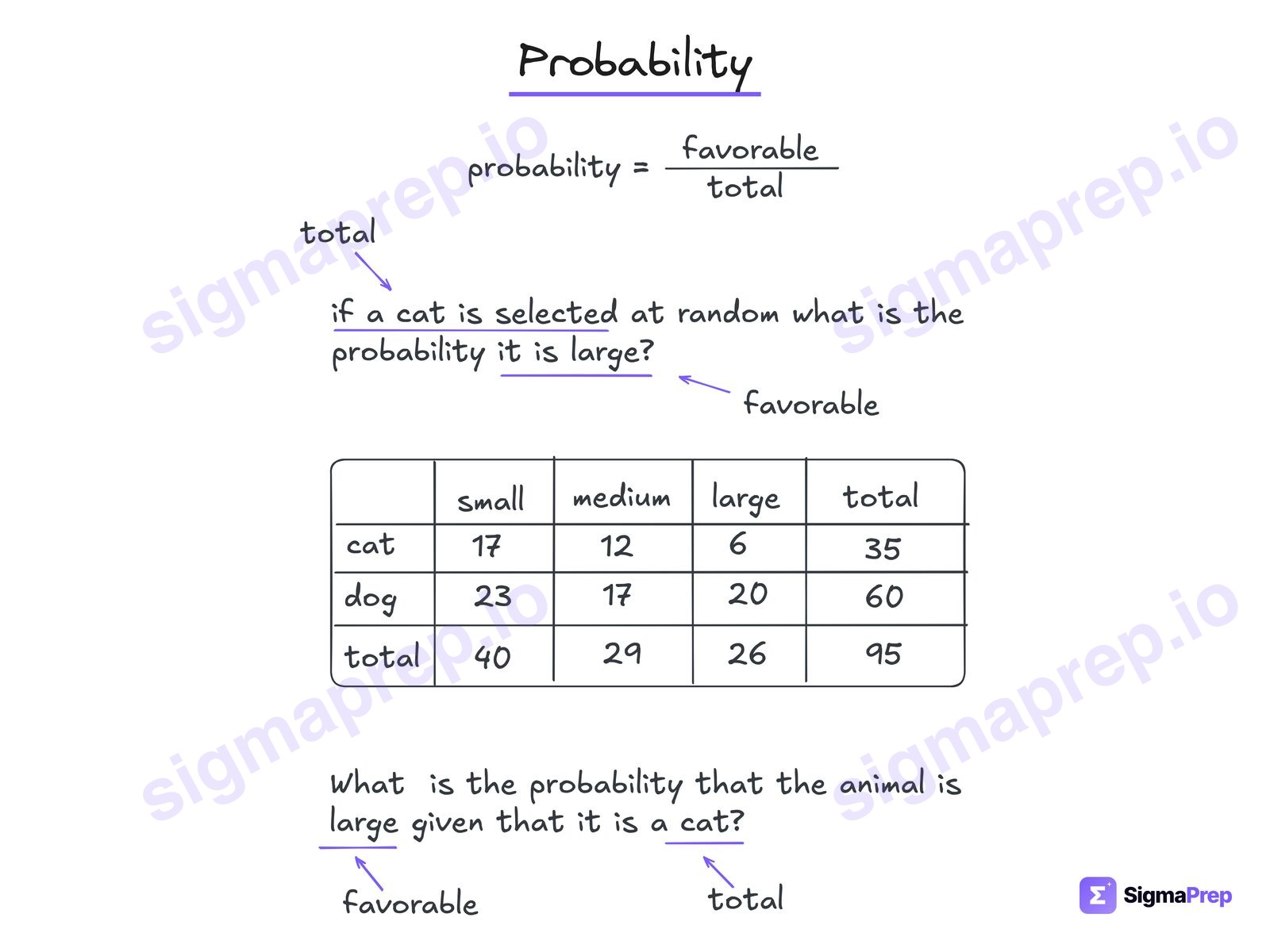
17. ProbabilityProbability just wants you to create a fraction. When you read these problems you need to know what the denominator is (the total) and what the numerator is (the favorable). The phrase "given that" swaps the total around.Worked example in the app →
Probability on the SAT wants one fraction from you: the favorable count over the total count. That is the whole skill. What changes from question to question is where the two numbers hide, and the phrase "given that," which swaps the total for a smaller one. It sits inside Problem-Solving and Data Analysis, about 15% of SAT Math.
Denominator first
Before you touch the numerator, decide what the total is. "Selected at random from the whole table" means the grand total. "Given that it is refurbished" means the total is only the refurbished row. Once the denominator is right, the numerator is just counting.
The five ways the SAT asks it
1. Favorable over total
Probability and conditional probability · Easyanswer A
A parking lot has 12 cars. Of these, 3 are red. If a car is randomly selected, what is the probability that the selected car will be red?
3 red out of 12 cars, 3/12, which is 1/4. The choice 3/4 is the probability of not red. Simplify or not, Desmos accepts both, but the free-response box wants a fraction or a decimal, never a percent.
2. Reading a two-way table
Probability and conditional probability · Easyanswer B
On a particular Saturday, 120 customers visited a bookstore. The table below summarizes whether or not the customers purchased book, bookmark, both, or neither.
Bookmark purchased
Bookmark not purchased
Total
Book purchased
45
20
65
Book not purchased
30
25
55
Total
75
45
120
Based on the data in the table, what is the probability that a bookstore customer selected at random on that day did not purchase a book?
"Did not purchase a book" is a whole row, 55 customers, over the grand total of 120. The wrong choices divide by a row or column total instead of the grand total, or use a single cell. When the question does not say "given," the denominator is the number in the bottom right corner.
3. Both conditions at once
Probability and conditional probability · Mediumanswer D
A store has 16 phones in stock. The table below classifies each phone by condition and price range.
≤$200
>$200
New
7
3
Refurbished
4
2
If a phone is selected at random, what is the probability that it is a refurbished phone priced at $200 or less?
Refurbished and $200 or less is one cell, 4 phones, over all 16: 1/4. "And" points at a single cell. The choice 7/16 is the new phones, and 3/16 is the wrong cell. Find the intersection of the row and the column before you divide.
4. An unknown in the total
Probability and conditional probability · Easyanswer B
A tray contains n cookies and 8 brownies. If one item is selected at random from the tray, what is the probability of selecting a cookie?
n cookies, 8 brownies, so the total is n + 8 and the probability of a cookie is n over n + 8. The choice n/8 forgot that the cookies are part of the total. Same fraction, just written with a letter.
5. Work backwards from a probability
Probability and conditional probability · Mediumanswer A
A school has 400 students enrolled in one of 3 programs: Art, Music, or Drama. The probability that a randomly selected student is in Art is 0.45, and the probability that a randomly selected student is in Music is 0.30. How many students are enrolled in Drama?
The three probabilities add to 1, so Drama is 1 − 0.45 − 0.30 = 0.25, and 0.25 of 400 students is 100. The choice 180 is Art's count, 120 is Music's. When they hand you probabilities and ask for a count, multiply the probability by the total.
Try one
This is a real question from our Probability · Medium set. Solve it the fast way, then watch how I do it.
try one · Probability · Medium
A bag contains marbles of 4 colors: 6 green, 4 orange, 30 purple, and 30 pink. If a marble is selected at random, what is the probability that the marble is neither purple nor pink?
Where the points actually go
Dividing by the wrong total, reading a row when the question meant a cell, and missing the "given that" that shrinks the denominator. Decide the denominator first, every time, and the topic gets boring fast.
The app has 231 probability questions, 112 easy, 77 medium and 42 hard, every one with a video explanation. The free diagnostic shows whether this is where your points are going.
Common Questions
It shrinks the total. "Given that the phone is refurbished" means the denominator is only the refurbished row of the table, not the grand total, and the numerator is the part of that row that matches the rest of the question.
Numerator is the count that matches the question, a cell, a row or a column. Denominator is the grand total in the corner, unless the question says "given that," in which case it is the row or column total named in that phrase.
Yes. Free-response answers accept fractions like 3/12 or decimals like 0.25. They do not accept percents, so 25% must be entered as 0.25 or 1/4.
Probability and conditional probability is one of the skills in Problem-Solving and Data Analysis, about 15% of SAT Math. Expect one per test, often with a two-way table.
Want more SAT tips like this?
One article a week. No spam.
Ready to raise your SAT Math score?
Take the free Diagnostic Quiz and see where you stand. No payment required.