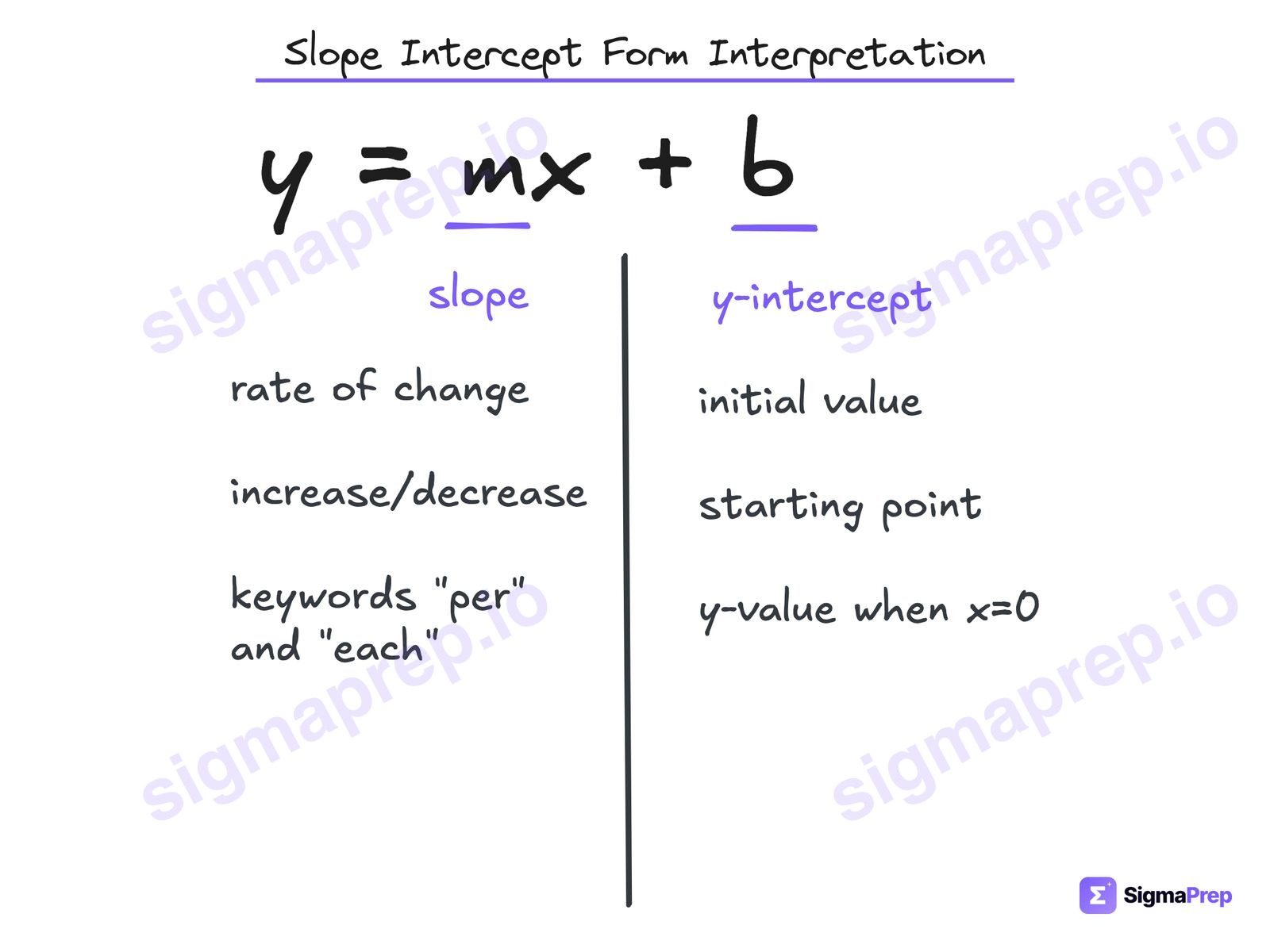
1. Slope-Intercept Form InterpretationSlope is always attached to the variable, and the keywords are per and each. Slope is the change in y for ONE change in x.Worked example in the app →
Linear functions are the largest skill in the Algebra domain, which is itself about 35% of SAT Math. Everything here is y = mx + b wearing a story. The slope is the "per" or "each" number, the intercept is the starting value, and once you can find those two in a paragraph, most of these questions take under a minute.
The two words that solve half of them
Per and each. Whatever number sits next to those words is the slope, and slope is always attached to the variable. The number standing on its own is the y-intercept, the value when x is 0. "$75 per hour plus $90 for parts" is f(x) = 75x + 90 before you finish reading the sentence.
The five ways the SAT asks it
1. Plug in, or find the input
Linear functions · Easyanswer C
The function f is defined by f(x)=18x+15. What is the value of f(x) when x=3?
The easy version. Either they give you x and want f(x), or they give you f(x) and want x. Both are one line in Desmos: type the function, then either evaluate it or set it equal to the value and read the intersection. The trap is only ever which one they asked for.
2. Write the function from the situation
Linear functions · Easyanswer D
To repair a dishwasher, a plumber charges $75 per hour for labor plus $90 for parts. Which function f represents the total amount, in dollars, the plumber will charge for this job if it takes x hours?
Per hour goes with x, the flat fee stands alone. The wrong choices put the 90 on the x or drop it, which is the whole question. If you read the two words first, you are done before you look at the choices.
3. Interpret the slope or the intercept
Linear functions · Hardanswer B
A container is being filled with water. The formula h=40+5t relates the height h, in centimeters, of the water in the container to the time t, in minutes, since filling began. Which of the following describes the meaning of the 5 in this context?
AThe time, in minutes, to reach a height of 40 centimeters
✓The increase in the height, in centimeters, of the water for each one-minute increase in time
CThe height, in centimeters, of the water when filling began
DThe increase in time, in minutes, for each one-centimeter increase in the height of the water
This is the type that separates 650 from 750. Two choices will both mention "each one-minute increase," and only the order tells them apart. Slope is the change in y for one change in x: the height changes 5 centimeters for each one minute, not the time changes for each centimeter. On the easy version one choice is obviously right. On the hard version you need that sentence exactly.
4. Build the function from two points or a table
Linear functions · Mediumanswer A
In the xy-plane, the graph of the linear function f contains the points (0,5) and (6,35). Which equation defines f, where y=f(x)?
Slope is rise over run between the two points, and if one of the points has x = 0 the intercept is handed to you. Here the slope is 30 over 6, which is 5, and the intercept is 5. When neither point is on the y-axis, Desmos regression or two clicks on the graph gets it faster than the algebra.
5. "The first day, then each additional day"
Linear functions · Hardanswer A
The cost of renting an excavator for up to 14 days is $350 for the first day and $175 for each additional day. Which of the following equations gives the cost y, in dollars, of renting the excavator for x days, where x is a positive integer and x≤14?
The most-missed linear function on the test. The rate applies to days after the first, so it is 175 times (x − 1), plus 350, which simplifies to 175x + 175. The obvious-looking answer 175x + 350 charges the first day twice. Whenever you see "first" and "each additional," the intercept is not the number they gave you.
Try one
This is a real question from our Linear Functions · Medium set. Solve it the fast way, then watch how I do it.
try one · Linear functions · Medium
The function g is defined by g(x)=3x+18. The graph of y=g(x) in the xy-plane has an x-intercept at (a,0) and a y-intercept at (0,b), where a and b are constants. What is the value of a+b?
Where the points actually go
Three places: reading the slope sentence backwards, charging the first day twice, and answering with the input when they asked for the output. None of them are math. They are reading, and the only way to make them automatic is volume.
The app has 462 linear functions questions, 175 easy, 147 medium and 140 hard, every one with a video explanation. The free diagnostic will tell you whether this topic is even where you are losing points.
Common Questions
The slope is the number attached to "per" or "each": the change in the output for one unit of the input. The y-intercept is the value when the input is zero, the starting amount or the flat fee. In f(x) = 75x + 90, the 75 is the hourly rate and the 90 is the fee before any hours.
Slope is the change in y divided by the change in x between the points. If one point is on the y-axis its y-value is the intercept. Otherwise plug the slope and one point into y = mx + b and solve for b, or type the two points into Desmos and run a linear regression.
Linear functions are the largest skill inside Algebra, which is about 35% of the Math section, 13 to 15 questions. Expect several linear function questions per test across both modules.
Because the rate only starts after the first day. The cost is the first-day price plus the daily rate times (days − 1), so the intercept in the simplified function is not the first-day price. The answer that looks obvious charges the first day twice.
Want more SAT tips like this?
One article a week. No spam.
Ready to raise your SAT Math score?
Take the free Diagnostic Quiz and see where you stand. No payment required.