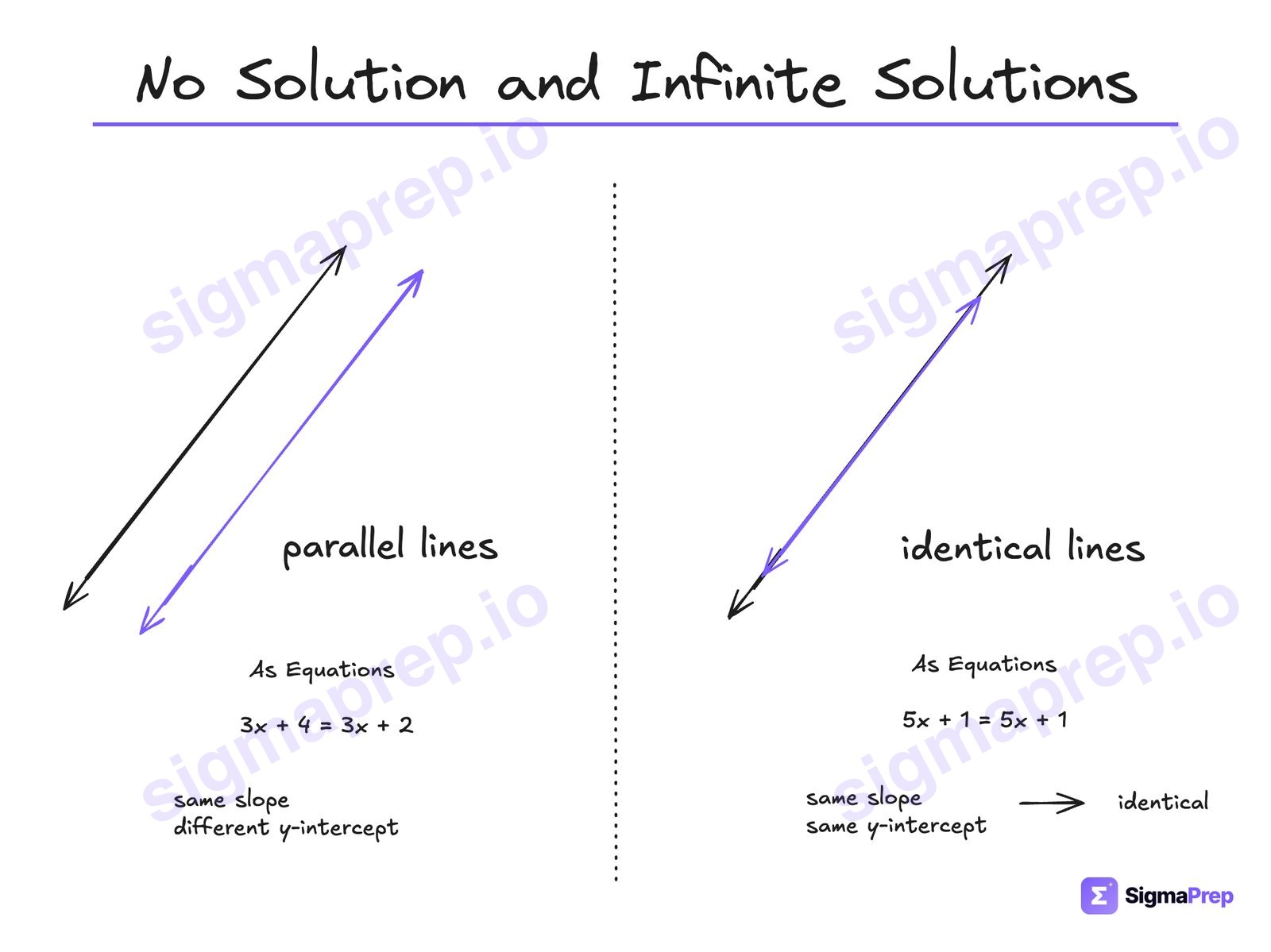
3. No Solution and Infinite SolutionsNo solution means parallel lines: same slope, different y-intercept. Infinitely many solutions means the same line: same slope and the same y-intercept. Get both sides into slope-intercept form, then match the slopes (and, for infinite, the intercepts) and solve for the constant.Worked example in the app →
Algebra is about 35% of SAT Math, 13 to 15 questions out of 44, and linear equations in one variable are the floor of it. They are the questions everybody is supposed to get, which is exactly why College Board hides its traps in them. There are five shapes, and the hard ones are the same five with a constant thrown in.
The rule that covers most of it
Desmos solves any one-variable equation. Type the whole equation in exactly as written, zoom out, and the solution shows up as a vertical line with the x-value on it. That is faster and safer than doing the algebra by hand, and it removes the arithmetic slip that costs most of the points here. What Desmos cannot do is read the question for you, and that is where the five shapes come in.
The equation gives x = 9. The question asks for x − 5, which is 4. Two of the four choices are there to catch people who stop at x. Every solve-it question on the test has this second step somewhere, so read the last line before you answer.
2. Build the equation from the words
Linear equations in one variable · Easyanswer B
Sarah paid a total of $210 for a tablet by making a down payment of $42 plus p monthly payments of $24 each. Which of the following equations represents this situation?
Fixed amount plus a per-thing amount times the count equals the total. The down payment is the fixed part, the $24 is attached to the months, so 24p + 42 = 210. The wrong choices swap which number gets the variable, so the whole question is knowing that "per month" is the number that multiplies p.
3. No solution, or infinitely many
Linear equations in one variable · Mediumanswer D
In the given equation, c is a constant. If the equation has no solution, what is the value of c?
This is the type to practice, because the hard ones are all this. Think of each side as its own line. No solution means the lines are parallel: same slope, different intercept. Infinitely many means the same line: same slope and the same intercept. Here (c − 5)x = 12 has no solution only when the x disappears, so c − 5 = 0 and c = 5. On the hard version the equation has fractions and constants on both sides; you distribute, put each side in slope-intercept form, and match the slopes.
4. Fractions and decimals
Linear equations in one variable · Mediumanswer 52
What value of x is the solution to the given equation?
Nothing new, just uglier. This is the one where you let Desmos do it: type the equation in with the fractions as written and read the answer, 52. Doing it by hand means a common denominator and three places to make a sign error.
5. A rate in a story
Linear equations in one variable · Hardanswer C
A power plant uses a conveyor to remove ash from a collection bin at a constant rate. The bin contained 18,000 kilograms of ash when removal began. After 5 hours, 13,650 kilograms remained. If the conveyor continues at this rate, what is the total number of hours it will have been running when 5,820 kilograms of ash remain in the bin?
A starting amount, a constant rate, and a target. Write starting amount minus rate times time equals target, solve for time. The rate is the part they make you find first: it hides in "after 5 hours, this much remained." Once you have it, the rest is shape 1.
Try one
This is a real question from our Linear Equations · Medium set. Solve it the fast way, then watch how I do it.
try one · Linear equations · Medium
If 2(3x−4)+5=4(x+1)−3, what is the value of x+1?
Where the points actually go
Almost nobody misses these because the algebra is beyond them. They miss on the last line of the question (x versus x − 5), on the no-solution setup, and on arithmetic that Desmos would have done for them. The fix is doing them easy to hard until the three traps are boring.
The app has 257 linear equations questions, 91 easy, 70 medium and 96 hard, every one with a video explanation. If you are not sure this is where your points go, the free diagnostic tells you which topics are actually costing you.
Common Questions
Algebra is about 35% of SAT Math, 13 to 15 questions per test, and linear equations in one variable are a few of those on every test. They appear in both modules, with the no-solution and infinitely-many-solutions versions in the harder second module.
Yes. Type the equation into the built-in Desmos calculator exactly as written and the solution appears as a vertical line with its x-value labeled. It works with fractions, decimals and parentheses, so it is the fastest and safest way to solve any one-variable equation on the test.
When the variable cancels out and what is left is false, like 0 = 12. Think of each side as a line: no solution means parallel lines with the same slope and different intercepts. Infinitely many solutions means both sides are the same line, same slope and same intercept.
Answering the wrong question. The equation gives x, and the question asks for x − 5 or 2x or x + 1, and two of the four choices are built for people who stop at x. Read the last line before you pick.
Want more SAT tips like this?
One article a week. No spam.
Ready to raise your SAT Math score?
Take the free Diagnostic Quiz and see where you stand. No payment required.