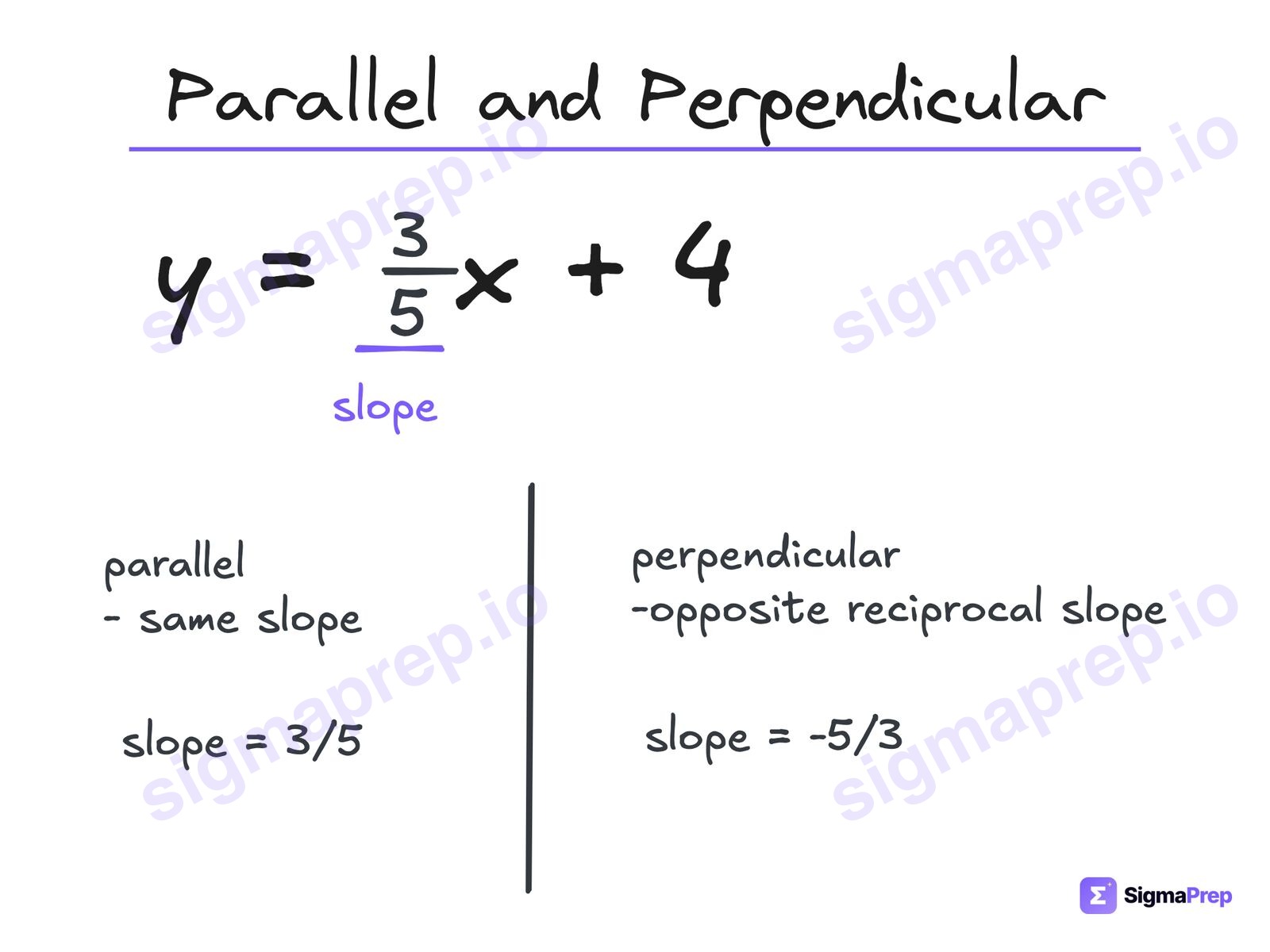
2. Parallel and PerpendicularYou can only read the slope in slope-intercept form, so isolate y first. Perpendicular is opposite reciprocal: flip the sign AND flip the fraction.Worked example in the app →
This skill is the line itself: its slope, its intercepts, its equation, and what the numbers mean when the line is a budget or a mixture. It sits inside Algebra, which is about 35% of SAT Math. Four of the five question types come down to getting the equation into y = mx + b, and the fifth is reading.
The one move
You can only read the slope when y is by itself. If the equation shows up as 3y + 21x = 7 or 12x − 4y = −8, isolate y first, then the slope is whatever multiplies x. Every parallel, perpendicular and intercept question starts with this move, and most of the wrong answers come from skipping it.
The five ways the SAT asks it
1. What does the number represent?
Linear equations in two variables · Easyanswer A
A store sells two different-sized containers of a certain organic juice. The store's sales of this organic juice totaled $2,134.56 last month. The equation 3.75x+6.20y=2,134.56 represents this situation, where x is the number of smaller containers sold and y is the number of larger containers sold. According to the equation, which of the following represents the price, in dollars, of each smaller container?
In ax + by = c, the coefficient is the price or rate of one unit of that variable, and the constant is the total. 3.75 multiplies x, so it is the price of one small container. The choices that say 3.75x describe the money from all the small containers, which is a different thing. Coefficient means per one, the product means all of them.
2. Parallel or perpendicular
Linear equations in two variables · Mediumanswer C
Line p is defined by 3y+21x=7. Line r is perpendicular to line p in the xy-plane. What is the slope of line r?
Isolate y: y = −7x + 7/3, so the slope is −7. Parallel keeps the slope. Perpendicular flips the sign and flips the fraction, so −7 becomes 1/7. Both flips, every time. The choices −7, 7 and −1/7 are each one flip short.
3. Write the line from a slope and a point
Linear equations in two variables · Mediumanswer A
Line k has a slope of −41 and passes through the point (8,7). Which equation defines line k?
Plug the slope and the point into y = mx + b and solve for b: 7 = −2 + b, so b = 9. Or type the point (8, 7) into Desmos, then type each answer choice in and see which line passes through it. Either way the intercept is 9, not 7. The choice with 7 in it is for people who assume the point's y-value is the intercept.
4. The intercepts from standard form
Linear equations in two variables · Hardanswer C
The x-intercept of the graph of 5x+3y=−29 in the xy-plane is (a,0) and the y-intercept is (0,b). What is the value of ab?
The x-intercept has y = 0, the y-intercept has x = 0. Cover one variable and solve for the other: a = −29/5 and b = −29/3. Then b over a is 5/3, and the 29 cancels, which is the tell that you set it up right. Desmos shows both intercepts when you click the line, if you would rather not do the fractions.
5. Mixtures and combinations
Linear equations in two variables · Easyanswer C
A scientist studying the effect of acid on a reaction mixes x liters of a weak-acid solution, which is 5% acid by volume, with y liters of a strong-acid solution, which is 85% acid by volume, to create 30 liters of a solution that is 10% acid by volume. Which equation represents this situation?
Percent times amount plus percent times amount equals percent times total. Weak acid gives 0.05x, strong acid gives 0.85y, and the result is 10% of 30 liters, so 0.05x + 0.85y = (0.10)(30). The wrong choices either forget to take 10% of the 30 or swap the percents. Two cups going into one cup, every mixture question on the test is this equation.
Try one
This is a real question from our Linear Equations in Two Variables · Medium set. Solve it the fast way, then watch how I do it.
try one · Linear equations in two variables · Medium
The equation 20x+4y=48 represents the graph of a line in the xy-plane. A second graph is obtained by shifting the first graph down 3 units. Which of the following is a y-intercept of the second graph?
Where the points actually go
Reading the slope off an equation that was not solved for y, doing one flip instead of two on a perpendicular, and treating a coefficient as a total instead of a rate. All three are habits, and habits change with repetition, not with another explanation.
The app has 483 questions on this skill, 182 easy, 154 medium and 147 hard, every one with a video explanation. The free diagnostic shows you whether this is where your points are going.
Common Questions
Isolate y first. Move the x-term over and divide by the coefficient of y, then the slope is whatever multiplies x. Reading the slope straight off standard form is the most common mistake on this topic.
The negative reciprocal: flip the sign and flip the fraction. A line with slope −7 is perpendicular to a line with slope 1/7. A parallel line keeps the same slope.
The coefficient is the rate or price of one unit of that variable, and the constant on the right is the total. So 3.75 is the price of one x-item, while 3.75x is the money from all of them.
Percent times amount for each ingredient, added, equals percent times amount of the final mixture. If one amount is unknown, the other is usually the total minus it. Then type the equation into Desmos and read the solution.
Want more SAT tips like this?
One article a week. No spam.
Ready to raise your SAT Math score?
Take the free Diagnostic Quiz and see where you stand. No payment required.