Parents ask this question a lot. Is it actually worth spending money on SAT prep? The short answer is yes. The right prep can raise a student's score by 100-200 points and that can change which colleges they get into, which scholarships they qualify for, and how many options they have.
The catch is that most SAT prep options have real problems. Some are overpriced. Some aren't structured enough to produce results. Some give you material but no plan. The type of prep matters as much as whether you prep at all.
Here's an honest look at the most common options and where they fall short.
Group Classes and Bootcamps
These typically cost $500-$2,000+ for a multi-week course. You show up at a set time, sit in a room with 15-30 other students, and a teacher covers SAT material.
The fundamental problem is that every student in that room has different strengths and weaknesses. One student might need help with algebra while another has algebra down but struggles with geometry. The teacher can't tailor the pace or focus to each individual. So some students are bored reviewing things they already know while others are lost because the class moved past their gaps too quickly.
You're also locked into someone else's schedule. Miss a session because of a school event or sports practice and you've lost that content. There's no replay button.
For the price point these courses charge, the results are often disappointing. Not because the teachers are bad but because the format fundamentally can't address individual needs.
Prep Books
A $30 SAT prep book seems like a bargain compared to a $2,000 course. And for some students it can work. But most students hit the same wall.
The book has a fixed set of problems. Maybe 200-400 math questions across all topics and difficulty levels. You work through them, check your answers, and then what? You've seen every problem in the book. You can't practice the same topic again with fresh questions. You can't drill just the areas where you're weakest without re-doing problems you already solved.
The other issue is that when you get a problem wrong a book can show you the solution but it can't show you the thought process. It can't demonstrate the fastest way to solve that type of problem or show you how to use Desmos to skip the algebra entirely. A static solution on a page is fundamentally limited compared to watching someone work through it.
Private Tutors
Private tutoring runs $75-$200+ per hour and it's the most effective format when it works. One-on-one attention, tailored pacing, real-time feedback. If you find the right tutor this is the gold standard.
The problem is finding the right tutor. Being great at math doesn't make someone a great SAT math tutor. The SAT tests math in a very specific way. It emphasizes interpretation, context, and Desmos fluency over raw calculation. A tutor who teaches school math brilliantly might not know the patterns the SAT uses, the fastest solving methods for specific question types, or how to use Desmos strategically.
And even with a great tutor you're limited by hours. At $150/hour most families can afford maybe 10-20 sessions. That's 10-20 hours of instruction. What happens in between sessions? The student needs structured practice on their own and most tutors don't provide a system for that.
Free Resources Like Khan Academy
Khan Academy's SAT prep is solid and it's free. For students who are self-motivated and good at creating their own study plan it can be enough. The problems are real College Board questions and the platform adapts to some degree.
Where it falls short is depth of explanation. The video explanations cover concepts but don't always show the fastest solving method for each problem type. There's less focus on test-taking strategy like when to use Desmos or how to eliminate answer choices quickly. And for students who need more accountability and guidance than "here are some problems, good luck" it can feel overwhelming.
What Actually Works
The prep that produces results has a few things in common regardless of the format:
- Enough practice volume. You need to see hundreds of problems across every topic to build real pattern recognition. Not 20 problems on linear equations. More like 80-100. Same topic different numbers different wording until the pattern is automatic.
- Difficulty separation. You should be able to practice Easy, Medium, and Hard questions separately. Mastering the fundamentals before moving to harder material is how you build toward a 700+ score systematically.
- Immediate feedback with explanations. When you get a problem wrong you need to see how to solve it the right way immediately. Not just the answer but the method. Ideally the fastest method.
- Your own pace. Some students need 2 months. Some need 4. The prep should work on your schedule not force you into someone else's.
- Tracking what you actually know. You need visibility into which topics you've mastered and which still need work. Most students don't actually know what they got wrong until it's too late.
What We Built and Why
Sigma Prep exists because we saw these gaps firsthand from years of tutoring. Here's specifically what we do differently:
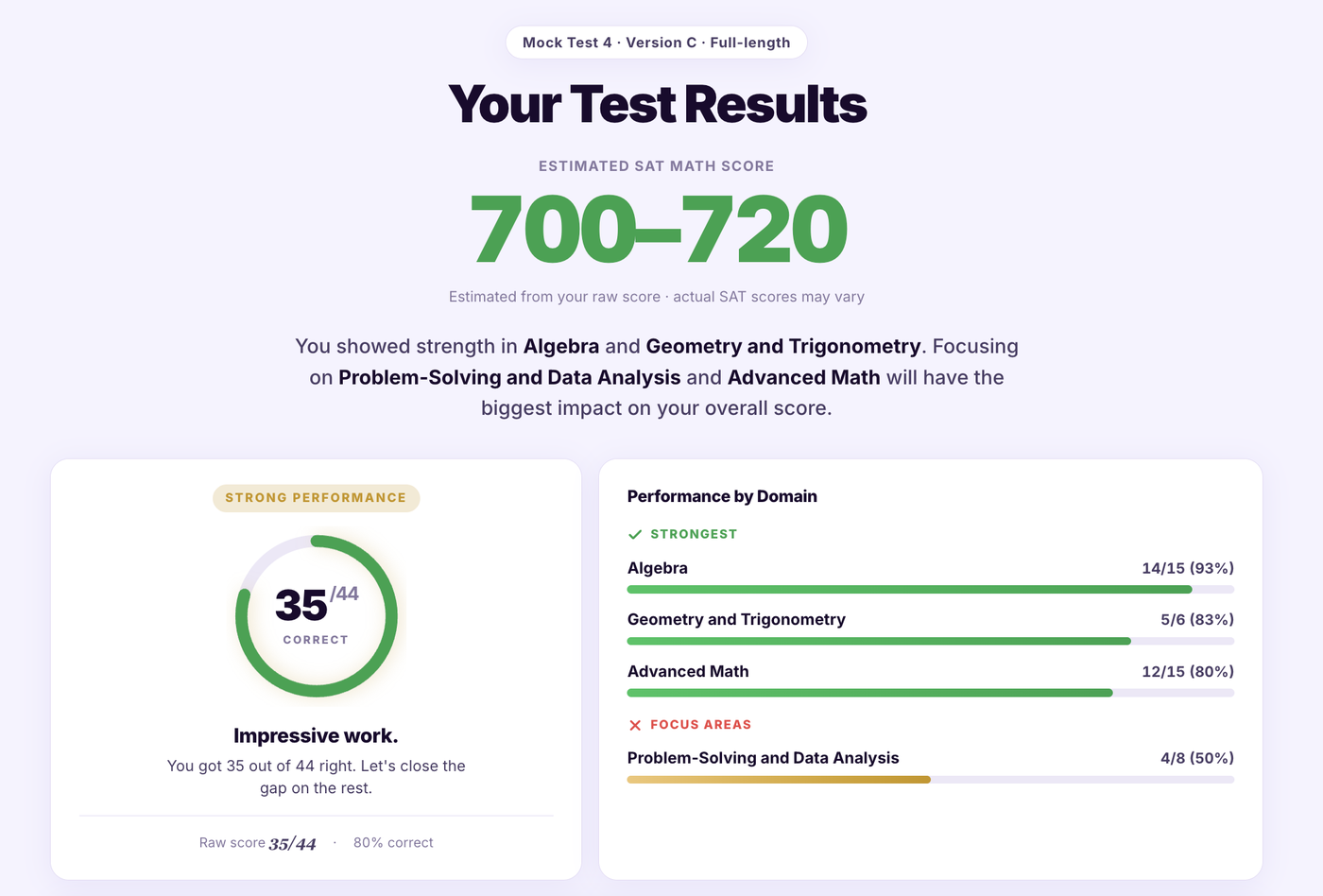
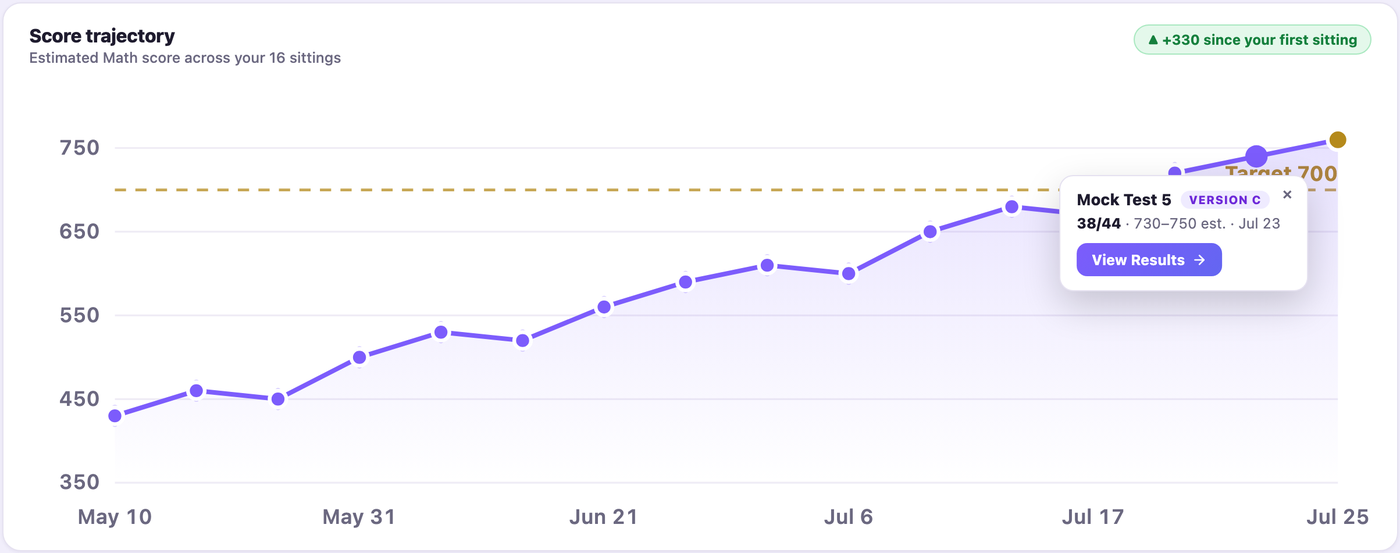
Over 7,000 practice problems across every SAT Math topic separated into Easy, Medium, and Hard. You can take the same topic quiz 4 or 5 times without seeing the same question. That's the volume of practice you need to build real consistency. Plus 24 full-length timed practice tests modeled on real SATs, each with video walkthroughs for every question, so you can measure your progress under real test conditions.
Video explanations for every single problem. Not just "the answer is B." A tutor walks through the fastest solving method for that exact problem type. When you get something wrong you watch how it's done and then immediately practice similar problems.
Difficulty-separated practice. Lock in Easy first. Then Medium. Then Hard. This is the same approach we described in our guide to scoring 700. Nail the fundamentals before grinding the hard ones.
Progress tracking that's actually useful. You can see exactly which topics you've mastered, which need work, and where your score stands. Parents can see it too.
Self-paced. Study at midnight or 6am. Spend 15 minutes or 2 hours. Pick up where you left off. No scheduled classes to miss.
Here's what it looks like.
See how the practice tests work →
The Bottom Line
SAT prep is worth it. A higher score opens doors to better schools and more scholarship money. The return on investment is real.
But the wrong prep wastes both time and money. Group classes that can't tailor to your needs. Books that run out of problems. Tutors who are great at math but don't know the SAT. These options can leave you frustrated and no closer to your target score.
The right prep gives you enough practice, at the right difficulty level, with expert explanations, at your own pace. That's what moves scores.
We make it affordable to try us out because we're confident in what we built. Take the free Diagnostic Quiz to see where you stand, then explore the platform. If it's not the right fit, no hard feelings. But we think you'll see the difference.