Short answer. Get a baseline from one official practice test, pick a target score from the colleges on the list, and set up short practice sessions four or five days a week for two to three months.
Your job as a parent is not teaching math. It is making sure practice happens, checking that practice-test scores move every few weeks, and changing the plan when they do not.
Most parents want to help with the SAT and are not sure where they fit. You probably are not going to sit down and teach systems of equations, and you should not have to. What you can do is set up the plan, keep it on track, and notice early when it is not working. That is most of what separates students who improve from students who do not.
This guide walks through it in order: where to start, how much practice is enough, what good practice looks like, how to tell whether it is working, and how to talk about it without turning every dinner into a progress meeting.
Step 1: Get a baseline score
Before anyone buys a course or books a tutor, your teen should take one full-length practice test under real conditions. College Board's official practice tests are free in the Bluebook app, the same app used on test day, so the format and timing match exactly. (If you are not sure which devices work, see Bluebook device requirements.)
The result tells you two things you cannot get any other way: the starting score, and where the points are being lost. A student at 520 in math with most misses in algebra needs a different plan from a student at 650 who loses points on a handful of hard geometry questions.
Step 2: Pick a target that comes from real colleges
"As high as possible" is not a target. Look up the middle 50% SAT range for the colleges on your teen's list; most admissions pages or Common Data Set reports publish it. A score at or above the middle of that range for their main schools is a sensible goal.
The gap between the baseline and the target is what sets the plan. A 40-point gap and a 200-point gap are different projects with different timelines.
Step 3: Set a realistic timeline
For most students, two to three months of steady practice before the test date works well. Less than that and there is no room to fix weak topics; much more and motivation tends to fade.
A routine that holds up for most families:
- Four or five sessions a week, 30 to 45 minutes each.
- One full practice test every two to three weeks, taken in one sitting.
- Review time after every session, going back over the questions they missed.
Short and frequent beats long and occasional. A student who practices for half an hour most days will usually improve more than one who crams for three hours on Sunday, because skills stick when they are used again a day or two later. Register early too: test centers fill up, and the regular registration deadline is about two weeks before each date.
Step 4: Know what good practice looks like
Hours logged are not the same as progress. Good practice has three parts:
- It targets weak topics. Practicing what they are already good at feels productive and changes nothing.
- It includes review. The improvement comes from understanding why a question was missed, not from doing more questions. (More on that in how to actually learn from SAT math mistakes.)
- It uses the real tools. The digital SAT has a built-in Desmos calculator, and students who practice with it save real time on test day. See how to use Desmos on the SAT.
If your teen finishes a session and cannot tell you which topic they worked on or what they got wrong, the session was probably closer to busywork than practice.
Step 5: Check whether it is working
This is where parents add the most value, and it comes down to three signals:
- Practice-test scores across sittings. One test is noisy. Three tests spaced a few weeks apart show a direction.
- Accuracy in the weakest topics. The topics that cost the most points at the start should be costing fewer each month.
- Consistency. Whether practice actually happened on most days, not just the night before a tutoring session.
If a month goes by and none of those has moved, more hours of the same thing will not fix it. Change something: the topics, the materials, or the kind of help.
Be aware that the official SAT score report does not show exactly which questions your teen missed, so after the real test you get a score but not much to act on. That is another reason practice tests during prep matter. See can you see which SAT questions you got wrong?
Step 6: Talk about it without nagging
"Did you study today?" almost always gets "yeah." Specific questions work better than general ones:
- "What topic did you work on this week?"
- "What was the hardest question you missed, and do you get it now?"
- "Your last practice test went up 30 points. What do you think made the difference?"
If practice has stalled, name what you noticed rather than giving a lecture: "I noticed there has not been much practice since Wednesday. What is getting in the way?" There is usually a real answer, like a big project, a sport, or a topic they are stuck on, and it is easier to fix once it is said out loud.
And when scores go up, say so. Recognizing effort matters more to teenagers than most parents expect.
Step 7: Decide what kind of help to pay for
There are three common routes, and they can be combined:
- Free official materials. The Bluebook practice tests and College Board's question bank are free and essential whatever else you use. (Here is what is in the official question bank.)
- A private tutor. Good for diagnosis and accountability, but often $100 an hour or more, and the tutor only sees your teen once or twice a week.
- An online course or app. Cheaper and available every day, but only useful if your teen actually opens it.
Whichever you choose, ask one question before you pay: how will I see what happens between sessions? If the answer is a text saying "the session went well," you will not know whether the prep is working until the real score arrives, and by then it is too late to adjust.
How Sigma Prep handles the parent side
We built a parent view into Sigma Prep for exactly this reason. Your teen sends you a link from their settings, and you can check their study days, practice scores over time, and progress in each SAT Math area, with no account and nothing to install. Parents also get an email when their child reaches topic milestones.
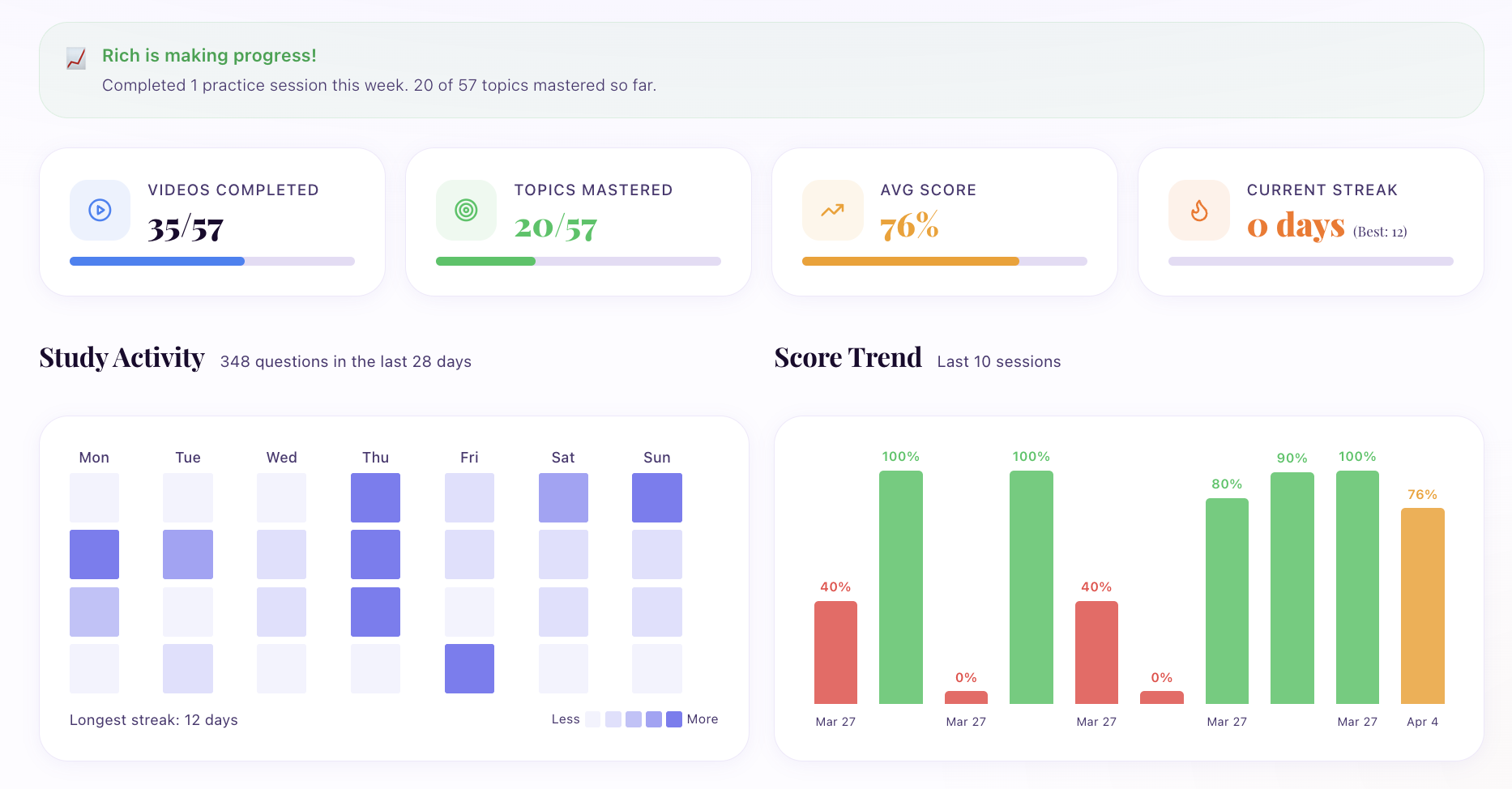
A good first step either way: have your teen take the free Diagnostic Quiz. It takes about 15 minutes and shows where they stand across SAT Math topics, which is the baseline every plan above starts from.