The SAT and ACT have converged a lot in the last year. The SAT is fully digital. The ACT now offers both digital and paper options. Both are shorter than they used to be. And as of December 2025 the digital ACT includes an embedded Desmos graphing calculator just like the SAT. So does it even matter which one you take anymore?
It does. There are real differences that can give you an edge depending on your strengths. Here's an honest breakdown from someone who tutors students on both.
The Big Picture: What Changed Recently
The SAT went fully digital in March 2024. The ACT took longer to catch up. The "Enhanced ACT" launched in April 2025 as a digital option and rolled out nationally in September 2025 for both digital and paper formats. It's shorter (about 2 hours vs the old 3 hours), the Science section became optional, and Math answer choices went from 5 to 4.
The biggest remaining advantage the SAT had was Desmos. The SAT has included an embedded Desmos graphing calculator since going digital, and students who know how to use it can solve hard problems in seconds. The ACT only had a basic scientific calculator built in. That changed in December 2025 when ACT announced Desmos would be available on the digital test. So that gap has closed, at least for students taking the ACT online. Paper ACT takers still use their own handheld calculator.
ACT: Digital vs Paper Is Its Own Decision
One thing that's unique to the ACT is that you actually have to choose between taking it digitally or on paper. The SAT is digital only so there's no decision to make there. But with the ACT the two formats have different scoring curves.
The digital ACT gives you Desmos which is a huge advantage for solving problems quickly. But the curve on the digital version may be slightly harsher, possibly because Desmos makes certain questions easier and the scoring adjusts for that. The paper ACT doesn't have Desmos (you bring your own calculator) but the curve may be a bit more forgiving.
It's hard to say definitively which format is more optimal since there isn't a ton of data yet on the enhanced digital ACT curve. If you're strong with Desmos the digital version probably favors you. If you prefer working on paper and are comfortable with a handheld graphing calculator the paper version might be worth considering. It's an extra variable to think about that SAT students don't have to deal with.
Practice Resources: SAT Has a Clear Edge
This is one of the biggest practical differences right now and it matters more than most people realize.
College Board offers 8 full-length official SAT practice tests through Bluebook. These use the real adaptive format, the real scoring algorithm, and real questions written by the same team that writes the actual test. They're free. The testing interface is polished and matches exactly what you'll see on test day.
The ACT currently offers only 2 practice tests for the enhanced format. The testing interface is noticeably rougher compared to Bluebook. Because the enhanced ACT only launched in April 2025 there simply aren't many examples yet of what the new test looks like.
The one advantage the ACT has here is that it releases actual test questions through a service called ACT My Answer Key. For certain national test dates students can order a copy of the real questions, their answers, and the answer key. The SAT does not release actual test content. So over time we'll get more real ACT examples, probably 3-5 more released tests within a year or so, but right now the SAT has much more practice material available.
Scoring: The 66/33 English-Math Split
This is a critical difference that doesn't get enough attention.
The ACT composite score is made up of three sections: English, Reading, and Math. Two of those three are English-based. That means roughly 66% of your ACT composite score comes from English and only 33% comes from Math.
The SAT splits evenly: 50% Reading & Writing, 50% Math. Each section is scored 200-800 and they add up to your total.
What this means in practice: if you're strong in English but weaker in math the ACT's scoring structure works in your favor. Your English scores carry twice the weight of math. Conversely if you're strong in math but weaker in English the SAT gives your math score equal weight.
The Science Question
The ACT Science section is now optional. It's not included in your composite score. Sounds simple but there's a catch.
Some colleges may require or recommend the Science score. If you're applying to STEM programs at certain schools you may need to have taken it. This means you need to research your target schools before deciding whether to skip it. And if you need it that's additional content to prepare for that SAT students don't have to worry about at all.
Math Content: Different Challenges
Neither test is definitively easier or harder on math. They're hard in different ways.
The ACT tests more topics. There are entire categories of math on the ACT that the SAT never touches. Logarithms, matrices, sequences and series, law of sines and cosines, and more. If you haven't covered these in school yet you'll need to learn them from scratch for the ACT. The SAT has a narrower scope but goes deeper within it.
The SAT is harder in how it asks questions. SAT math questions often test conceptual understanding and interpretation rather than pure calculation. You might get a question that describes a real-world scenario and asks what a specific value represents in context. The wording can make problems seem more difficult than the underlying math actually is. Many students feel SAT questions look unfamiliar even when they know the math because their school classes don't emphasize these kinds of contextual and interpretive questions as much, though that's slowly changing as more curricula adapt.
The ACT is more straightforward calculation. ACT math problems tend to look more like what you see in school. Here's a setup, do the math, pick the answer. There's less interpretation and more direct problem solving. If you prefer "just tell me what to calculate" the ACT format may feel more natural.
So Which One Should You Take?
There's no universal answer but here's a framework:
Lean toward the SAT if:
- You're stronger in math than English (50/50 split helps you)
- You want more official practice material available right now
- You're comfortable with conceptual and contextual questions
- You don't want to worry about whether you need to take a Science section
- You want the most polished digital testing experience
Lean toward the ACT if:
- You're stronger in English than math (66/33 split helps you)
- You prefer straightforward calculation-based math questions
- You've already covered advanced topics like logarithms and matrices in school
- You like a faster-paced test with less time per question
The best approach: Take an official practice test for each. Compare your scores. The test where you score higher with less effort is probably the right one for you. Both tests are accepted at every college in the US, so there's no admissions advantage to one over the other.
Our Take
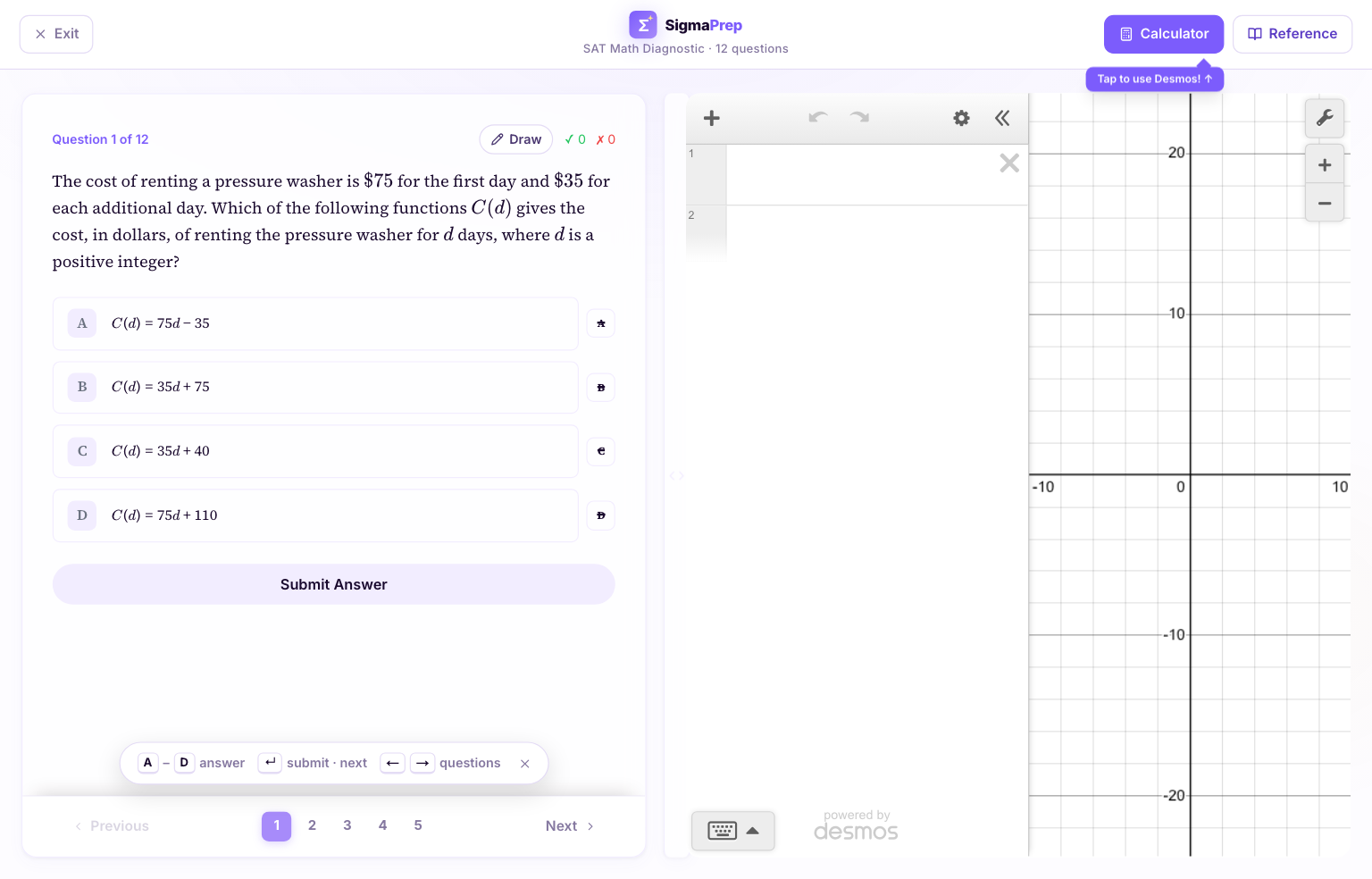
We focus on SAT Math at Sigma Prep. That's a deliberate choice. The SAT has more official practice resources, a more polished digital experience, a scoring structure that gives math equal weight, and a narrower math scope that lets students go deep on fewer topics rather than spreading thin across many. For most students we work with these factors add up to a better outcome.
That said, the right test is whichever one plays to your strengths. If the ACT is a better fit for you, take the ACT. The goal is the highest score possible, not loyalty to a specific test.
Curious where you'd score on SAT Math right now? Take the free Diagnostic Quiz to get a baseline across all four domains. Takes about 15 minutes, no payment required.