The SAT reference sheet is twelve formulas and three notes, and it is the only formula help you get on test day. There is one sheet, it covers Math, and it is the same on every test and every module. College Board calls it the reference sheet, students call it the formula sheet, and most of them find out on test day that it is a lot shorter than they hoped. Here is exactly what is on the SAT Math reference sheet, what is not, how to open it in Bluebook, and the three ways students misuse it.
What is on the SAT reference sheet
Twelve formulas and three notes. That is the whole sheet.
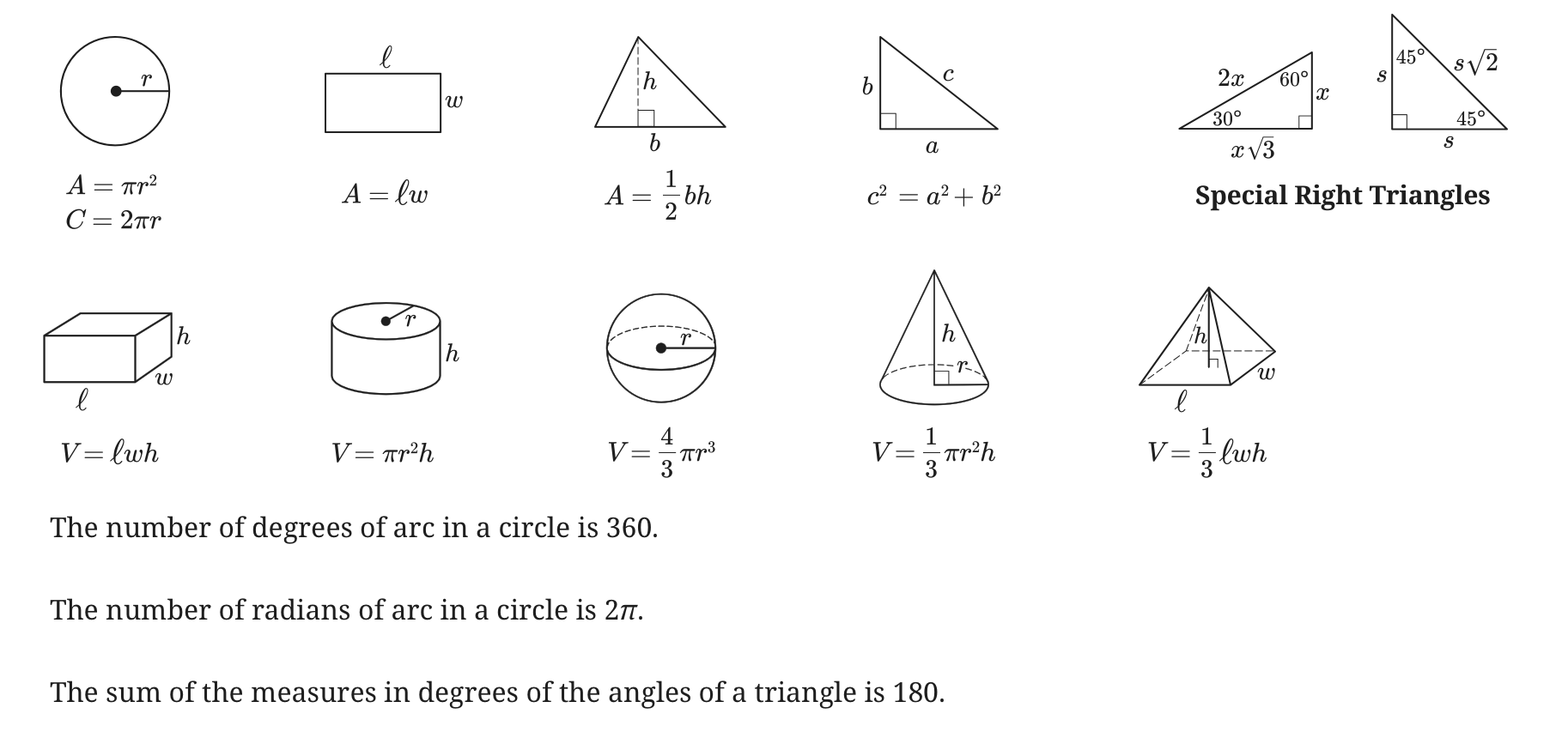
- Circle: area A = πr², circumference C = 2πr
- Rectangle: area A = lw
- Triangle: area A = ½bh
- Right triangle: Pythagorean theorem a² + b² = c²
- Special right triangles: 45-45-90 with sides x, x, x√2, and 30-60-90 with sides x, x√3, 2x
- Rectangular prism: volume V = lwh
- Cylinder: volume V = πr²h
- Sphere: volume V = &frac43;πr³
- Cone: volume V = ⅓πr²h
- Pyramid: volume V = ⅓lwh
The three notes: a circle has 360 degrees, a circle has 2π radians, and the angles of a triangle add to 180 degrees.
If you came here looking for an SAT cheat sheet, this is the only one the test hands you. Everything students mean by a cheat sheet, the formulas you actually have to bring in your head, is the list further down.
How to open it in Bluebook
In the Math section, the toolbar at the top of every question has a Reference button next to the calculator. It opens the sheet in a panel you can drag around the screen, so you can keep it open next to a geometry problem. Close it with the X, reopen it any time. The paper practice tests print the same sheet at the start of each Math module.
What is not on it
This is the list that matters, because these are the formulas the test assumes you carry in your head. None of them appear on the reference sheet.
- Slope, slope-intercept form and point-slope form
- The midpoint and distance formulas
- The quadratic formula, vertex form and the discriminant
- Exponent and radical rules
- The equation of a circle, and how to complete the square to find its center
- Arc length and sector area as a fraction of the whole circle
- Sine, cosine and tangent, and the radian conversion
- Percent change, and reversing a percent change
- Mean, median and standard deviation, and what changes each one
- Probability from a two-way table
- When a system of equations has no solution or infinitely many
- Exponential growth and decay setups
Every one of those is on the free Sigma Prep SAT Math formula sheet, with a real SAT question solved next to it. That sheet exists precisely because the official one stops where the hard questions start.
Three mistakes students make with it
- Opening it hoping the formula is there. Ten seconds of scrolling for a slope formula that was never on the sheet. If the question is algebra, do not open it.
- Not using it for the volumes. Students memorize the cone and pyramid formulas, mix up the one-third, and get them wrong. Those five are on the sheet. Look them up, every time.
- Misreading the special triangles. The 30-60-90 diagram puts x opposite the 30, x√3 opposite the 60 and 2x on the hypotenuse. Students pull the wrong side for the wrong angle. Match the side to the angle across from it before you write anything.
Is the reference sheet enough?
For geometry, mostly. For the other three quarters of the test, no. Algebra, advanced math and data analysis make up about 30 of the 44 questions, and the sheet has nothing for any of them. Knowing the formulas is not the hard part either. Knowing which one a question is asking for, in disguise, is where the points go.
Two ways to find out where you stand. The free diagnostic is twelve real SAT Math questions and tells you which topics are costing you. The free full-length test is the real thing, adaptive and scored, with a video on every problem you miss.