Short answer: one month is enough to move your SAT Math score, as long as you spend it on the questions you actually miss. Week 1, take a full-length test and find your weak skills. Weeks 2 and 3, work those skills, starting each one at the level where you started missing. Week 4, timed tests and careless-mistake review. Plan on about 5 to 7 hours a week.
If you have six weeks, the 6-week plan has more room. This is the compressed version.
Or let Sigma Prep build the plan for you
The plan below is the general shape. Sigma Prep's study plan does it for your situation, free with an account:
- Fits your test date. Pick your SAT date and it paces the topics to the time you have left.
- Starts you at the right level. Take the free diagnostic or a full-length test, and each topic starts at the difficulty your misses call for, so you don't waste a week on what you already know.
- Orders topics by the math you have taken. An Algebra 1 student and a precalculus student get different orders.
- Updates itself. As you practice and take tests, it moves you up or adds work where you are still missing.
Start with the free 12-question diagnostic and your plan is built from the result.
Week 1: Find out where the points are
Take one full-length Math test under real timing, either an official one in Bluebook or a Sigma Prep test. Then list every miss and every guess by skill. Most students find their misses cluster in a handful of skills, often 8 to 12. That list is your whole month. Everything not on it gets less time.
Weeks 2 and 3: Work your weak skills at your level
Work through your weak skills one at a time, starting each one at the level your test showed. If you missed the easy version of a skill, start there; if you only missed the hard one, go straight to hard and don't spend time re-proving what you already know. For each skill, learn the method, do enough questions that you recognize the setup on sight, then move on. Learn the Desmos moves along the way; for many question types they are faster than algebra.
Halfway through, around the end of week 2, take a second full-length test to check that the skills you worked on are actually turning into points.
Week 4: Timed tests and careless mistakes
Take one or two more full-length tests, timed. Review every miss and sort it: a type you did not know, or a point you gave away by misreading the question, dropping a sign, or answering for the wrong thing. With a week left, the giveaways are the cheapest points there are. In the last few days, do light review and the week-before checklist, not new topics.
How many hours it takes
About 5 to 7 hours a week: one full-length test (about 70 minutes plus review) and four or five 45-minute sessions on your weak skills. More helps, but consistency matters more than marathon sessions.
What to skip with one month left
- Working through a textbook from chapter one.
- Practice on skills and levels you already get right.
- Re-taking a practice test you have already seen; memory inflates the score.
Is one month enough for your score?
From the 500s or 600s, 50 to 100 points in a month is realistic because most misses are fixable Easy and Medium questions. From 700 up it is slower, since what is left is Hard questions and careless errors. See what score is realistic and how long improvement usually takes.
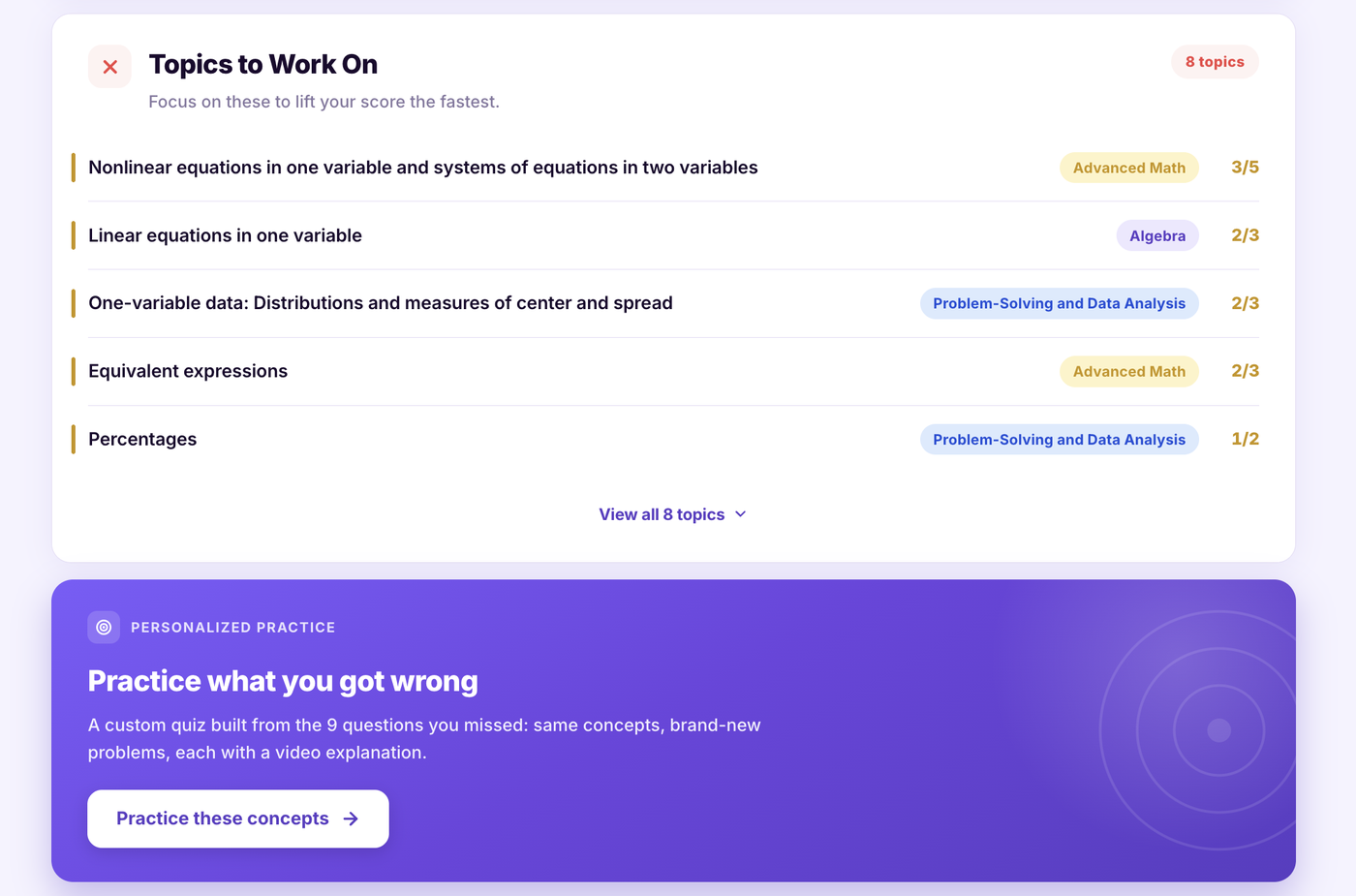
Take the free diagnostic and get a study plan built for your test date, or start week 1 with the free full-length Math test. No card needed.