PSAT scores just came out and a lot of students are looking at their math score thinking something is wrong. Maybe you scored way lower than you expected. Maybe your parents are worried. Maybe you're starting to stress about the actual SAT.
Take a breath. There's a very good reason your score might be low and it probably has nothing to do with your ability.
You Haven't Learned the Material Yet
This is the thing almost nobody tells students before they take the PSAT. The test covers content from four math domains and one of the biggest ones is what College Board calls "Advanced Math." It makes up about 35% of the entire math section.
Here's the problem. Advanced Math is basically Algebra 2 content. Quadratics, polynomials, exponential functions, systems of nonlinear equations, and more.
If you took the PSAT as a sophomore or early junior you were probably just starting Algebra 2. Or maybe you hadn't even taken it yet. So you walked into a test where more than a third of the questions were on material you literally haven't been taught.
Of course your score was low. You can't be expected to answer questions on things you haven't learned.
Even Algebra 2 Won't Fully Prepare You
Here's the part that surprises most people. Even after you finish Algebra 2 you still won't be fully prepared for SAT Math. Not because the class is bad but because the SAT tests very specific things within each topic.
Take the discriminant as an example. In Algebra 2 you'll spend weeks or months on quadratics. You'll learn factoring, the quadratic formula, completing the square, graphing parabolas. The discriminant (the b² - 4ac part) is probably one lesson within one unit of one chapter. Your teacher covers it, you do a few homework problems, you move on.
But the SAT loves the discriminant. It shows up repeatedly across different question types. You need to know it cold. Not just the formula but what it means, how to use it to determine the number of solutions, how it connects to the graph. The SAT will ask about it in ways your textbook probably never did.
And that's just one example. The same thing is true for dozens of specific concepts across all four domains. The SAT picks very particular skills from your math classes and tests them in very particular ways. Your classes give you broad coverage. The SAT wants depth on specific topics.
The Desmos Factor
There's another reason scores are lower than students expect. The digital SAT gives you a built-in Desmos graphing calculator that can solve a huge number of problems faster than doing them by hand. But most students don't know how to use it effectively because schools don't teach it that way.
When you don't know Desmos you're solving problems algebraically in 2 to 3 minutes that could take 20 seconds with the calculator. That's a massive time disadvantage on a timed test. And time pressure leads to rushing which leads to careless mistakes which leads to a lower score.
So What Should You Do
First, don't panic. A low PSAT score is not a prediction of your SAT score. It's a snapshot of where you are right now before you've finished learning the content and before you've done any real test prep.
Second, understand that general math classes aren't SAT prep. They'll give you the foundation but they won't teach you the specific skills, strategies, and calculator techniques that the SAT rewards. You need focused practice on exactly what College Board tests.
Third, start preparing with the right materials. You want practice problems that mirror what actually shows up on the SAT. Not generic math problems. Not problems that are "SAT-like." Actual problems that match the format, difficulty, and specific concepts the test targets.
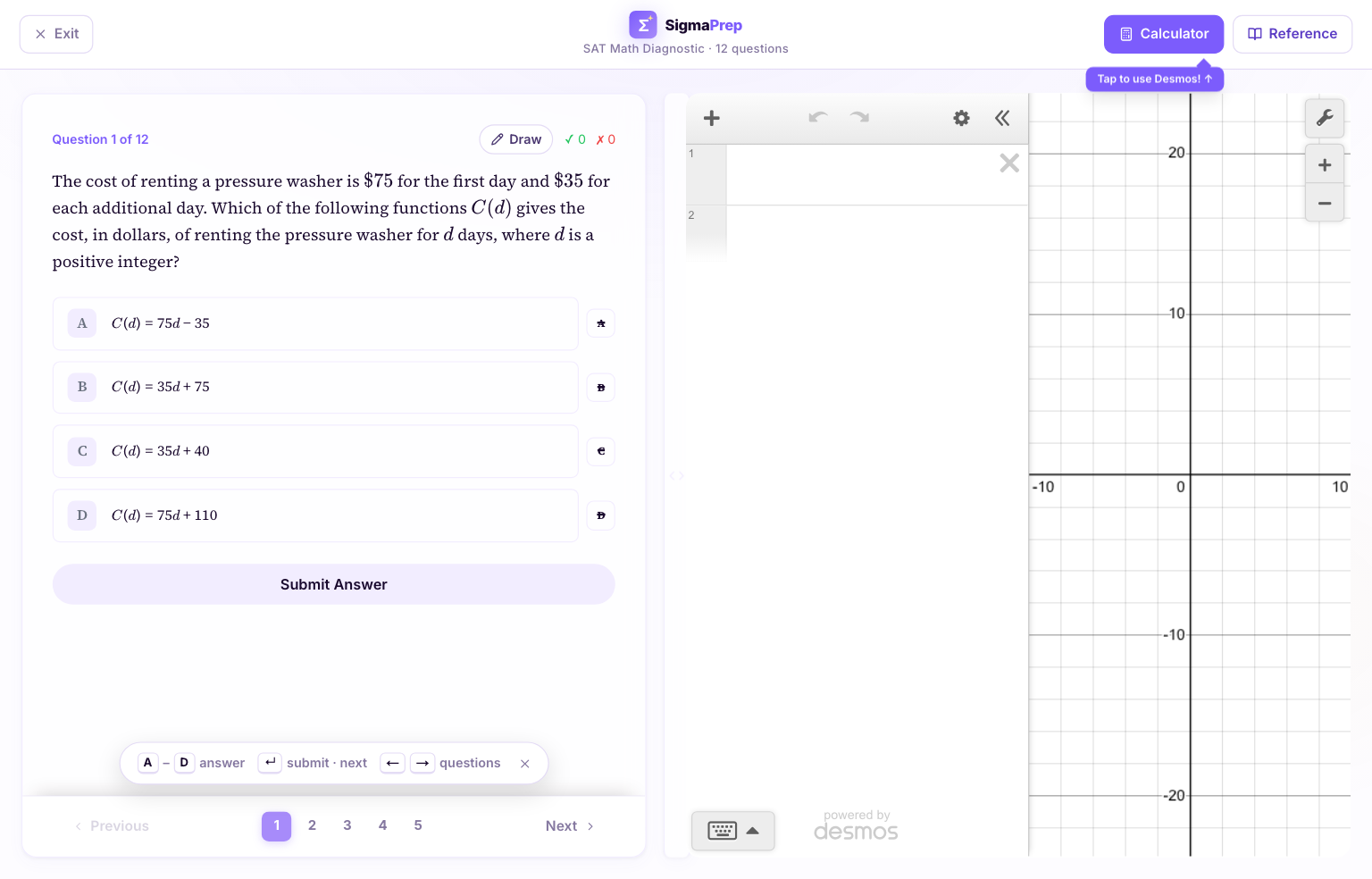
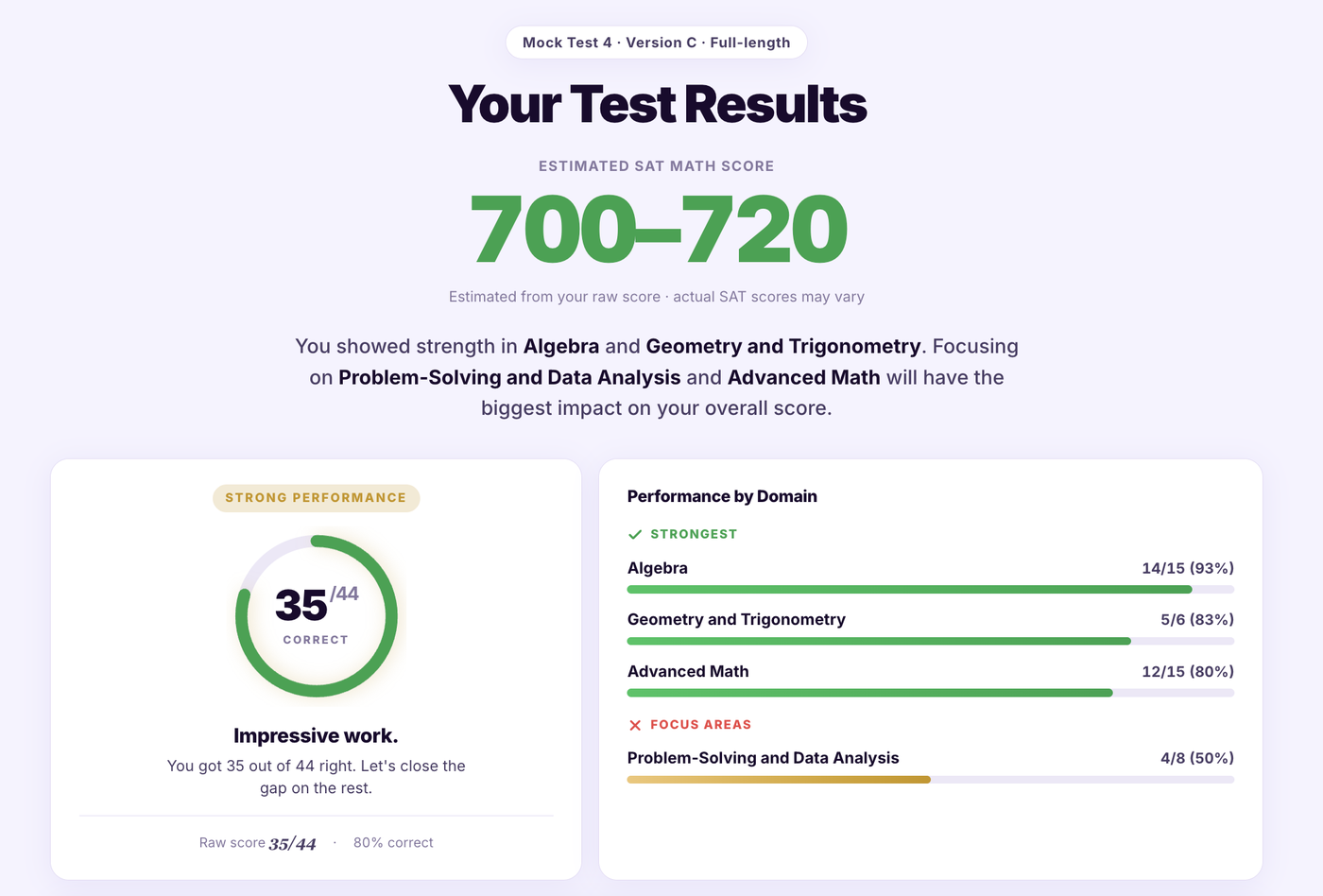
That's what we built Sigma Prep to do. Every problem is hand-selected to focus on what the SAT actually tests. No filler, no unlikely edge cases. And every problem comes with a video showing the most efficient way to solve it, usually with Desmos.
Here's what it looks like.
Try the free diagnostic → twelve questions, no card.
Want to see where you actually stand? Take the free Diagnostic Quiz. It's a set of real SAT-style problems that will show you exactly what the test looks like. When you get a question wrong you'll see a video of how to solve it the fastest way possible. No payment required.
Your PSAT score is a starting point, not a final answer. With the right prep, students regularly improve 100 to 200+ points. The key is knowing when to start and how to study it.